Cortina 1956: The Soviet Winter Olympic Debut and Its Medal Count
How the USSR won 16 medals at Cortina: shared skating gold, cross-country results, hockey and the distinction from its 1952 Summer Olympic debut.
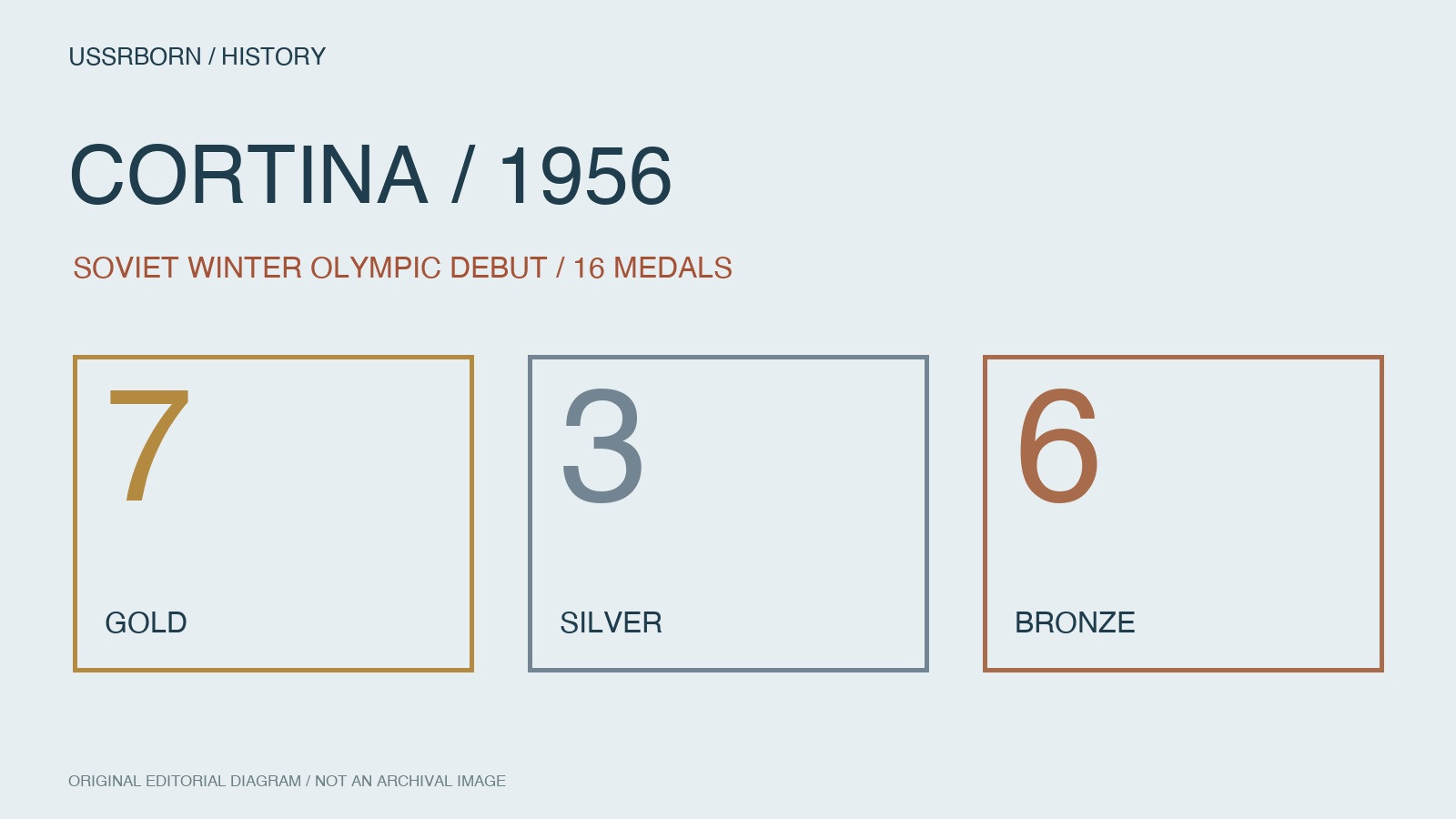
The Soviet Union made its Winter Olympic debut at Cortina d'Ampezzo in 1956 and immediately headed the medal table. Its total was seven gold, three silver and six bronze medals. Behind those 16 awards lies an interesting distinction: seven gold medals did not mean victories in seven separate events.
Why the debut belongs to 1956
The Italian Games ran from 26 January to 5 February 1956. They were the first Winter Olympics attended by a Soviet team. The USSR's wider Olympic debut had already occurred at the Helsinki Summer Games in 1952.
Leaving winter out of a statement about a 1956 Olympic debut changes its meaning. A first Olympic appearance also does not necessarily mean a first international appearance. Soviet speed skaters and ice hockey players already had experience at major overseas competitions.
Austria followed the USSR in the final medal table with four gold medals, and Finland had three. That comparison describes the results of these particular Games. It is not a universal measure of every winter sport played in each country.
Four skating golds from three winning distances
Men's speed skating comprised four medal events. Soviet athletes won three of them: Yevgeny Grishin took the 500 metres, Boris Shilkov the 5,000, and Grishin shared first place with Yury Mikhaylov at 1,500 metres.
The shared victory produced two gold medals in a single event. Consequently, the Soviet skating total included four golds from three winning distances. Sweden's Sigvard Ericsson won the remaining distance, 10,000 metres.
This explains an apparent mismatch between an event list and a national medal total. The table counts the awards actually made. Two athletes sharing first place do not create an extra discipline, and the resulting total is not an arithmetic mistake.
Cross-country skiing: individual and relay success
Two Soviet skiing golds came from the women's 10 kilometres and the men's 4 x 10 kilometre relay. Lyubov Kozyreva won the individual race, with Radya Yeroshina second. The Soviet women also took silver in the 3 x 5 kilometre relay.
Pavel Kolchin earned bronze at 15 and 30 kilometres, while Fyodor Terentyev took bronze at 50 kilometres. Cross-country skiing supplied seven Soviet medals altogether. The relay illustrates another counting rule: a team event contributes one award of the appropriate colour to the national table, even though the team's members receive medals.
Cortina's programme differed from that of the preceding Winter Games. Men's 30 kilometres and the women's relay were additions. Comparing Olympic totals across years without considering the available events therefore leaves out part of the explanation.
Hockey and the victory over Canada
The hockey team's gold became one of the most memorable results of the Soviet debut. The International Ice Hockey Federation's account describes a 2-0 Soviet victory over Canada, represented by the Kitchener-Waterloo Dutchmen.
This was a new Olympic achievement, but not the sudden appearance of an unknown national team. The USSR had already won the 1954 World Championship, before losing to Canada in 1955. Cortina continued an emerging rivalry. The history of Soviet hockey provides the wider setting.
The later image of international contests involving teams assembled from NHL stars should not simply be projected backward onto 1956. A country's name in a result does not answer which team represented it or how the roster was selected.
Reconstructing the total of sixteen
Speed skating contributed seven awards, cross-country skiing another seven, and hockey one gold. The remaining medal came in alpine skiing: Yevgeniya Sidorova won bronze in the slalom.
The sport-by-sport calculation is 7 + 7 + 1 + 1 = 16. Four skating golds, two cross-country golds and the hockey title give the seven gold medals. Grouping by sport and grouping by medal colour are two ways of describing the same results.
Breaking down the total shows where achievements were concentrated. It also helps avoid treating an elite Olympic result as a direct measurement of an entire population's fitness. The history of the GTO programme concerns a different part of the Soviet sporting system.
A debut within a wider competition
Cortina was not solely a Soviet story. Austria's Toni Sailer won all three men's alpine skiing events. The Norwegian Olympic Museum, by contrast, recalls Norway's painful fall in medal numbers compared with its home Games in Oslo four years earlier.
These different national perspectives make the competition more visible. The Soviet performance was an exceptional debut, assembled from individual starts, strong opponents and a particular programme. It should be examined through those results, rather than used as a shortcut to a sweeping explanation of an entire society.
For another stage in Soviet Olympic history, the Moscow Games of 1980 provide a useful comparison, while retaining the distinction between Summer and Winter competitions. The central lesson of Cortina's medal arithmetic remains simple: first identify what is being counted, then interpret the total.
The cover is an original diagram of the medal result, not an archival image.