The Red Machine: how the USSR taught the world to play hockey
The country first saw ice hockey in 1946. Eight years later it crushed the game's founders 7 to 2, and twenty years after that it made Canada tremble until the final 34 seconds. The story of the most beautiful team machine in sports history, and the price its parts paid.
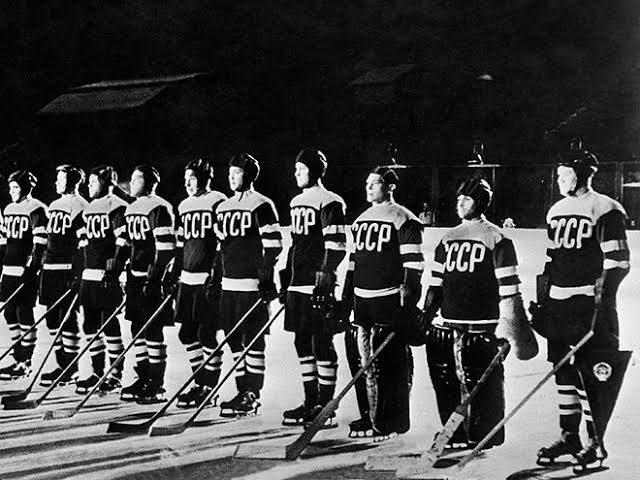
The team with four letters on its chest
The Soviet national hockey team is probably the most decorated side in the history of world team sports. Seven Olympic gold medals out of a possible nine, more than twenty world championship titles, an Olympic record of 62 wins against six losses. The jersey with the four letters CCCP became one of the most recognizable images in sport, and the team's nickname, the Red Machine, was coined not in Moscow but in a frightened North America.
The most astonishing thing about this story is its timeline. Canadian ice hockey was not played in the USSR at all: the country played bandy, hockey with a ball. The first championship under Canadian rules was held only in 1946. The students needed eight years to catch their teachers, and another twenty to change the game itself.
7 to 2: a debut that scared Canada
On March 7, 1954, at the world championship in Stockholm, the Soviet debutants faced Canada in the deciding match. Canada had until then won world titles almost automatically. The newcomers won 7 to 2 and took the gold at their very first tournament. Two years later, at their first Olympics in Cortina, the Soviets took Olympic gold as well.
The secret was not individual talent but a different understanding of the game. Coach Anatoly Tarasov, who called himself a student not of the Canadians but of his own imagination, built hockey as a collective art: constant motion, the pass above the shot, the five-man unit as a single organism. He took his players to the ballet and made them play chess: grace and calculation counted no less than strength. The Canadians played a game of vertical force; the Russians began playing chess on ice at full speed.
The 1972 Summit Series: 34 seconds from the end
For twenty years the two hockey worlds could not meet properly: the Olympics and world championships were closed to professionals, so the best Canadians, the NHL stars, never played the USSR. In 1970 Canada left international hockey altogether in protest. The question of who was stronger hung in the air until September 1972, when it was put to a direct test: eight games, four in Canada, four in Moscow. The Canadian press promised 8 to 0 for the professionals.
The first game in Montreal ended in shock: the USSR won 7 to 3, and the twenty-year-old goaltender Vladislav Tretiak, whom Canadian scouts had written off before the series, became a world celebrity in one evening. What followed was a transoceanic war of nerves at the height of the Cold War: millions at their screens in both countries, fights on the ice, refereeing scandals, and magnificent hockey. The resolution came in the eighth game in Moscow with the series tied: with 34 seconds left, Paul Henderson scored the winner. Canada took the series four games to three, with one tie.
Formally the USSR lost. In reality both sides won, and the Canadians themselves said so: the myth of the hopeless "amateurs" was dead, and after 1972 world hockey began learning from the Soviet school. Today that series is considered perhaps the single most important event in the history of the game.
The machine and its parts
By the late 1970s the Red Machine had reached perfection: the Larionov unit, with the Makarov, Larionov and Krutov line and defenseman Fetisov behind them, ran combinations that opposing goalies could analyze only while fishing the puck out of the net. The team's core was the army club CSKA, and there lay the underside of the beauty. The players were listed as officers, lived at training bases eleven months a year, saw their families on weekends, and the word of coach Viktor Tikhonov was an order in the literal, military sense.
The world saw the system's price in 1980 at Lake Placid: a US team of college students beat the unbeatables 4 to 3, and America called it the Miracle on Ice. The machine answered the way machines do: it took the next two Olympic golds, in Sarajevo in 1984 and Calgary in 1988, without giving opponents a chance, while the Moscow Games of 1980 had shown it at home. And its greatest goaltender, Tretiak, retired at 32: the system that would not release him to the NHL was the one opponent he could not beat.
The right to leave was won by Fetisov. In the late 1980s the team captain went into open conflict with Tikhonov and the system, demanding a legal NHL contract, and won: from 1989 Soviet players began leaving for North America legally. A few years later the "Russian Five" in Detroit would win the Stanley Cup playing precisely Tarasov's hockey.
The legacy
With the country's dissolution the Red Machine vanished along with the letters on the jersey, but its school dissolved into world hockey completely: the passing game played today by the best NHL clubs grew from Tarasov's ideas. The 1972 Summit Series stands in the textbooks as the moment that changed the sport, the Miracle on Ice as the greatest upset in its history, and the argument over whether the Red Machine was hockey's summit or its most beautiful prison goes on. The honest answer is the usual one: both at once.
Frequently asked questions
Why was the Soviet team called the Red Machine? The nickname came from the North American press, for a flawless team game in which the five-man unit worked as a single mechanism. It stuck in the 1970s.
When did the USSR first win the world hockey championship? On March 7, 1954, at its debut world championship in Stockholm, beating Canada 7 to 2 in the deciding match.
Who won the 1972 Summit Series? Canada: four wins to three with one tie, the decisive goal scored by Paul Henderson 34 seconds from the end of the eighth game. The series nonetheless destroyed the myth of professional superiority and raised the prestige of the Soviet school.
What was the Miracle on Ice? The 4 to 3 victory of a US college team over the USSR at the 1980 Lake Placid Olympics. In the United States it is considered the greatest upset in sports history.
How many titles did the Soviet team win? Seven Olympic golds (1956 to 1988) and more than twenty world championships, with an Olympic record of 62 wins, 6 losses and 2 ties.
Why did Soviet players not play in the NHL? The system would not release them: CSKA players were listed as military servicemen. Vyacheslav Fetisov was the first to win the right to leave legally, and from 1989 transfers to the NHL became possible.
Related
- CCCP: what the four letters mean: the inscription on the most famous jersey in hockey history.
- The Cold War: the backdrop that turned matches into battles of systems.
- The 1980 Moscow Olympics: the home Games of the Red Machine era.
- Soviet ballet: the art Tarasov used to teach his players grace.
Sources
The facts in this article can be verified against authoritative sources:
- Wikipedia, "Soviet Union men's national ice hockey team": https://en.wikipedia.org/wiki/Soviet_Union_men%27s_national_ice_hockey_team
- Wikipedia, "Summit Series": https://en.wikipedia.org/wiki/Summit_Series
- Wikipedia, "1974 Summit Series": https://en.wikipedia.org/wiki/1974_Summit_Series
- Russia Beyond, "The fearsome Red Machine: The meteoric rise and dramatic decline of Soviet hockey": https://www.rbth.com/history/328171-rise-and-fall-soviet-hockey
Where assessments diverge (hockey's summit or its beautiful prison), we give both sides.