The Soviet Pension Reform of 1956: Age, Service and Payments
What the 1956 state pension law provided: age and service requirements, financing, amounts in pre-1961 rubles and the limits of coverage.
On 14 July 1956, the Supreme Soviet adopted the USSR Law on State Pensions. It took effect on 1 October. This was an important event in Soviet social history, but two familiar shortcuts distort it: that pensions had not existed before, or that the law immediately gave every older person an identical payment. Its rules instead connected entitlement to employment, length of service, the type of pension and specific qualifying circumstances.
What the law covered
The legislation organized state pensions under three headings: old age, disability and loss of a breadwinner. That distinction matters when reading historical records. A pension recipient was not necessarily someone who had reached retirement age. A payment might instead concern loss of working capacity or support for eligible members of a deceased breadwinner's family.
The original 1956 publication survives in library collections. The Presidential Library catalogue identifies the adoption date and the Moscow publisher, Izvestia. A separate Russian State Library record describes the same year's edition. These records establish the identity of the publication; its operative provisions must be checked in the legal text itself.
The reform belongs to the period known as the Khrushchev Thaw. That political context is useful, but it cannot explain an individual's entitlement on its own. To understand what a pension meant for a particular person, it is necessary to identify the provision under which that person qualified.
Age and service were separate requirements
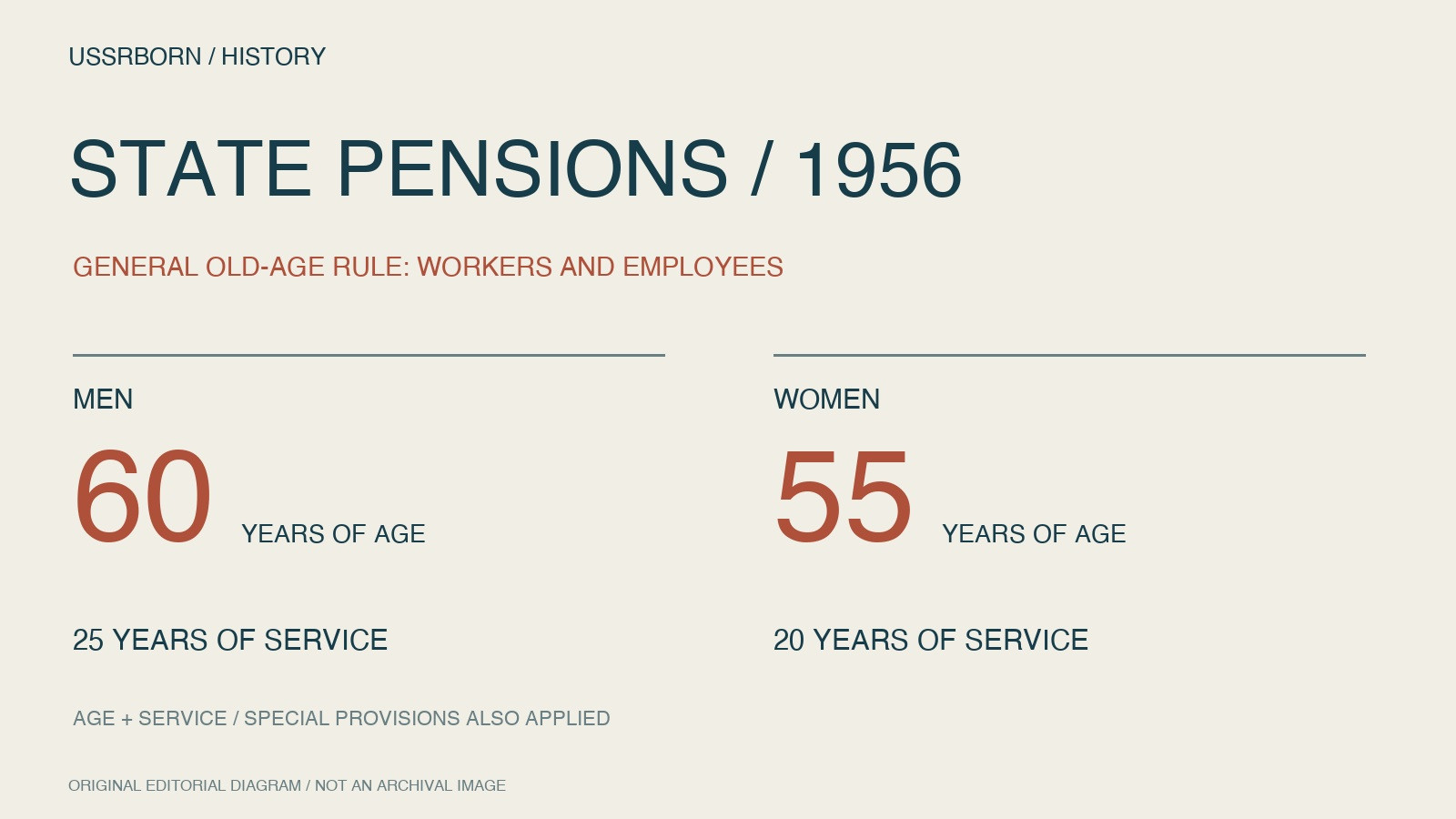
Under the general old-age rule for workers and employees, men qualified at 60 with at least 25 years of service, and women at 55 with at least 20 years. Both conditions mattered. Reaching the specified birthday was not equivalent to satisfying every requirement of the ordinary scheme.
Preferential provisions existed for particular circumstances. Underground work, hazardous employment and hot workshops could carry lower age and service requirements, linked to approved lists of occupations and industries. A separate provision covered women who had given birth to at least five children and raised them to the age of eight: eligibility at 50 with at least 15 years of service.
The detailed framework appeared in the regulations approved by Council of Ministers Resolution No. 1044 of 4 August 1956. The familiar shorthand “60 for men, 55 for women” is therefore a starting point for the general arrangement, not a complete explanation of every pension case. It leaves out the employment record and the existence of special provisions.
How pensions were financed
The state financed payments through annual allocations from the USSR budget, including state social-insurance funds. Those funds received contributions from enterprises, institutions and organizations. The legislation specified that this financing did not involve corresponding deductions from wages. State pensions were also exempt from taxation.
This was a statement about financing, not a description of an individual savings account. Service and earnings could determine entitlement and the amount payable without the pension representing the return of a personally accumulated pot of contributions.
The distinction helps interpret family memories. Saying that a pension depended on wages may be correct. Explaining that relationship by importing the mechanics of a modern funded retirement account would be misleading. Similar everyday words can refer to different institutions in different periods, so the historical rule must be understood on its own terms.
The original amounts were in pre-1961 rubles
The original regulations stated a monthly minimum of 300 rubles and a maximum of 1,200 rubles for the general old-age pension arrangement. These are rubles before the 1961 monetary reform. The figures are not a national average, a uniform payment to every pensioner or a single schedule applying to every kind of pension.
The basic calculation depended on earnings. For ordinary working conditions, the table used decreasing percentages across higher earnings bands: 100 percent for earnings up to and including 350 rubles, falling to 50 percent in the highest band. The table also set a minimum amount within each band. Supplements were provided separately, subject to the maximum.
A hypothetical calculation illustrates how the table worked. For assessed earnings of 600 rubles, the ordinary scale specified 75 percent, producing a basic amount of 450 rubles. This is an arithmetic example under paragraph 19, before supplements or special circumstances. It is not a claim that 450 rubles was the typical pension received by Soviet citizens.
The 1961 monetary reform changed the unit of account at ten old rubles to one new ruble. A comparison of denominations therefore converts 300 old rubles into 30 new ones and 1,200 into 120. It does not establish that pension provisions remained unchanged throughout the following decades. Nor does the conversion alone measure purchasing power: that requires evidence about prices, expenditure and household circumstances.
Why coverage was not identical for everyone
The law's main old-age provisions addressed workers and employees. Membership of a collective farm did not automatically confer the same pension on the same terms. A separate all-Union law on pensions and benefits for collective-farm members was adopted in 1964 and took effect in 1965. Its scope is discussed in the article on collective-farm pensions.
The distinction should not be simplified into “urban residents had pensions, rural residents did not.” Employment history, legal status and the basis of entitlement mattered, not merely the location of a home. A worker at a state enterprise in the countryside and a collective-farm member belonged to different employment categories.
Military personnel and certain other groups also had particular arrangements. A general statement about Soviet retirement cannot replace the provisions applicable to the type of service or work involved. The category of recipient is essential evidence when interpreting a payment recorded in a family document.
Reading the correct version of the law
An online page headed “Law of 14 July 1956” may reproduce a much later amended text. For example, the version published by Kontur is explicitly dated to the revision of 22 May 1986 and incorporates changes made over several decades. It can help trace the law's structure and commencement clause, but its later monetary amounts must not be projected back into 1956.
A useful sequence for reading a pension file is to establish the date of the award, the type of pension, the recipient's category and the version of the rules then in force. Only after that should the employment record and assessed earnings be compared with the calculation. This approach is more informative than assuming that every pension described in a family recollection followed one permanent formula.
The 1956 reform illuminates life in the USSR through the operation of social provision. Behind a broad promise of support stood specified conditions, administrative procedures and distinctions between groups. Understanding those details makes it possible to explain both what the reform offered and the limits of its coverage.