The 1958 Soviet School Reform: Eight Years, Work and Secondary Education
How the 1958 reform changed Soviet schools: compulsory eight-year education, production training and the return from eleven to ten years in 1964 to 1966.
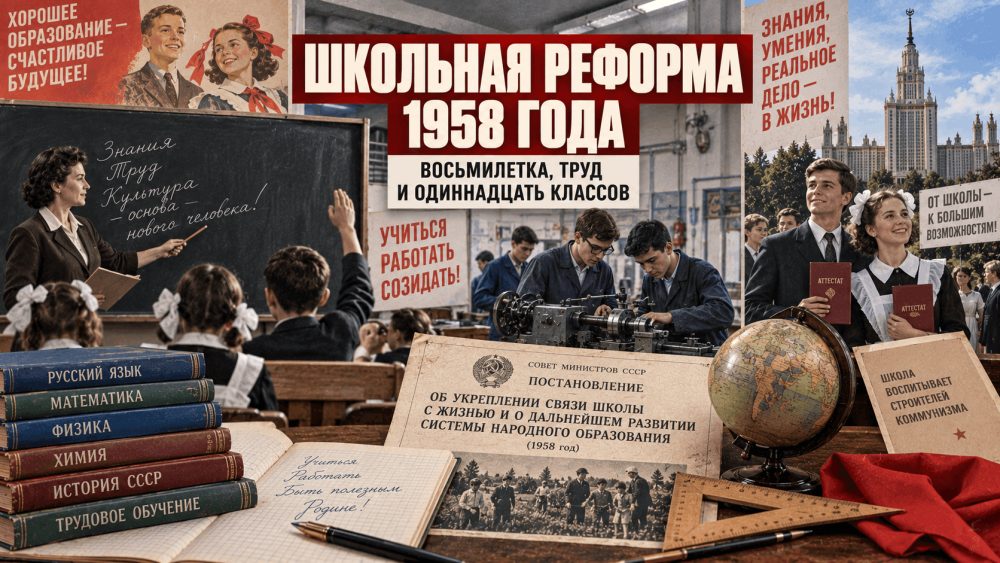
On 24 December 1958, the Supreme Soviet adopted a law on strengthening the connection between school and life and developing public education in the USSR. It raised compulsory schooling from seven to eight years while reorganizing further education around the combination of general study and work.
Two numbers are easily confused in accounts of the reform: eight and eleven. Eight referred to the compulsory, incomplete secondary stage. Eleven resulted from adding a three-year upper-secondary program with production training. They described different levels within the system, not competing answers to how long every Soviet pupil had to remain at school.
What the reform was intended to change
The reform belonged to the period of Nikita Khrushchev. Its ambition was to bring education closer to production. Graduates were expected to understand scientific fundamentals, respect labor and prepare for participation in economic life. The law also explicitly assigned the school a role in communist education. It was therefore more than an adjustment to timetables or a politically neutral vocational initiative.
Political preparation preceded legislation. The Electronic Library of Historical Documents records draft theses associated with the Communist Party Central Committee plenum of 12 November 1958 and their publication in Pravda. This bibliographic evidence helps distinguish discussion of the reform's direction from the adoption of the all-Union law in December.
Like other changes associated with the Khrushchev Thaw, the school reform combined an ambition to renew institutions with administrative reorganization. Its concrete provisions are more informative than the general slogan of bringing school closer to life. They reveal which pupils were affected, what routes remained available and how the transition was supposed to work.
Eight years as the compulsory foundation
Article 2 replaced universal compulsory seven-year education with eight-year education. The eight-year school was to combine general knowledge, polytechnical preparation and education through work. Participation in socially useful labor was framed in terms appropriate to children's age.
This did not mean that further education was being abolished or discouraged in principle. The law provided several routes beyond the compulsory stage. Its structure attempted both to enlarge the common foundation and to organize the relationship between later study and employment.
The distinction becomes clearer when set against earlier educational campaigns. The likbez literacy campaign addressed the problem of illiteracy. The 1958 reform concerned the duration and content of a developed school system. Access to basic reading and writing and the organization of a pupil's later educational route are related questions, but they are not the same historical problem.
Calling the reform simply an introduction of an eleven-year compulsory school therefore misstates its design. The compulsory foundation and the route to complete secondary education need to be described separately.
What happened after the eighth year
Article 4 identified three principal types of institution providing complete secondary education:
- Evening or shift schools for working and rural youth. Pupils combined employment with a three-year course after the eight-year foundation.
- General secondary labor polytechnical schools with production training. Their three-year upper stage was intended to provide both secondary education and occupational preparation.
- Technicums and other specialized secondary institutions, combining general secondary education with specialist study.
The third category should not automatically be assigned the same three-year duration as the first two. The cited provision did not impose that single length on every technicum specialty. Nor did the law require every pupil to leave daytime schooling for full-time factory employment after the eighth year. A daytime school route remained part of the system.
For successful students in evening schools, the law called for arrangements reducing the working day or working week. This detail shows that combining work and study required changes in the organization of time, not merely additional effort by the student.
These routes also involved different institutions and responsibilities. A school, an employer and a specialized college could not simply be treated as interchangeable places where the same program happened. Understanding the reform requires attention to which route a particular pupil followed.
Production training was not one uniform activity
The law envisaged training in educational and production workshops at enterprises, pupil brigades on collective and state farms, experimental farms, and school or interschool workshops. The balance between theory and practice was to depend on the field of preparation and local conditions. Rural schools were to take the agricultural work cycle into account.
Consequently, the reform did not prescribe one identical experience across the entire country. A school close to an industrial enterprise and a rural school faced different possibilities. Equipment, instructors and suitable training places had to be available locally even when the overall direction was established nationally.
It is helpful to distinguish polytechnical education from preparation for a particular occupation. The former concerns understanding scientific and technical foundations; the latter concerns the knowledge and skills needed for specified work. The law connected those aims, but counting hours outside a classroom could not by itself establish that either had been achieved.
A hypothetical example illustrates the difference. Watching a machine operate, understanding its operating principle and learning to perform a task safely are three distinct outcomes. A visit to a workshop does not automatically prove any of them. This is an analytical illustration, not a claim that all schools followed one particular training exercise.
The same distinction matters when assessing success. Evidence that a school organized workplace attendance is evidence of an activity. Establishing what pupils learned, whether the activity supported general study and whether a qualification was later used requires further information.
Why implementation took several years
Article 7 prescribed a transition beginning in the 1959/60 academic year and lasting three to five years. Plans were to reflect the circumstances of the union republics. Pupils already in the eighth through tenth grades were to be able to complete school under existing curricula, with strengthened preparation for work.
This transitional provision is essential when reading personal recollections. Different graduating classes could encounter different arrangements without contradicting the existence of an all-Union reform. A school certificate is best interpreted with its graduation date, institution type and local transition in view.
The law also sought to avoid interrupting the supply of secondary graduates to higher education. Reorganization was not supposed to produce a gap in the preparation of future specialists. This concern helps explain why preserving some existing arrangements during the transition was compatible with changing the system's overall structure.
Other articles required stronger material facilities, training places and teacher retraining. An additional year and a new educational emphasis required rooms, equipment and qualified people. Legislation assigned responsibilities for creating those conditions; it did not demonstrate that the conditions already existed everywhere.
That difference between an instruction and its fulfillment is especially important for educational history. The text of a reform is indispensable for understanding intentions and rules, but it cannot substitute for records of actual implementation.
The return to ten years
Resolution No. 665 of the Communist Party Central Committee and USSR Council of Ministers, dated 10 August 1964, shortened the upper stage of the relevant secondary schools from three years to two after the eight-year foundation. The transition was to take place over two years beginning on 1 September 1964. This restored a ten-year route through general secondary school.
The compulsory eight-year foundation was retained. Moreover, the resolution still called for strengthening the material base of production training. It should therefore not be described as an immediate, complete abolition of all learning connected with work.
The Presidential Library's historical overview associates the revision with insufficient suitable workplace opportunities and problems affecting general educational preparation. This is an assessment of implementation, distinct from the law's prescriptions. It does not establish that every school had identical conditions or that every practical activity was unsuccessful.
The chronology matters here as well. A decision in August 1964, a transition beginning that September and a process extending over two years are not three descriptions of one instantaneous event. Keeping those dates separate makes apparently inconsistent memories much easier to understand.
A better way to assess the reform
Three levels should be kept in view: goals, rules and results. The goal was to connect education with work. The rules established stages, types of institution and transitional arrangements. Results depended on implementation and require evidence about particular schools, cohorts and educational outcomes.
The history of everyday Soviet life adds another perspective, but recollections also need dates and context. One graduate may remember an eleventh school year and another a ten-year course. Both can be accurate descriptions of different experiences.
The reform's legacy cannot be captured by saying that it was simply canceled. The compulsory foundation expanded; routes beyond it were reorganized; and a three-year upper-secondary stage was subsequently shortened. Separating these developments shows what lasted, what changed and why the school history of 1958 to 1966 cannot be reduced to one number.
Sources
- USSR law of 24 December 1958, full text, especially Articles 1 to 11 and the transitional provisions.
- Resolution No. 665 of 10 August 1964, shortening the upper-secondary stage and setting the transition period.
- Presidential Library: the 1958 school reform, an overview of implementation and its difficulties.
- Electronic Library of Historical Documents: November 1958 draft theses, the bibliographic record of the document preceding the law.
The cover is an original editorial diagram of the compulsory eight-year foundation and the combination of study and work, not an archival poster.