The Soviet Internal Passport: From 1932 to the 1974 Reform
Who received Soviet internal passports? Explore rural exceptions, residence registration and the 1974 reform, with new documents issued from 1976 to 1981.
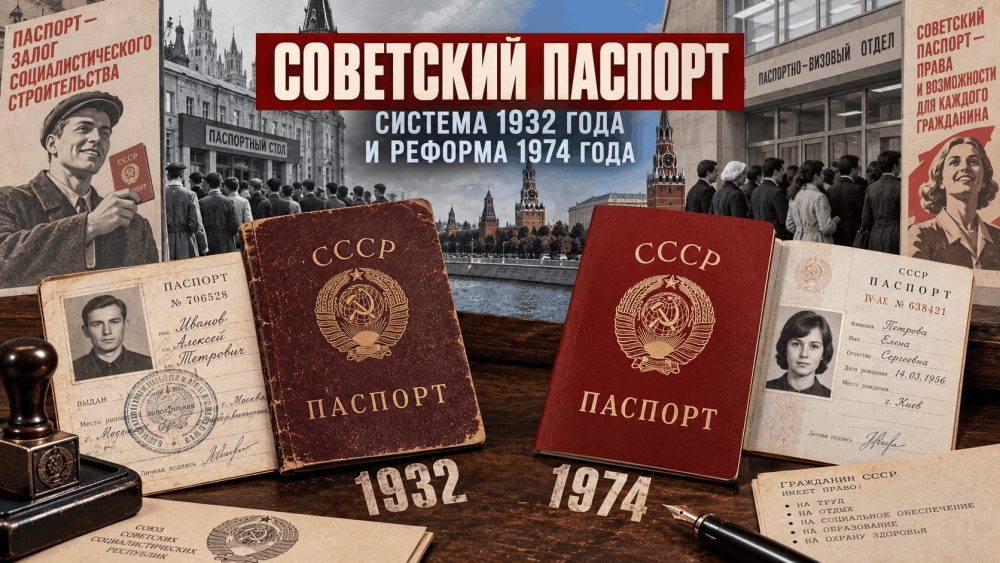
The Soviet internal passport was a document for everyday life inside the country. It identified its holder and carried information used by public authorities. Yet the familiar idea of a single Soviet passport conceals a changing system. The rules established in 1932 and the reform approved in 1974 did not cover the population in the same way.
Three questions need to be kept separate. Did a person possess an identity document? Were they registered at a particular address? Could they actually move and settle elsewhere? A passport did not automatically answer all three. Equally, the absence of passports among much of the rural population does not mean that Soviet legislation contained no procedure for a rural resident to obtain one when leaving.
Why the Soviet government introduced the system in 1932
On December 27, 1932, the Central Executive Committee and Council of People's Commissars adopted a decree establishing a unified passport system together with compulsory residence registration. Major cities, including Moscow, Leningrad and Kharkiv, were to be covered first. The Presidential Library places the decision within the government's increasing control over population movement.
The decree's own introduction reveals purposes beyond convenient record keeping. It called for a better account of urban residents and the removal of people classified by the authorities as socially undesirable. Those classifications belonged to the political language of the Stalin period. They should not be repeated as if they were impartial descriptions of the people concerned.
The passport therefore served more than one purpose. It documented identity, while the procedures for issuing and registering it also helped determine who could remain in important urban centres. This distinction matters when studying everyday life in the USSR. An administrative document that looked routine to one person could represent a serious obstacle for another.
Why many rural residents did not have passports
Decree No. 861 of April 28, 1933, defined the system's territorial reach more precisely. It covered cities, workers' settlements, district centres, industrial enterprises, transport, state farms and specified other places. Rural territory was not a single undifferentiated exception. Settlements containing machine and tractor stations, for example, were included, as were certain border areas.
Permanent residents of rural localities outside the designated areas generally did not receive passports. Village and settlement soviets maintained population lists under police supervision. This created an important difference in the documentary position of urban and rural residents.
However, Article 3 of the same decree explicitly provided for a rural resident moving for an extended period, or permanently, into an area with the passport system to receive a passport valid for one year. A permanent resident would subsequently obtain a passport at the new place of residence under the ordinary rules. Separate provisions dealt with documents explaining temporary visits for purposes such as official business, holidays and medical treatment.
That is not evidence that relocation was unrestricted or easy. It is evidence against the blanket assertion that no rural resident could obtain a passport or leave before 1974. An individual case requires a date, a place, a reason for moving and the rules and administrative decisions that applied. A route set out in legislation and an accessible route in practice are not necessarily the same thing.
Passport and propiska: two different functions
An internal passport primarily established who a person was. Propiska, usually translated as residence registration, concerned where that person was recorded as living and the administrative permission associated with residence. Possessing the document did not remove the registration requirements.
The distinction is particularly clear in the 1933 decree. For designated restricted cities, refusal of a passport or registration could lead to a prohibition on residence and an order to leave. Other localities were treated differently. Even within one decree, therefore, the passport system did not operate as an identical set of conditions across the entire country.
Consider a hypothetical example. Someone has obtained an identity document, found a possible job and hopes to move in with relatives. The first step does not prove that the residence registration question has been resolved. Local rules and housing circumstances still matter. This is why passport history intersects with the history of communal apartments and mass housing construction, without being reducible to either subject.
The distinction also prevents a misleading reading of family documents. A surviving passport establishes some facts about its holder, but it does not by itself tell us how difficult a move was, what applications preceded it or which requests were refused.
What changed with the 1974 reform
On August 28, 1974, the Soviet Council of Ministers adopted Resolution No. 677. The new regulations established the general requirement that Soviet citizens aged sixteen and above possess passports. Specified groups, including serving military personnel, used the identity documents provided for their circumstances.
Implementation was gradual. Some provisions took effect on July 1, 1975, while the full arrangements began in January 1976. The issue of the new passports was scheduled from January 1, 1976, through December 31, 1981. Consequently, the date of the reform and the date when a particular person received a new document could be several years apart.
The transition rules specifically mentioned rural residents who had not previously been issued passports. They provided for passports for extended departures and identity certificates stating the purpose of certain shorter journeys. This wording is useful evidence of a transition taking place over time, rather than an overnight exchange of documents across the whole country.
The reform widened passport coverage. It did not make every other aspect of the residence system disappear. Treating it as a single moment when all restrictions ended would confuse two different administrative changes.
What the new passport recorded
The regulations listed surname, given name, patronymic, date and place of birth, and ethnic nationality. The passport also carried prescribed information about children and entries concerning marriage, military obligations and residence registration. A common Soviet format incorporated Russian and the relevant union republic language, with provision for autonomous republic languages as well.
The nationality entry requires care in English. Here it referred to ethnic affiliation, not citizenship. If the parents belonged to different ethnic groups, the first passport could record the nationality of either parent according to the recipient's choice. The regulations did not permit a subsequent change to that entry. Translating the field simply as citizenship would therefore change its meaning.
The passport had no fixed expiry date, but new photographs had to be added when the holder reached twenty-five and forty-five. A passport lacking the required photograph was invalid. Indefinite validity did not mean that the holder would never need to return to the issuing authorities.
These details show the combination of functions inside the document. It recorded relatively stable personal information alongside entries that could change with family circumstances or residence. The passport was a continuing administrative record as well as a means of identification.
Did the reform abolish residence controls?
No. The 1974 regulations retained propiska, temporary residence registration and deregistration requirements. Extending access to the standard identity document was not equivalent to establishing unrestricted choice of residence. Likewise, the social rights later expressed in the 1977 Soviet Constitution need to be distinguished from the administrative procedures through which people sought to exercise them.
There is also a practical point about sources. The GARANT version linked below incorporates amendments made in 1983 and editorial notes on the later fate of particular provisions. A later annotation should not be mistaken for a rule already operating in 1974. Reading historical legislation requires attention to both the original adoption date and the version being consulted.
For a family historian, the most useful questions are specific: who was entitled or required to have a passport at that date, how was it issued, where could the holder reside, and what other documents were needed? Those questions reveal more than a universal claim that Soviet citizens were either entirely free to move or entirely unable to do so.
Sources
- Decree of December 27, 1932, establishing the unified passport system: original document in Russian.
- Decree No. 861 of April 28, 1933: territorial coverage and passport issue, in Russian.
- Council of Ministers Resolution No. 677 of August 28, 1974, with subsequent amendments, in Russian.
- Presidential Library: introduction of the Soviet passport system, in Russian.