The Moscow Treaty of 1970: Borders, Force and Ratification
What the Soviet-West German Moscow Treaty said about borders and force, and why the agreement signed in 1970 entered into force only in 1972.
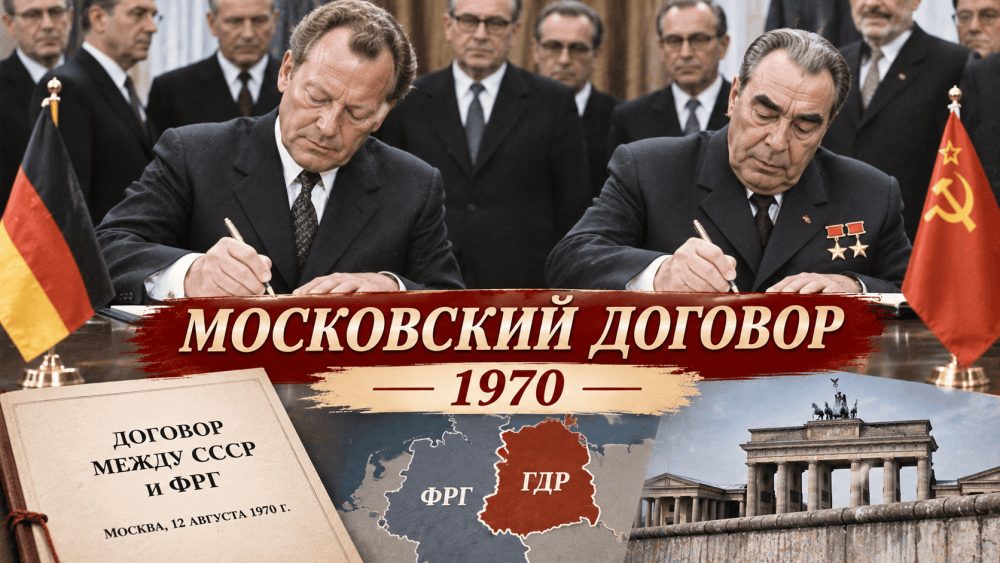
On 12 August 1970, the Soviet Union and the Federal Republic of Germany signed a five-article treaty in Moscow. Its central commitments concerned peaceful dispute settlement, respect for the territorial integrity of European states and the inviolability of existing borders. It entered into force on 3 June 1972. The interval matters: signing an agreed text and bringing a ratified treaty into effect were separate stages.
Relations did not begin in 1970
The treaty's preamble explicitly referred to the agreement of 13 September 1955 establishing diplomatic relations. Moscow and Bonn were therefore building on an existing relationship. Their stated intention was to improve cooperation, including economic relations and scientific, technological and cultural contacts.
This starting point makes the document easier to understand. Diplomatic representation already had an agreed basis. The new task was to establish principles for relations in a divided Europe. Article 1 identified peace and détente as important policy objectives. It connected the normalization of European relations with the actual situation in the region, without making the settlement of every outstanding postwar dispute a prior condition.
The German Foreign Office's historical account dates the start of negotiations to 1969 and identifies January-May 1970 as an important phase of Egon Bahr's talks with Andrei Gromyko. The signatories were heads of government Alexei Kosygin and Willy Brandt and foreign ministers Andrei Gromyko and Walter Scheel.
What renouncing force meant
Article 2 placed the relationship within the purposes and principles of the United Nations Charter. Disputes were to be settled exclusively through peaceful means. The undertaking to refrain from threatening or using force covered both bilateral relations and questions affecting European or international security.
This provision concerned how policy could be pursued. It did not require the two states to adopt the same political system or to agree on every issue. Nor did it declare that their disagreements had disappeared. Its practical meaning lay in setting a rule for conduct when disagreements remained.
Reading the article this way avoids treating détente as a claim of friendship without qualifications. A treaty can impose an obligation on states whose interests still differ. The text's importance was precisely that it made peaceful conduct an explicit commitment rather than leaving it as a general aspiration.
The borders named in Article 3
The best-known article linked peace with the existing territorial situation. It contained three connected commitments: respect for the territorial integrity of all European states within their existing borders, the absence of present or future territorial claims, and recognition of those borders as inviolable.
Two boundaries were expressly identified: Poland's western frontier along the Oder-Neisse line and the border between the Federal Republic and the German Democratic Republic. They were included within a broader provision concerning European borders, rather than being the only boundaries covered by the article.
The text also specified its reference date: the borders as they stood when the treaty was signed. That wording anchored the commitment in a particular historical situation. The document was consequently more precise than a broad statement about accepting the postwar order. It identified the territorial framework to which the parties were committing themselves.
The three elements should be read together. Respect for territorial integrity, renunciation of territorial claims and border inviolability were related, but each expressed a distinct aspect of the undertaking. Reducing the article to a single slogan loses that structure.
German unity and earlier agreements
At the signing, the West German government delivered a letter preserving its political objective of peaceful German unity through free self-determination. The letter and the five articles were separate texts. The treaty's wording should not be replaced by the letter, but the accompanying document helps explain the political position Bonn maintained when signing.
Article 4 stated that the treaty did not affect bilateral or multilateral agreements previously concluded by the parties. The background reproduced in the Federal Constitutional Court's decision of 7 July 1975 also includes diplomatic notes concerning the four powers' rights in relation to Germany and Berlin. The Moscow agreement was not presented as a substitute for the entire body of postwar arrangements.
This is an important limit on what a short bilateral treaty could accomplish. It set principles for Soviet-West German relations within a larger international framework. It did not contain a detailed procedure for bringing the two German states together.
Ratification and the two-year interval
Article 5 made ratification necessary and specified that the treaty would enter into force when instruments of ratification were exchanged in Bonn. The signatures in Moscow completed agreement on the text; they did not replace the later procedure.
Germany's Federal Agency for Civic Education records the Bundestag's approval of the Moscow and Warsaw treaties on 17 May 1972 following intense domestic controversy. The instruments were exchanged on 3 June. The constitutional court's account likewise identifies that exchange as the moment the Moscow Treaty entered into force.
The Warsaw Treaty, signed with Poland on 7 December 1970, was a separate agreement. The fact that the two treaties were debated together does not mean that the Soviet Union signed on Poland's behalf. Keeping the parties and dates distinct prevents several steps in West German eastern policy from being compressed into a single event.
A short guide to reading the document
The treaty's historical importance is visible in the relationship between its provisions. Acceptance of the existing situation was coupled with a commitment to peaceful methods. Territorial questions were not to become a justification for force. Earlier international obligations remained in place.
Three dates provide a reliable framework: 12 August 1970 for signature, 17 May 1972 for Bundestag approval, and 3 June 1972 for entry into force. They describe different stages of one diplomatic process. The cover presents that sequence as an original editorial diagram, not an archival image.