The red star: five rays over one sixth of the earth
Tin stars of the Moscow garrison painted red, a novel about communism on Mars, and a beer brand that hid its own star for forty years. The story of the sign that rose over the Kremlin and has never come down.
What the red star means
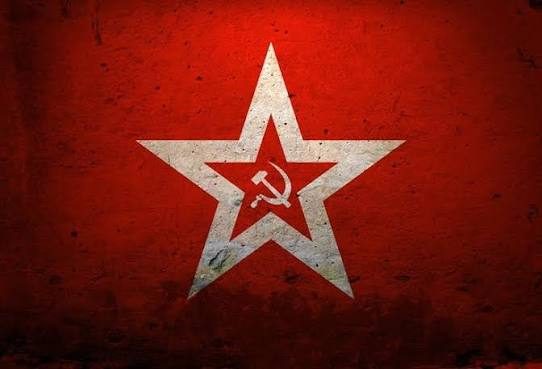
The red five-pointed star is the military and state symbol of the USSR, second in recognition only to the hammer and sickle. The division of labor between them was almost official: the hammer and sickle stood for peaceful work, the star for its armed defense. It burned on caps and tanks, on the Kremlin towers and the wings of aircraft, on the state emblem and flag, and it outlived the country that raised it: the army of today's Russia wears the red star still.
The five rays have several canonical readings, and that is the honest part of the story: the symbol was chosen before its meaning was agreed. The official version of the early years was the five continents that world revolution would unite. Later came the five fingers of the worker's hand and the five groups of society building communism. The oldest frame is astronomical: the five-pointed star had long been the sign of Mars, the god of war, and a "Mars star" defending labor fit an army badge without strain.
Where it came from
Like every successful symbol, the star has several lineages, and we give them all. Five-pointed stars were worn on the shoulder straps of Imperial Russian officers; in 1917 the Provisional Government approved them for cap badges. By the most credible everyday account, soldiers of the Moscow garrison in 1917 were issued tin stars to distinguish them from the mass of front-line troops flooding the city, and with the revolutionary mood the stars were painted red. There is a literary trail as well: in 1908 the Bolshevik Alexander Bogdanov published a utopian novel titled Red Star, about a communist society on Mars. The book was popular in revolutionary circles, and the name of the future symbol stood, literally, on its cover.
The official birthday can be set at May 7, 1918: Order No. 321 approved the "Mars star with plow and hammer" as the breast badge of the Red Army. By July the star had moved from the chest to the cap, where it stayed for seventy years. The plow at the center soon gave way to the sickle, and the country's two chief symbols grew into one.
The ascent: from the cap to the Kremlin
From there the star climbed in the literal sense. In the 1920s it entered state symbolism; in 1924 it took its place above the hammer and sickle on the Soviet flag. In 1930 the Order of the Red Star was founded, one of the country's most widely awarded combat decorations. And in 1935 the stars made their most symbolic ascent of all: on the Kremlin towers, the double-headed eagles of the empire were replaced by stars, from 1937 ruby ones glowing from within. The lit star over the Kremlin became Moscow's night silhouette and the signature shot of Soviet newsreels.
Everything the country counted as its summits reached for the star: it topped the spires of the Stalin high-rises, and it was painted on the fuselages of fighters and the armor of the tanks of the Great Patriotic War. For millions of people in occupied Europe, the red star on armor meant the end of Nazism. That is the brightest line in the symbol's biography, and it is earned.
The star's other side
The biography has other lines, and we name them just as plainly. The star was the sign not only of a liberating army but of the state that stood behind the Gulag and the repressions; in the countries of Eastern Europe, where it arrived after the war not as a guest but as a master, it is remembered differently than in Moscow. After the Soviet collapse, several states of the former socialist bloc legally restricted the public use of the red star along with other communist symbols, a decision still argued over in Europe, since for millions of people the same sign remains the memory of fallen relatives.
The Cold War West saw the star as the enemy's chief marker, down to the curiosities: the Heineken brewery, whose star is older than the Soviet one, removed the red fill from its logo from 1951 to 1991 to avoid associations with the USSR, and restored the color only after the Union's dissolution.
The star after the country
The red star proved the most durable of Soviet symbols. The Russian army kept it as its emblem, the stars still glow over the Kremlin, and Red Star remains the name of the main military newspaper, of stadiums, factories and stations. In world culture the star lives a double life: as the political sign of left movements and as a design element, from army-style fashion to logos, long detached from ideology. The five rays outlived the country and, in large part, the meanings poured into them: a fate common among great symbols and uncommon among everything else in the Soviet inheritance.
Frequently asked questions
What did the red star mean in the USSR? The armed defense of labor: the star was the army's sign, paired with the hammer and sickle, which stood for peaceful work. The five rays were most often read as the five continents of the future world revolution.
When did the red star become the Red Army's symbol? The badge was approved by order on May 7, 1918, as the "Mars star with plow and hammer"; that summer the star moved to the cap.
Why five points? The five-pointed star is an ancient sign of protection, linked in military heraldry to Mars; small stars were worn in the Russian imperial army too. The Bolsheviks took a familiar military sign and made it red.
When did the stars appear on the Kremlin towers? In 1935, replacing the double-headed eagles; since 1937 they have been glowing ruby stars. They burn to this day.
What is the Order of the Red Star? A combat decoration founded in 1930 for service in the country's defense, one of the most widely awarded in Soviet history.
Is the red star used today? Yes: it remains the emblem of the Russian army and an element of countless logos and names. At the same time, several Eastern European countries restrict the public use of communist symbols by law.
Related
- The hammer and sickle: the peaceful half of the great symbolic pair.
- CCCP: what the four letters mean: the flag and emblem where the star stood above the sickle.
- The Soviet anthem: the audible part of the same symbolic row.
- The October Revolution of 1917: the event that raised the star.
Sources
The facts in this article can be verified against authoritative sources:
- Russia Beyond, "5 main symbols of the Soviets explained": https://www.rbth.com/history/334284-5-main-symbols-of-soviets
- Russia Beyond, "The Soviet flag explained": https://www.rbth.com/history/333914-soviet-flag-explained
- Wikipedia, "Uniforms and insignia of the Red Army (1917-1922)": https://en.wikipedia.org/wiki/Uniforms_and_insignia_of_the_Red_Army_(1917%E2%80%931922)
- Wikipedia, "Emblem of the Russian Soviet Federative Socialist Republic": https://en.wikipedia.org/wiki/Emblem_of_the_Russian_Soviet_Federative_Socialist_Republic
- Political Symbols, "Red Star": https://politicalsymbols.net/red-star.html
All versions of the star's origin are given with their degree of reliability; present-day disputes over the symbol are reflected from both sides.