The Soviet anthem: the melody that outlived its country
A contest with 200 entries, Stalin's overnight edits, two decades without words and three sets of lyrics by one poet. The story of the music still heard in stadiums today — now as the anthem of another country.
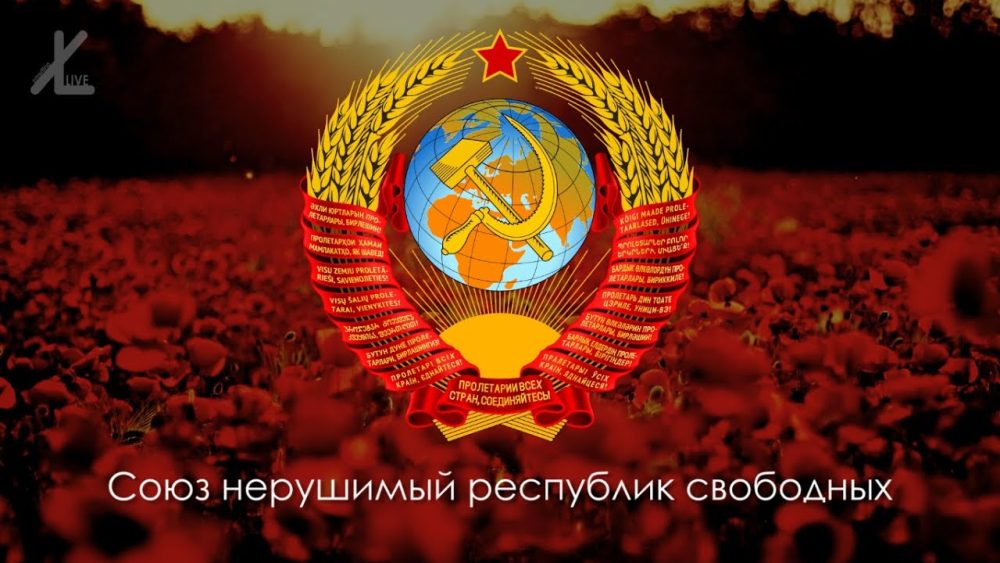
What the Soviet anthem was
The State Anthem of the USSR is the ceremonial song to music by Alexander Alexandrov that served as the Soviet Union's national anthem from 1944 until the country's dissolution in 1991. The words were written by Sergey Mikhalkov together with the poet El-Registan; Mikhalkov would later rewrite the text twice more for the same melody — a fate without parallel in the history of anthems.
Alexandrov's melody — massive, slow, built like a chorale — is recognized worldwide from its first bars: for decades it sounded at Olympic games, parades and space broadcasts, and it has entered dozens of films and video games. And since 2000 the same music has been the anthem of the Russian Federation, making it one of history's rarest cases: a melody that outlived the state it was written for.
Before 1944: the Internationale
For the first two decades and more of Soviet power, the anthem was the Internationale — the French song of the workers' movement, with words by Eugène Pottier and music by Pierre Degeyter, translated into Russian in 1902. The choice was ideological: the young state saw itself not as a country but as the vanguard of world revolution, and its anthem was a worldwide one.
By the middle of the Great Patriotic War that logic had expired. In 1943, shoring up the alliance with the Western powers, Moscow dissolved the Comintern — the headquarters of world revolution — and the Internationale became doubly awkward: diplomatically and in substance. The war was being fought not for world revolution but for the Fatherland, and the country needed an anthem about itself. The calculation was blunt: a soldier should sing about his country, not about a movement.
The contest, Stalin, and one night
A contest was announced in 1943: more than two hundred entries from the country's best composers and poets. The music was ultimately chosen by Stalin personally — and it was not new: the melody by Alexandrov, director of the Red Army Ensemble, had been written back in 1938 as the Hymn of the Bolshevik Party. The solemn, almost liturgical build of the tune — Alexandrov had directed a church choir in his youth — proved perfect for a state canon.
The words came with an almost comic backstory. The war correspondents Sergey Mikhalkov — already famous as a children's poet — and Gabriel El-Registan had not even been invited to the poets' briefing; as the story goes, El-Registan saw the key lines in a dream, woke his friend, and the first draft was finished overnight. The text was then edited by Stalin himself — a writer of verse in his own youth: he cut, changed epithets, and once demanded by a late-night phone call that a third, "martial" stanza about the Red Army be added. In its first version the text glorified both Lenin and Stalin.
The country heard the new anthem on the radio at midnight on January 1, 1944; it took official effect on March 15, 1944. The Internationale did not disappear — it became the anthem of the Party.
Twenty years without words
After Stalin's death and Khrushchev's Secret Speech of 1956, the anthem found itself in an impossible position: the exposed leader's name stood right there in the text. The solution was quintessentially Soviet: the words simply stopped being performed. For twenty-one years — from 1956 to 1977 — the Soviet anthem was played without lyrics: the orchestra played, the choir kept silent. The era is known as that of the "song without words"; a generation of Soviet citizens grew up not knowing the country's main melody had a text at all.
A famous curiosity occurred at the 1976 Canada Cup hockey tournament: the Canadian singer Roger Doucet insisted on performing the Soviet anthem with words — words that officially did not exist; scholars of Russian studies helped assemble a text for him.
Only in 1977, for the 60th anniversary of the October Revolution and the new constitution, was a second version adopted — written, again, by Mikhalkov. Stalin vanished from the text, and so did the war; a line about the party of Lenin appeared, and the three different refrains were replaced by a single one. The music did not change by a note.
The melody after the USSR
With the dissolution of the Union the anthem departed with the country. The symbolic disorientation of the 1990s was literally audible: at the 1992 Olympics the unified team of former republics stood to Beethoven's Ode to Joy, while Russia adopted Glinka's Patriotic Song — a melody without words, for which no lyrics could be agreed in ten years of trying.
In December 2000, at Putin's initiative, the Duma brought back Alexandrov's music — now as the anthem of Russia. The new words were written by the same Sergey Mikhalkov, by then 87 years old: his third text for one melody in 57 years, now about God, historical heritage and the country's greatness — with no communism. The decision split opinion: Yeltsin publicly objected to the return of the Soviet melody; part of society saw a restoration of Soviet symbols, another part a restoration of continuity, and polls showed that many Russians were simply attached to the tune. We give both positions — it is the very same argument over the Soviet legacy as the one around the hammer and sickle.
Today the anthem of the USSR lives a double life: as a historical symbol in films, games and documentaries, and as a working melody at every match and ceremony involving Russia. Few tunes of the 20th century can rival its recognizability.
Frequently asked questions
Who wrote the Soviet anthem? The music — Alexander Alexandrov (originally the Hymn of the Bolshevik Party, 1938); the words — Sergey Mikhalkov and Gabriel El-Registan (1943). Mikhalkov also wrote the revised 1977 version and the lyrics of Russia's anthem in 2000.
When did the Soviet anthem appear? It was first broadcast on the radio at midnight on January 1, 1944, and officially adopted on March 15, 1944. Before that, the anthem was the Internationale.
Why was the Soviet anthem performed without words? The 1944 text mentioned Stalin, and after the denunciation of his cult the words were dropped. From 1956 to 1977 the anthem was played in orchestral form only, until a new version without Stalin was adopted.
How did the 1977 text differ from the 1944 one? Stalin and the references to the war were removed, a line about the party of Lenin was added, and the three different refrains were replaced by a single common one. Both versions were written by Mikhalkov.
Why do Russia and the USSR share one anthem melody? In 2000 Russia brought back Alexandrov's music with new words by Mikhalkov. Supporters saw continuity and people's attachment to the melody; opponents, a restoration of Soviet symbols.
Where can the lyrics of the Soviet anthem be read? The official texts of both versions are published in historical documents and encyclopedias (see the sources below). We do not reproduce them here, as Mikhalkov's verses are protected by copyright.
Related
- CCCP: what the four letters mean — the country the anthem sang of.
- The hammer and sickle: the USSR's main symbol — the visual half of the state canon.
- Joseph Stalin — the editor of the anthem's first text.
- The dissolution of the USSR (1991) — the moment the anthem fell silent, to return nine years later.
Sources
The facts in this article can be verified against authoritative sources:
- Wikipedia, "State Anthem of the Soviet Union": https://en.wikipedia.org/wiki/State_Anthem_of_the_Soviet_Union
- Wikipedia, "National anthem of Russia": https://en.wikipedia.org/wiki/National_anthem_of_Russia
- Seventeen Moments in Soviet History (Michigan State University), "New National Anthem": https://soviethistory.msu.edu/1943/new-national-anthem/
- Nationalanthems.info, "Union of Soviet Socialist Republics (1944–1991)": https://nationalanthems.info/sun.htm
Where assessments diverge (the melody's return in 2000), we give both positions rather than one.