The Seven Sisters: Stalin's skyscrapers over Moscow
Eight foundations laid in one hour of one day, seven towers built, and one sister that vanished. Why Stalin needed skyscrapers, who really built them, and how their silhouette became Moscow's second coat of arms.
What the Stalin high-rises are
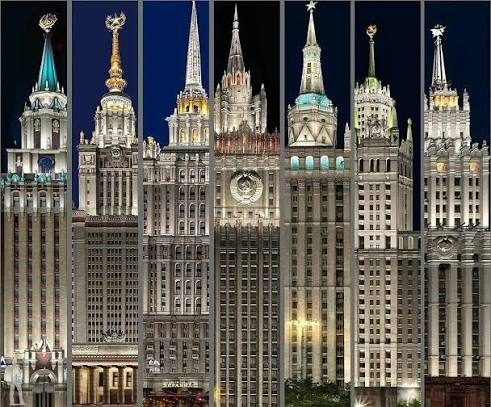
The Stalin high-rises, nicknamed the Seven Sisters in the West, are seven towers from 136 to 240 meters tall built in Moscow between 1947 and 1957: the main building of Moscow State University on the Lenin Hills, the Ministry of Foreign Affairs, the Leningradskaya and Ukraina hotels, the residential buildings on the Kotelnicheskaya Embankment and Kudrinskaya Square, and the mixed-use tower at the Red Gates. Stepped tiers, tented turrets, spires crowned with stars: the silhouette is recognizable from any postcard and has long served as Moscow's second coat of arms.
The style is called Stalinist Empire: a blend of Russian baroque, classicism and Gothic laid over the frame of an American skyscraper. The resemblance to 1930s Manhattan is no accident, and that is where the story begins.
Why Stalin needed skyscrapers
The project's motive was stated by its commissioner himself, and the formula survives: we won the war, yet foreigners will come to Moscow and see not a single skyscraper; against the capitalist capitals, that is a moral blow. The answer to America was to be given with America's own weapon: towers. The project also had a ghost of a predecessor: the prewar Palace of the Soviets, a 420-meter tower topped by a hundred-meter Lenin, meant to be the tallest building on earth. The war stopped it at the foundation stage, the steel of its frame went into anti-tank hedgehogs, and the giant pit later became the world's largest open-air swimming pool. The high-rises were the built version of that unbuilt dream.
The gesture was chosen in the era's signature style: on September 7, 1947, the day of Moscow's 800th anniversary, at exactly one in the afternoon, the first stones of all eight future towers were laid simultaneously. The city received not a construction project but a performance.
How they were built
Technically the high-rises were a leap over a missing step: steel frames, high-speed elevators, self-contained systems of everything. The country had no experience of such buildings and learned on the run, from that same Manhattan. The famous spire appeared, by consistent testimony, on Stalin's direct demand: the first designs ended in flat American-style roofs, and the leader wanted the Soviet towers to differ from the overseas ones. The Foreign Ministry received its spire while already under construction, which is why it is lighter than it looks. The university building, the tallest of the seven at 240 meters, was moved back from the edge of the Lenin Hills at the last moment for fear of landslides; until 1990 it remained the tallest building in Europe.
The ceremonial construction had an unceremonial side, and we state it plainly. Working hands were desperately short, and the sites employed, among others, Gulag prisoners and prisoners of war; forced labor is documented, in particular, at the Kotelnicheskaya Embankment building and at the university. The towers that became the symbol of a victorious country were built, in part, by people who had no choice.
Homes for the chosen
The settling of the towers honestly mirrored the society's structure. Apartments in the residential sisters were distributed as a supreme reward: the Kotelnicheskaya building, with its 540 apartments, its own cinema and its own post office, housed famous actors, scientists and generals; entering it from the street was impossible in principle. The Ukraina and the Leningradskaya received foreigners and delegations, the Foreign Ministry stayed a ministry, and the university tower gave the country its most famous campus building, home to generations of students.
The eighth sister was never born. The skyscraper in Zaryadye, beside the Kremlin itself, got as far as its foundation, but after Stalin's death the project was stopped: it was judged that the tower would overwhelm the Kremlin, and the campaign against "architectural excesses" begun under Khrushchev closed the subject of high-rises altogether. The style, however, had time to travel across the socialist bloc: sisters of the Moscow towers stand in Warsaw (the Palace of Culture and Science, a "gift of the USSR" the Poles argue about to this day), Riga, Bucharest, Prague and Kyiv.
Moscow's second coat of arms
The high-rises were conceived as propaganda and became the city. Their silhouette has held Moscow's skyline for seventy years: people navigate by them, films are shot around them, and every tourist photographs them first. Together with the metro they form a single ensemble of the Stalinist Empire style: palaces below the ground and towers above it, two halves of one statement. In the Cold War the ensemble served as a showcase in the contest of systems; today it serves simply as beauty, and there is an irony in that which the towers have earned.
Their honest verdict is the same as their era's: an architectural masterpiece paid for, in part, with the unfreedom of its builders. We name both sides, because the true history of buildings, like that of countries, consists of both.
Frequently asked questions
How many Stalin high-rises are there? Seven were built: the university, the Foreign Ministry, the Leningradskaya and Ukraina hotels, the residential buildings on the Kotelnicheskaya Embankment and Kudrinskaya Square, and the tower at the Red Gates. An eighth, in Zaryadye, was planned and cancelled after Stalin's death.
Why are they called the Seven Sisters? The nickname stuck in the West because of the towers' obvious family resemblance: the shared stepped silhouette, the turrets, the star-topped spires. In Russia they are usually called simply the Stalin high-rises.
Which is the tallest? The main building of Moscow State University on the Lenin (Sparrow) Hills: 240 meters, 36 floors. Until 1990 it was the tallest building in Europe.
Who built the Stalin high-rises? The country's leading architects, each with an individual design; alongside hired workers, the sites used prisoners and prisoners of war; forced labor is documented at the Kotelnicheskaya building and the university among others.
What was the Palace of the Soviets, and was it built? A prewar design for a 420-meter tower crowned by a statue of Lenin, intended as the world's tallest building. The war stopped it; the pit later became the Moskva open-air pool, and today the rebuilt Cathedral of Christ the Saviour stands on the site.
Are there such buildings outside Moscow? Yes: the style was exported across the socialist bloc. The most famous sister is the Palace of Culture and Science in Warsaw; related towers stand in Riga, Bucharest, Prague and Kyiv.
Related
- Joseph Stalin: the commissioner of the towers and of the era.
- The Moscow Metro: the underground half of the same Empire style.
- The Gulag: forced labor on the ceremonial construction sites.
- The Cold War: the contest in which the towers were an argument.
Sources
The facts in this article can be verified against authoritative sources:
- Official Moscow city portal (mos.ru), "Seven Sisters: How Stalinist high-rises were built": https://www.mos.ru/en/news/item/147840073/
- Radio Free Europe / Radio Liberty, "The Secrets Of Stalin's Seven Sisters": https://www.rferl.org/a/stalins-seven-sisters-the-skyscrapers-of-moscow/29496621.html
- Wikipedia, "Eighth Sister": https://en.wikipedia.org/wiki/Eighth_Sister
- Museum Studies Abroad, "Moscow's Seven Sisters: A Short History of Stalin's Skyscrapers": https://museumstudiesabroad.org/moscow-seven-sisters-history-stalin-skyscrapers/
- Facts and Details, "Stalin's Seven Sisters: Stalin-Era Skyscrapers in Moscow": https://factsanddetails.com/russia/Places/sub9_9a/entry-7021.html
Information on forced labor follows RFE/RL and historical research; both the ceremonial and unceremonial sides of the construction are reflected.