Tarkovsky’s Solaris: Its Conception, Cannes 1972 and the 1973 Release
From Tarkovsky’s proposal and Gorenstein’s screenplay to the cast, Lem’s criticism, the Cannes Jury’s Special Grand Prix and Soviet release.
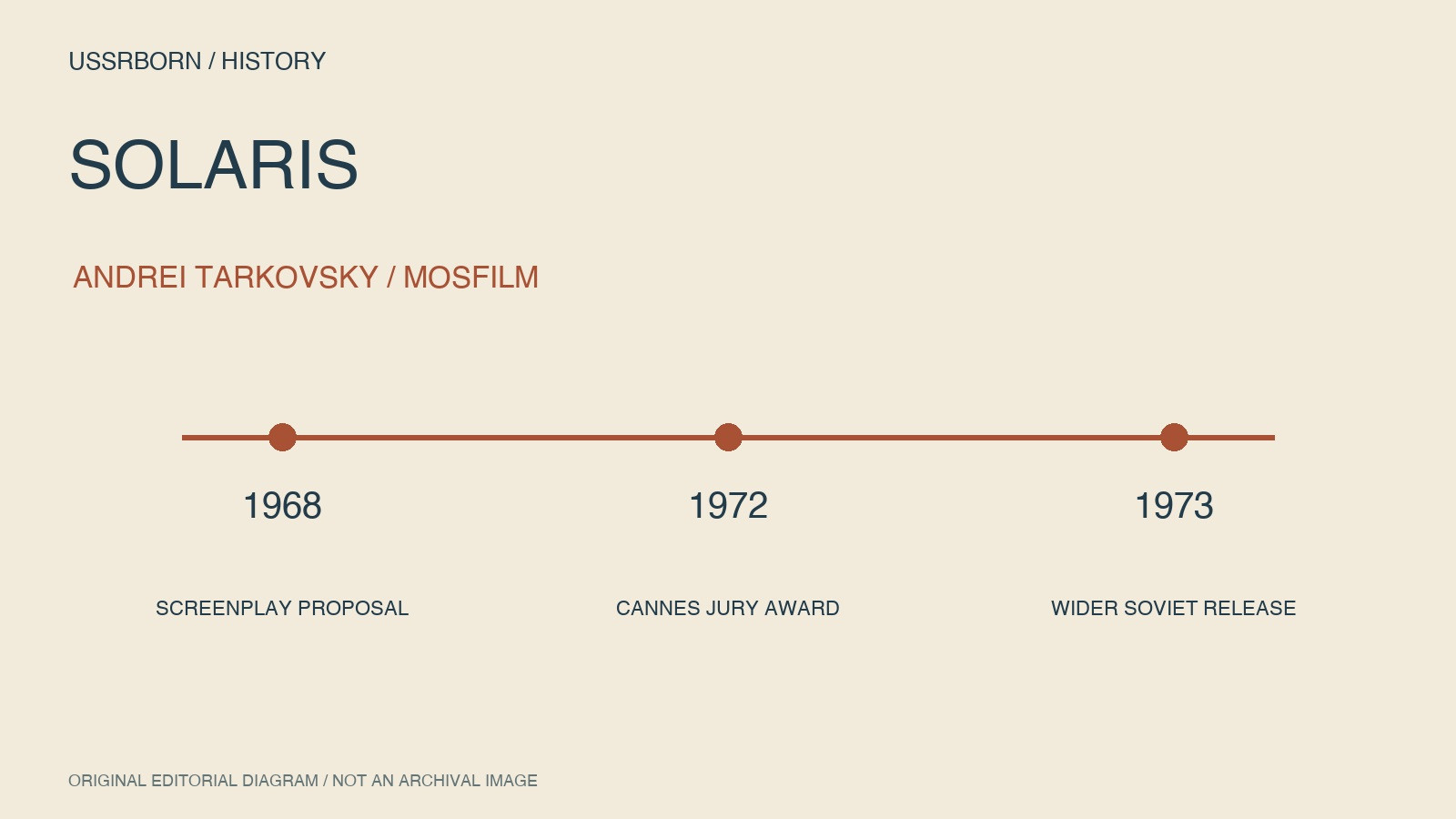
Andrei Tarkovsky's Solaris is a 1972 Mosfilm production based on Stanislaw Lem's novel. It competed at Cannes in May and received the Jury's Special Grand Prix. According to the studio's archival account, its wider Soviet release followed in February 1973. The two years refer to different stages in the film's journey to audiences rather than contradictory dates for the same event.
What happens on the station
Psychologist Kris Kelvin arrives at a station studying the planet Solaris. Instead of routine scientific work, he encounters people whose behaviour is difficult to explain. Then Hari appears, connecting the strange events directly to his own past. An investigation of the unknown becomes a confrontation with memory and responsibility.
The dramatic situation invites a reading in which Kelvin cannot remain a detached observer. He is both investigator and participant. This is an interpretation of the conflict, not a claim that the film has only one permissible meaning.
From novel to screenplay
Tarkovsky and Friedrich Gorenstein wrote the screenplay. Mosfilm's archival series reproduces the director's proposal of 26 November 1968. It already connected the difficulty of understanding an unfamiliar world with Kelvin's relationship with Hari. The ethical conflict was therefore part of the early conception, rather than an accidental discovery at the editing stage.
Tarkovsky's film was not the first Soviet screen adaptation of the book. Boris Nirenburg made a television version in 1968, with Vasily Lanovoy playing Kelvin. The two productions should be treated as separate adaptations.
The people who made the screen world
Donatas Banionis played Kelvin and Natalya Bondarchuk played Hari. The production team included cinematographer Vadim Yusov, production designer Mikhail Romadin and composer Eduard Artemyev. Their credits matter because a film's world is built through images, designed space, sound and performance together.
The Cinema Museum preserves associated material, including sketches and photographs taken during production. Such objects reveal stages of preparation behind the finished screen space. A sketch documents a design proposal, while a production photograph records a working moment. Neither should automatically be treated as a frame from the final version.
Lem's objection
The Cinema Museum reproduces the novelist's criticism of the adaptation. Lem believed that Tarkovsky had shifted attention from knowledge and contact with a radically unfamiliar intelligence towards an intimate story of guilt and relationships. This is the original author's position, which should be distinguished from an assessment of the film as an independent work.
The disagreement need not be settled by declaring one artist correct. A novel and its adaptation can retain characters and a basic situation while placing their emphasis differently. The contrast itself offers a productive question: how much attention goes to the nature of the Ocean, and how much to the person confronted by materialised memory?
The precise Cannes award
The festival's official retrospective identifies Solaris as the recipient of the Jury's Special Grand Prix. That should not be confused with the festival's highest award or casually renamed the Palme d'Or. The 1972 list records its top award separately, shared by films directed by Elio Petri and Francesco Rosi.
Solaris brings together several histories: the transformation of a literary source, collaboration within a production team, festival recognition and release to a wider audience. Keeping these strands distinct makes it possible to see beyond the shorthand label of philosophical science fiction and examine a particular film, its conception and the debate surrounding its adaptation.