Intourist: the abroad they were shown
The only office through which a foreigner could enter the USSR, hotels that barred the locals, and a guide behind whose smile stood the Lubyanka. How a country behind the Iron Curtain sold itself to the world, and what it hid while doing so.
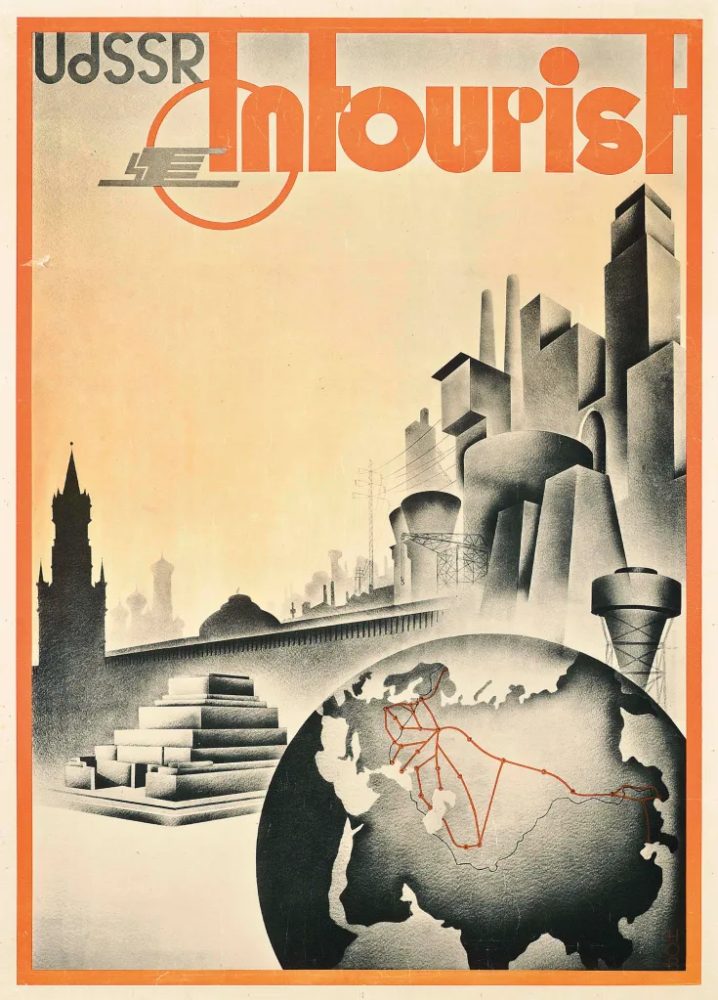
What Intourist was
Intourist (a contraction of the Russian for "foreign tourist") was a state joint-stock company founded on April 12, 1929, and granted a monopoly on all inbound tourism to the USSR. No foreigner could come to the Soviet Union on his own: the route, the hotel, the transport, the interpreter, even the list of what could be seen, all of it was arranged and controlled by Intourist. The organization lasted to the end of the USSR and outlived it, becoming an ordinary travel firm, but in the Soviet decades it was not a travel agency but an institution, at the junction of economics, propaganda and state security.
Behind the travel-bureau sign, three machines worked at once. The first earned the country hard currency. The second showed the foreigner a ceremonial USSR. The third, invisible, watched and recruited. Intourist cannot be understood without seeing all three, and it has to be told whole.
Currency in exchange for an impression
Intourist was born in the late 1920s for a purely monetary reason. Industrialization was beginning, the country desperately needed hard currency to buy Western machine tools and technology, and the foreign tourist was a living source of it: he paid in hard money for what cost almost nothing inside. The first office was placed in Moscow's Metropol Hotel, a representative office in Leningrad's Europeyskaya, and soon branches opened in Britain, Germany and the United States. The task was stated without embarrassment: bring in hundreds of thousands of paying guests and exchange their money for impressions.
The impression was designed no less carefully than the route. Intourist became an advertising machine as well: bright posters called visitors to "See USSR" in Moscow, Leningrad, the Volga, Crimea and the Caucasus, painting a country of color and progress. Unlike domestic propaganda, which drove its own citizens to work harder, Intourist's advertising enticed outsiders to come and admire. The first guests were celebrities: the writer Theodore Dreiser, Bernard Shaw, the Nobel laureate Romain Rolland, whose enthusiastic testimonials were then quoted around the world as firsthand evidence.
Organized spontaneity
Freedom to move about the country was not granted to the foreigner; in its place Intourist offered a carefully staged performance. The guest saw exactly what was shown: model factories, the best sanatoriums, the palaces of the Moscow Metro, ceremonial facades. Many cities and whole regions remained closed entirely. Western scholars named this regime "organized spontaneity": the tourist seemed to stroll, but always along an approved route and always under the eye of a guide who was interpreter, docent and unspoken observer in one.
The foreigner's daily life was separate too, fenced off from the Soviet one. Guests stayed in Intourist hotels, which an ordinary Soviet citizen simply was not admitted to; they paid in special money, not the rubles in citizens' pockets. Foreign currency and special checks opened the doors to a parallel world of plenty, the very one that stood behind the windows of the Beryozka shops and that we described in the article on the Soviet ruble. The tourist left with a sincere impression of a rich and welcoming country, because he saw exactly that: the version assembled specially for him. What hid behind the facade, the lines, the shortages, the communal flats, was not on the itinerary.
The shadow of the Lubyanka
Intourist's third function appeared in no brochure, but it was woven into the very fabric of the organization. Intourist was closely tied to the state security organs and, in the Cold War years, effectively worked as an unspoken arm of the First Main Directorate of the KGB, foreign intelligence. The hotels for foreigners were designed as a controlled environment: bugged rooms, trained guides, pre-approved routes, all to watch the guests and limit their unplanned contacts with Soviet people. The defector and former intelligence officer Viktor Suvorov later described Intourist plainly as a structure under KGB control that decided who was let into the country.
The machine worked in the other direction too. Abroad, Intourist's foreign branches served as convenient cover for sending intelligence officers into other countries, from the United States to France: a post at a travel firm gave a legal pretext for work abroad. So one and the same sign let outsiders in under surveillance and sent its own people out under cover. For a country behind the Iron Curtain, this was logical: if you crack the door outward, your own man should be standing behind it.
A parallel world for export
By Brezhnev's time, in the era of "peaceful coexistence," Intourist unfolded at full strength: thousands of foreign groups a year, new hotels, among them the high-rise Hotel Intourist beside Red Square, opened in 1970. Outwardly it was a showcase of a prospering socialism, shown to tens of thousands of Western guests; inwardly it was the same triple mechanism of currency, propaganda and surveillance as in 1929. Intourist sold not a trip but a managed impression, and did it professionally: its own slogan promised not merely a journey but a journey into a new world.
The irony is that this world truly was new, only nonexistent outside the itinerary. The tourist saw a country that did not exist: without lines, without empty shelves, without what surrounded its own citizens every day. Intourist was, in essence, the same VDNKh, only alive and portable: the country in its ceremonial, ideal version, shown to those whose opinion it mattered to reach the world.
After the curtain
With the end of the USSR, the monopoly vanished too: the borders opened, people could travel on their own, and Intourist turned from an institution into an ordinary commercial travel firm like many others, keeping its name, its real estate and the capital accumulated over decades. The hotels changed owners, the guides stopped writing reports, and the word itself remained a monument to an age when a country could be seen only through a single window, cut specially for the purpose.
Intourist's honest verdict is exactly as double as everything Soviet. It did open the country to the world, showed its culture, its museums, its metro and its theaters, and thousands of foreigners saw the USSR through its eyes. And it was also the instrument that decided what precisely they would be shown and what concealed, and kept an eye on the guests besides. Both roles were played by one office, and they cannot be separated: Intourist was that very impossibility of separation, cast in the mold of a travel agency.
Frequently asked questions
What was Intourist? A state joint-stock company founded in 1929 with a monopoly on all inbound tourism to the USSR: a foreigner could enter the country only through it. The name is a contraction of the Russian for "foreign tourist."
Why was Intourist created? Above all for hard currency: during industrialization the country needed hard money to buy Western technology, and foreign tourists were a source of it. Its second task was propaganda for the achievements of socialism.
Could foreigners travel freely in the USSR? No. Intourist set the route, the cities and the sites, many territories were closed, and the guest was always accompanied by a guide. Western historians call this regime "organized spontaneity."
Is it true that Intourist was linked to the KGB? Yes. The organization was closely tied to state security and effectively worked as an arm of foreign intelligence: bugged hotels, surveillance of guests, and abroad its branches served as cover for intelligence officers.
Why did foreigners pay in special money? Guests paid in currency and special checks rather than ordinary rubles. This opened access to a parallel world of goods and services unavailable to ordinary citizens, the same as in the Beryozka shops.
Does Intourist still exist? Yes, but now as an ordinary commercial travel firm. After the Soviet collapse the monopoly vanished, and Intourist became one travel operator among many, keeping its historic name.
Related
- The KGB: the agency whose unspoken arm Intourist was.
- The Iron Curtain: the border whose only window this office served as.
- The Soviet ruble: the special money the guests paid in.
- VDNKh: the same showcase of a ceremonial country, only stationary.
Sources
The facts in this article can be verified against authoritative sources:
- Wikipedia, "Intourist": https://en.wikipedia.org/wiki/Intourist
- Russia Beyond, "What were foreign tourists allowed to see on trips to the Soviet Union?": https://www.rbth.com/travel/330988-foreign-tourists-soviet-union
- Comrade Gallery, "Selling the Soviet Dream: Tourism Behind the Iron Curtain": https://www.comradegallery.com/journal/selling-socialism-intourist-and-the-evolution-of-soviet-tourism
- ANU Press, Jack Perrett, "'See USSR': The Soviet Union's experimental tourism industry of the 1930s": https://press-files.anu.edu.au/downloads/press/n14684/pdf/05_perrett.pdf
- Young Pioneer Tours, "How to Visit the Soviet Union and Eastern Bloc Countries During the Cold War": https://www.youngpioneertours.com/visit-the-soviet-union-and-eastern-bloc/
Claims about Intourist's intelligence links follow testimony and historical publications; the organization's double nature (showcase and surveillance) is stated directly.