VDNKh: the showcase of a country that never was
An exhibition city with a palace for every republic, golden wheat sheaves and fountains, where the country displayed itself as it wished to be. The story of the "Soviet Versailles": from a parade of kolkhoz victories to the shashlik market of the nineties and back.
What VDNKh is
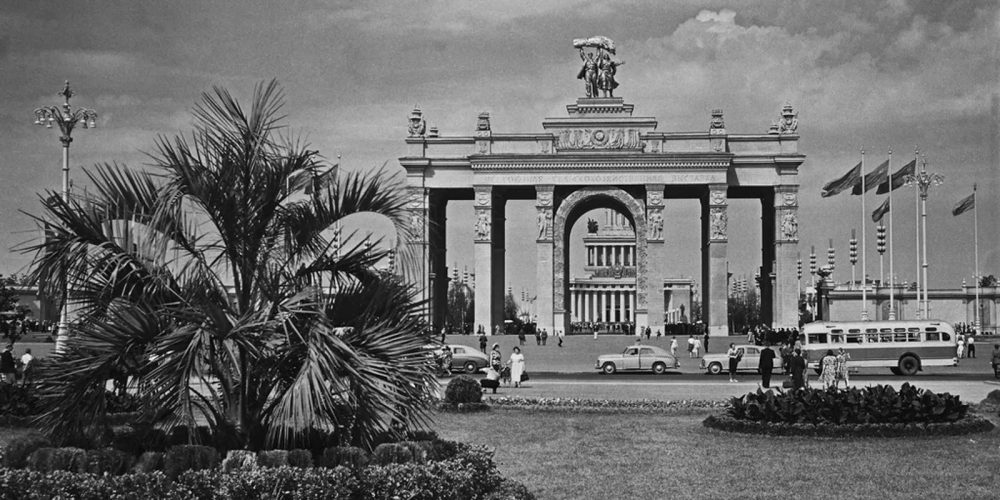
VDNKh, the Exhibition of Achievements of the National Economy, is a giant exhibition city in the north of Moscow: hundreds of hectares, dozens of palace-pavilions, triumphal arches, gilded fountains. It was conceived as a permanent showcase of socialism: every republic and every industry received a palace of its own here, and the visitor received the chance to tour the whole country in a day, the country in its ceremonial, ideal version.
The Spanish architect Santiago Calatrava called the ensemble the "Soviet Versailles," and the comparison is doubly exact: like Versailles, VDNKh was built not for use but for impression, and like Versailles it outlived the regime that created it. Today it is one of Moscow's most visited places, with some 25 million guests a year, and perhaps the most complete surviving self-portrait of the USSR.
A parade of kolkhoz victories
It began with agriculture, and the timing speaks for itself. The decision to hold an All-Union Agricultural Exhibition was taken in 1935, immediately after collectivization and the famine: a country that had just lived through a rural catastrophe was to show itself and the world a flourishing kolkhoz order. The exhibition was built like a city: two years of design, two thousand artists and architects, palaces in national styles for every republic. The construction ran at the height of the terror and did not escape it: the exhibition's first chief architect, Vyacheslav Oltarzhevsky, was arrested in the middle of the work.
On August 1, 1939, the VSKhV opened: 136 hectares, 250 structures, 400 sculptures, a parachute tower and a Ferris wheel. In the three months of its first season, three and a half million people came. At the entrance stood Vera Mukhina's monument Worker and Kolkhoz Woman, just returned from the Paris World's Fair: the pair with the hammer and sickle that became the country's second coat of arms. The showcase worked: the visitor saw abundance, record sheaves and prize bulls. What that abundance had cost the village, the showcase did not say. That is what showcases are for.
The golden age: from sheaves to sputniks
The war closed the exhibition for thirteen years: the pavilions became warehouses and barracks. The VSKhV reopened on June 25, 1954, rebuilt more lavishly still, with new arches and the two fountains that became its eternal symbols. The Friendship of Nations: sixteen gilded young women in the national costumes of the republics, circling a sheaf of wheat. And the Stone Flower, the country's first musical fountain, drawn from the Ural fairy tales of Bazhov.
In 1959 the exhibition changed profile and name: as VDNKh it now displayed the entire national economy at once, and the era's chief exhibits became the space ones. Real satellites and spacecraft hung in the Kosmos pavilion, a Vostok carrier rocket rose by the entrance, and for millions of Soviet schoolchildren it was here that the space age stood within arm's reach. For Muscovites and visitors VDNKh was simply the best day out: ice cream, fountains, shashlik, cinema and doughnuts famous across the Union. Propaganda and holiday were inseparable here, and that is the whole design of the place.
The nineties: a market in the palaces
The country's collapse turned the showcase into a flea market, perhaps the most symbolic metamorphosis in all of post-Soviet Moscow. Funding vanished, and in the 1990s the palace-pavilions were leased to traders: in the Kosmos hall, under real satellites, they sold televisions, seedlings and fur coats; shashlik smoked by the Friendship of Nations; the gilding flaked. The exhibition of achievements became an exhibition of survival. For a whole generation, the VDNKh of the nineties means not palaces but kiosks, and that memory too is part of the place's biography.
The turn came in 2014: Moscow returned the exhibition's historic name and began a sweeping restoration. The traders were moved out, the pavilions cleared, and from behind the kiosk plywood emerged mosaics and moldings unseen for decades. Forty-nine of VDNKh's structures hold protected landmark status; the restoration of "totalitarian heritage," as academic researchers call it, itself became a scholarly dispute over whether beauty created as propaganda should be restored. Moscow's answer was practical: it should, and the lines outside the pavilions confirm it.
The showcase as a document
Today VDNKh does what it always did, with the sign reversed: the showcase once sold the future, now it displays the past. A mockup of Buran stands here, the Kosmos pavilion houses the country's finest space museum, the republics' palaces hold museums and exhibitions, and the Friendship of Nations shines its gilding over a skating rink that in winter becomes one of the largest in the world.
To historians VDNKh is precious precisely as a document: nowhere else did the USSR's self-image survive so completely, and together with the metro and the high-rises it forms the chief ensemble of the Stalinist style. On this showcase the country always looked better than it lived, and the entire Soviet story fits into that gap between the palace of plenty and the line for sausage. VDNKh honestly shows the first; our site exists so that the second stands beside it.
Frequently asked questions
What does VDNKh stand for? The Exhibition of Achievements of the National Economy. It opened in 1939 as the VSKhV (All-Union Agricultural Exhibition), has carried the name VDNKh since 1959, and was called VVC from 1992 to 2014.
What is the Friendship of Nations fountain? VDNKh's main fountain (1954): sixteen gilded female figures in the national costumes of the Soviet republics around a wheat sheaf. One of Moscow's most recognizable symbols.
Why is Worker and Kolkhoz Woman at VDNKh? Vera Mukhina's monument was created for the Soviet pavilion at the 1937 Paris World's Fair and was installed at the exhibition entrance after its return.
What happened to VDNKh in the 1990s? The exhibition lost its funding and was leased to traders: markets operated in the historic pavilions and the ensemble decayed. Restoration began in 2014 with the return of the VDNKh name.
What is worth seeing at VDNKh today? The Friendship of Nations and Stone Flower fountains, the Kosmos pavilion with its space museum and the Buran mockup, the republics' palaces, the arches and avenues; in winter, one of the world's largest skating rinks.
Why is VDNKh called the "Soviet Versailles"? The comparison belongs to architect Santiago Calatrava: like Versailles, it is an ensemble built for impression and grandeur rather than use, and it outlived the era that created it.
Related
- The kolkhoz: the order whose "victories" the exhibition displayed first.
- The Moscow Metro: the underground part of the same ceremonial ensemble.
- Sputnik 1: the era that replaced the wheat sheaves in the main pavilions.
- Buran: the spacecraft whose mockup became a showcase exhibit.
Sources
The facts in this article can be verified against authoritative sources:
- Official Moscow city portal (mos.ru), "Touring the Soviet Versailles: Don't miss these VDNKh attractions": https://www.mos.ru/en/news/item/26915073/
- Official Moscow city portal (mos.ru), "VDNKh as seen by its first visitors in 1939": https://www.mos.ru/en/news/item/63463073/
- Academia.edu (academic paper), "The Expos of 1930s in the Contemporary City: The Case of VDNKh in Moscow": https://www.academia.edu/63337999/THE_EXPOS_OF_1930S_IN_THE_CONTEMPORARY_CITY_THE_CASE_OF_VDNKH_IN_MOSCOW_1938_RESTORED_SINCE_2013
- Express to Russia, "VDNKh Park, Moscow": https://www.expresstorussia.com/guide/moscow-vdnkh.html
- TrendyMoscow, "All-Russian Exhibition Center (VDNKh)": https://www.trendymoscow.com/attractions/vdnkh
The contrast between showcase and reality (an exhibition of plenty after the famine) is stated directly, as the site's editorial frame requires.