The kolkhoz: the village that lost its land
Work paid in tally marks in an accountant's notebook, a passport that did not exist, and a garden plot that outproduced every field around it. How the system that held the Soviet village for half a century worked, and why the whole world knows the word kolkhoz.
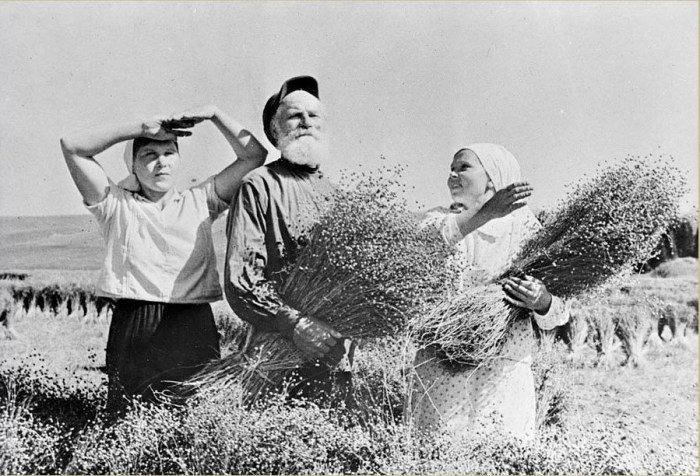
What a kolkhoz was
A kolkhoz (a contraction of the Russian for "collective farm") was the organizational form of the Soviet village: peasants formally pooled their land, livestock and labor into a common enterprise, while in practice they worked for the state, which took the produce at prices it set itself. Alongside it existed the sovkhoz ("Soviet farm"), a fully state-owned operation whose workers received wages like factory hands; the kolkhoz was officially considered a mere "transitional stage" toward that ideal.
The word entered the world's languages untranslated, like sputnik and gulag, and with reason: the system had no analogues. The lives of tens of millions of people and the entire fate of the Soviet countryside passed through the kolkhoz, and without it one cannot understand the planned economy, the shortages, or even the city dweller's passion for the dacha: all links of one chain.
How the village was driven in
In the 1920s collective farms were voluntary and rare: peasants who had received land from the revolution had no intention of giving it up. The year 1929, proclaimed the year of the "great turn," changed everything. Industrialization needed grain, for export, for hard currency, for the growing cities, and the state decided to take the countryside whole. A decree of January 1930 set the pace of "total collectivization," and those who resisted were declared "kulaks": millions of peasants, often simply the more capable farmers, were dekulakized, with confiscation of everything and deportation, for many through the Gulag.
The village fought back: it slaughtered livestock rather than surrender it (the country's herds fell by half and took decades to recover), it rebelled, it fled to the cities. The answer was procurement at any price, searches and the confiscation of food. The catastrophe culminated in the mass famine of 1932 and 1933, the Holodomor in Ukraine and the famines of Kazakhstan, the Volga and the Kuban, which took millions of lives. By the mid-1930s collectivization had won: the independent village ceased to exist.
The trudoden: working for tally marks
The kolkhoz is easiest to understand through its basic unit, the trudoden, the "labor day." A kolkhoz member received no wages. Each task earned labor days: the simplest counted as half, machine work as much as four and a half; the farm accountant marked tally strokes in a notebook. Settlement came once or twice a year, and not in money but in the residue: whatever remained of the harvest after obligatory deliveries to the state at prices the state itself assigned, several times below real value. In a bad year a labor day might bring a handful of grain; the village learned the expression "working for tally marks" on its own skin.
The system's second pillar was unfreedom. Kolkhoz members were not entitled to internal passports: leaving the village without permission was impossible, and historians call this outright a "second serfdom." The comparison is harsh but structurally accurate, and we cite it as an assessment in which the argument is over the word, not the facts. The countryside began receiving passports en masse only from 1974. Pensions for kolkhoz members were introduced only in 1966; before that, old age was secured only by one's own household.
And here lies the system's central paradox. Every family was left a household plot, a tiny fraction of the land. Those fractions, worked by hand after the kolkhoz shift, gave the country a disproportionately enormous share of its potatoes, vegetables, milk and meat. The private garden outproduced the common field several times over: a verdict the system passed on itself annually, and one the urban six sotki would later inherit.
A thaw for the village, and the permanent crisis
After Stalin the state tried to humanize and revive the system. Under Khrushchev procurement prices were raised and the Virgin Lands plowed; under Brezhnev kolkhoz members received pensions, guaranteed money wages in place of labor days and, at last, passports. The village breathed easier, and went on emptying: the young left for the cities at the first opportunity, and in the remaining farms a learned helplessness took root: land that belongs to everyone belongs to no one.
The economic verdict was relentless. The country with the world's largest black-earth belt bought grain abroad from the 1960s on; by the 1980s roughly a sixth of its bread was imported, paid for with oil. Every autumn the cities were mobilized for the harvest: students, engineers and researchers sent "to the potatoes" became as much a symbol of the system as the lines outside shops. The kolkhozes lasted to the end of the USSR and mostly did not survive it: in the 1990s they were reorganized and dismantled, though the word and individual farms live on in some post-Soviet countries.
The legacy
The kolkhoz left two inheritances, and they sit badly in one frame. The first is human: dekulakization, famine, decades of tally-mark labor and rightlessness, a ruined and depopulated countryside whose pain still sounds in literature, from the "village prose" writers to the archival studies. The second is linguistic and everyday: in colloquial speech "kolkhoz" became a byword for anything done crudely and by improvisation, and that irony is a verdict too. A system conceived as the highest form of farming survives in the language as a synonym for amateurism.
We will not straighten this verdict either: there were prosperous "millionaire" kolkhozes, honest chairmen, and village life with its holidays, people make a home of any system. But the economy's judgment is beyond appeal: the country that took the peasant's land away spent its final decades buying bread from countries that had not.
Frequently asked questions
What is a kolkhoz, in simple terms? A collective farm into which Soviet peasants were merged during collectivization: land and labor held in common, produce delivered to the state at assigned prices. It existed from the late 1920s to the end of the USSR.
How did a kolkhoz differ from a sovkhoz? A sovkhoz was a state farm paying wages like a factory. A kolkhoz was formally a cooperative: its members received not wages but a share of the residual harvest according to labor days.
What was a trudoden? The unit of labor accounting on collective farms (1930 to 1966): tasks earned from half to four and a half labor days per day, settled in produce from what remained after state deliveries. Money wages arrived only in the 1960s.
Is it true that kolkhoz members had no passports? Yes: internal passports were not issued to them, and leaving the village required permission. Mass passportization of the countryside began only in 1974; pensions came in 1966.
Why did private plots outproduce kolkhoz fields? The tiny household plots supplied a disproportionately large share of the country's food, because on his own land a man worked for himself. That productivity gap is the system's chief economic verdict.
Do kolkhozes exist today? Mostly not: in the 1990s they were reorganized into other forms. Individual enterprises with the name and status survive in some post-Soviet countries.
Related
- The planned economy: the system of which the kolkhoz was a part.
- The Holodomor: the price of collectivization paid by the village.
- The dacha: six sotki: the urban sequel to the household-plot paradox.
- The Gulag: where dekulakization led.
Sources
The facts in this article can be verified against authoritative sources:
- Encyclopedia.com (Encyclopedia of Russian History), "Collective Farm": https://www.encyclopedia.com/plants-and-animals/agriculture-and-horticulture/agriculture-general/collective-farm
- Wikipedia, "Kolkhoz": https://en.wikipedia.org/wiki/Kolkhoz
- Wikipedia, "Trudoden": https://en.wikipedia.org/wiki/Trudoden
- Wikipedia, "Sovkhoz": https://en.wikipedia.org/wiki/Sovkhoz
- Internet Encyclopedia of Ukraine, "Workday (trudoden)": https://www.encyclopediaofukraine.com/display.asp?linkpath=pages\W\O\Workday.htm
Evaluative characterizations ("second serfdom") are attributed as historians' assessments; the factual base (passports, labor days, pensions) is documentary.