The dacha: six hundred square meters that fed a country
A tsar's gift that became a national religion. How tiny plots attached to factories grew into the food security system of an entire country, and why the word dacha entered the world's dictionaries untranslated.
What a dacha is
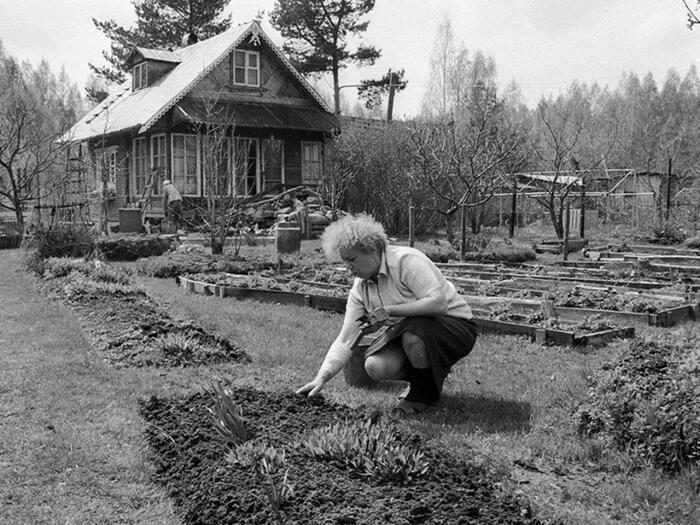
A dacha is a country plot with a small house where a Soviet, and later post-Soviet, family spends weekends and vacations, growing food and resting from the city. The definition sounds ordinary, but the phenomenon behind it is unique: in no other country have country plots played such a role in the economy, the psychology and the very structure of life. Roughly every third resident of the country owned a dacha, and the word entered English and other languages untranslated, like sputnik and glasnost: there is simply no exact equivalent for the thing itself.
The word comes from the Russian verb "to give": in the 18th century, dachas were the lands that tsars granted to their favorites. The road from a tsar's gift to six hundred square meters of potatoes took two centuries, and it is one of the most revealing roads in Russian history.
From Chekhov to the commissars
The prerevolutionary dacha was about leisure, not vegetables. With the growth of railways in the 19th century, the urban middle class began renting summer houses, and dacha life, with its samovars, romances and boredom, became a world of its own, described best by Chekhov, himself a passionate dacha dweller. The revolution confiscated that world but did not abolish it: the dachas went to the new elite. State dachas were issued to commissars and generals, the writers' village of Peredelkino became a legend of Soviet literature, and for two decades the word "dacha" was a mark of rank.
The turn came after the war, and the motive was not ideological but gastric: a devastated country with inefficient collective farms could not feed its cities. The state struck a tacit bargain with the very "private instinct" it had spent decades uprooting: a 1949 decree on collective and individual gardening allowed plots to be distributed to city dwellers, at a norm of 600 square meters inside city limits or 1,200 beyond them. Thus was born the phrase every Soviet person knew: the six sotki.
The republic of six sotki
Distribution ran through the workplace: factories, institutes and ministries received land and parceled it out to their employees, organizing them into garden cooperatives. The scale snowballed: in the Moscow region alone, membership in garden cooperatives grew from forty thousand in the early 1950s to four million by 1983. On the six sotki one could put up a light summer house, within size and height limits that the people learned to circumvent creatively, and grow anything at all.
They grew everything. Potatoes as the foundation, cucumbers and tomatoes in homemade greenhouses, currants, apple trees, strawberries; from March, seedlings occupied the windowsills of city apartments. In autumn the harvest turned into zagotovki: pickles, jams and preserved fruit in jars that filled balconies and cupboards. The dacha set the calendar of life: the May holidays meant planting, every summer weekend meant weeding and watering, September meant harvest and canning. The Friday evening suburban trains, packed with people carrying rucksacks and seedlings, were as much a symbol of the era as the lines outside shops.
Food as the point
Now the essential part, the reason it all existed. Tiny plots worked by hand on weekends became the country's food backbone: researchers estimate that by the late Soviet years, private and dacha plots produced the bulk of the potatoes, vegetables and fruit the country consumed, while occupying a negligible share of its farmland. Planned agriculture with its giant collective farms fed the country worse than the Sunday labor of its city dwellers, and in the years of total shortage this fact was not a subject of irony but a condition of survival.
Economists later formulated the law that dacha owners had always known: the worse things are in the country, the more potatoes are planted on the six sotki. The crises of the 1990s confirmed the law in full, when the dacha fed families again as salaries evaporated.
More than a vegetable garden
To reduce the dacha to food would be to misunderstand it. The six sotki were a territory of freedom that the Soviet person lacked everywhere else: here he was an owner, not an employee, and nobody called meetings. After the kommunalka and the cramped khrushchyovka, one's own patch of earth felt like an estate. Psychologists and sociologists write in earnest about the dacha as the Soviet system's "safety valve": labor on one's own land returned to people a sense of control over life.
The dacha bred a whole culture: bathhouse Saturdays, shashlik grills, boundary wars with neighbors and mutual aid with the same neighbors, children's dacha summers that several generations recall as the best time of childhood. And a culture of things: washstands made from kettles, greenhouses from old window frames, sheds from everything, since building materials were as absent from the shops as everything else. Dacha construction became an encyclopedia of Soviet ingenuity.
The dacha after the USSR
The dacha's post-Soviet story is a rare soft landing. The plots were privatized, and the six sotki became, for millions of families, their first private land. The dacha survived the crises, feeding the country in the 1990s, and the prosperity of the 2000s, when vegetable beds began giving way to lawns and barbecues. Sociologists record the change of roles: from a survival system the dacha is turning back into the place of leisure it was before the revolution, and the circle closes. But the law of the six sotki has not gone anywhere: in every new crisis, seed sales rise and the beds reclaim the lawns. The dacha remains what it has always been: the country's quiet answer to any times.
Frequently asked questions
What is a dacha, in simple terms? A country plot with a small house for weekends, rest and growing food. In the USSR dachas were distributed through workplaces; roughly every third resident had one.
Why exactly six sotki? The norm was fixed by the 1949 decree on collective gardening: 600 square meters inside city limits or 1,200 beyond. The calculation rested on what a family could work by hand and what would feed it without "surpluses."
Where does the word dacha come from? From the Russian verb "to give": in the 18th century, dachas were lands granted by tsars to their favorites. Later the word spread to any country house and plot.
Did dachas really feed the country? Researchers estimate that by the end of the Soviet era, private and dacha plots supplied the bulk of the country's potatoes, vegetables and fruit while occupying a small share of the land. In the crises of the 1990s the dacha again became the family's support.
What could be built on a dacha? A light summer house within size limits; permanent homes and second floors were formally banned, and dacha owners invented workarounds, from "attics" to "verandas."
Do dachas exist today? Yes, tens of millions of plots: some still feed their owners, some have become places of pure leisure. In every economic crisis, the vegetable beds return.
Related
- Shortages in the USSR: why the six sotki were a matter of survival.
- The khrushchyovkas: the urban half of Soviet daily life.
- The kommunalka: the crowding from which the dacha was an escape.
- The planned economy: the system quietly insured by its dacha owners.
Sources
The facts in this article can be verified against authoritative sources:
- Slavic Review (Cambridge University Press), "Contesting Capitalism at the Post-Soviet Dacha": https://www.cambridge.org/core/journals/slavic-review/article/abs/contesting-capitalism-at-the-postsoviet-dacha-the-meaning-of-food-cultivation-for-urban-russians/10BF1E2C552C910DBB52F4A1C2B66B04
- National Geographic (via City Farmer), "In pinched Soviet times dacha gardens grew much of Russia's food": https://cityfarmer.info/in-pinched-soviet-times-dacha-gardens-grew-some-90-percent-of-russias-vegetables/
- Jamestown Foundation, "The Dacha: Russia's Retreat, Soul Saver and Key Food Supplier": https://jamestown.org/the-dacha-russias-retreat-soul-saver-and-key-food-supplier/
- Russia Beyond / GW2RU, "Why were exactly 6 ares allocated for dachas in the USSR?": https://www.gw2ru.com/lifestyle/231832-soviet-dacha-6-ares
- Russiapedia (RT), "Of Russian origin: Dacha": https://russiapedia.rt.com/of-russian-origin/dacha/
Estimates of the dacha share in the country's food supply vary by method; we give the stable overall picture confirmed by multiple sources.