Leonid Kantorovich: Linear Programming and the 1975 Economics Prize
Why did Leonid Kantorovich win the 1975 economics prize? Explore linear programming, resource constraints and an original worked example proving an optimal plan.
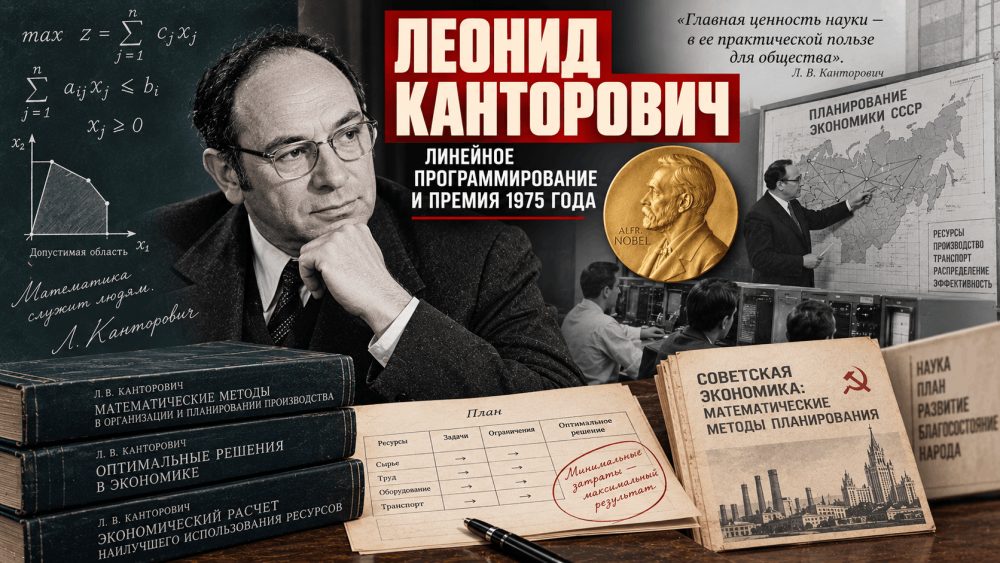
A factory has equipment, materials and workers, but not enough of every resource to fulfil every possible order. How should it choose the combination of products that gives the best result? Leonid Kantorovich turned questions of this kind into rigorous mathematical problems. His work showed that a production plan could be evaluated not only for feasibility, but also for whether a better feasible plan existed.
In 1975, Kantorovich shared the Sveriges Riksbank Prize in Economic Sciences in Memory of Alfred Nobel with Tjalling Koopmans for research on the optimum allocation of resources. The recognition concerned a scientific contribution applicable across different economic systems. It was not an award for the overall performance of the Soviet economy.
From mathematics to economic decisions
Born in St Petersburg in 1912, Kantorovich entered Leningrad University in 1926 and became a professor in 1934. His later career included work in the Siberian branch of the Academy of Sciences and in Moscow. He was a mathematician whose research crossed disciplinary boundaries.
In his Nobel autobiography, he traced his early economic research to consulting for a plywood-trust laboratory in 1938. A practical equipment-allocation problem suggested a broader class of questions. His booklet on mathematical methods of organising and planning production appeared in 1939.
The subject extended far beyond one industrial assignment. How should limited capabilities be divided between competing uses? That question connects Kantorovich's research to a central problem of the planned economy: what to produce, in what quantity, and at the cost of giving up which alternatives?
What linear programming means
Here, programming means constructing a plan. It does not necessarily refer to writing computer code. A computer can calculate a solution, but the mathematical formulation exists independently of a particular software package.
A linear-programming problem has three main components. Decision variables describe choices that can be made. Constraints describe what is possible. An objective function states the result to be maximised or minimised. In a linear model, proportional contributions are added together without products of decision variables or other nonlinear relationships.
A feasible solution respects the constraints. An optimal solution produces the best value of the chosen objective among all feasible solutions. That difference is fundamental. A factory can stay within its resource limits without making the best possible use of them.
The mathematical claim is also narrower than saying that one plan is best in every imaginable respect. It is best according to the stated objective and the specified constraints. Change those assumptions, and the answer may change.
An invented workshop example
Consider a teaching example created for this article, not historical data from a Soviet enterprise. A workshop makes two divisible products, A and B. Each unit of A uses two equipment hours and one unit of material. Each unit of B uses one equipment hour and two units of material. The workshop has one hundred equipment hours and eighty material units available.
Suppose A contributes three hypothetical value points per unit and B contributes four. These points are only a device for comparing plans. Producing A alone gives fifty units and one hundred and fifty points. Producing B alone gives forty units and one hundred and sixty points. The second option looks better, but comparing those two extremes does not solve the whole problem.
Making forty units of A and twenty of B uses exactly one hundred equipment hours and eighty material units. It produces two hundred points, outperforming both single-product plans. The two products consume the scarce resources in different proportions, so a mixture uses them more effectively.
This does not establish a universal rule that diversification is always best. It follows from the specific resource requirements and values in this example. A different model might favour one product exclusively.
How can we prove that the plan is optimal?
Let x represent the amount of A and y the amount of B. The constraints are 2x + y ≤ 100 for equipment time and x + 2y ≤ 80 for material. Both quantities must be nonnegative. The objective is to maximise 3x + 4y.
Multiply the first resource inequality by 2/3 and the second by 5/3, then add them. The result is 3x + 4y ≤ 200. Every feasible plan is therefore worth at most two hundred points. The combination of forty units of A and twenty of B reaches that bound, proving it is optimal for the model.
The example demonstrates something more useful than a lucky guess. We have both a plan and a reason why no other feasible plan can beat it. Real industrial models may involve many more products and constraints, but the distinction between a plausible suggestion and a demonstrated optimum remains important.
The assumption that products are divisible also matters. If a problem requires whole vehicles, indivisible shifts or minimum batch sizes, those requirements must be represented. They cannot simply be ignored because a continuous calculation is easier.
Why a scarce resource needs a value
An extra equipment hour and an extra unit of material need not improve the best achievable result by the same amount. Their usefulness depends on the complete set of alternatives and constraints, not merely on how much of each resource is currently in stock.
This connects with dual valuations, often called shadow prices. Under suitable conditions, they describe how the optimal objective changes when a resource limit changes slightly. Such a valuation belongs to a particular model and range of conditions. It need not equal a retail price or remain valid after a major change in production arrangements.
The official 1975 prize announcement highlighted Kantorovich's work connecting resource allocation and the price system. This is relevant to Soviet economic history because the problem concerned not only targets but also the measures by which individual enterprises judged their decisions. The Kosygin reform provides related institutional context, although the administrative reform and the mathematical theory were not one project.
The general lesson is that the value of an input can depend on what it allows the whole system to do. Counting physical quantities alone does not establish the best allocation.
What an optimum does not promise
Our workshop example assumes that equipment availability, material requirements and the value of output are known. Actual data can be incomplete. Machines fail, quality varies and demand changes. Optimisation solves the problem that has been formulated; it does not guarantee that the formulation adequately describes reality.
Suppose a required delivery deadline is omitted. A plan may use materials and equipment efficiently while arriving too late for the customer. If pollution is left out, a high objective value says nothing about environmental consequences. These are explanatory examples of modelling limits, not claims about particular calculations performed by Kantorovich.
Choosing the objective is equally important. Maximum output, minimum cost and even utilisation of equipment are different criteria. Mathematics can help reason consistently about a chosen criterion, but it does not decide on society's behalf which criterion should take priority. It should not be presented as an automatic cure for consumer shortages.
Nor is an elegant solution evidence that an organisation will implement it. Decisions require information, responsibilities and incentives, as well as a calculation. A mathematical result and an institutional outcome are different kinds of achievement.
What the 1975 prize recognised
The Royal Swedish Academy of Sciences recognised Kantorovich and Koopmans for their contributions to the theory of allocating limited resources optimally. Sharing the prize did not mean they had always collaborated: the announcement described their work as substantially independent.
Kantorovich's Nobel lecture addressed both the possibilities of mathematical economics and difficulties of applying it. He discussed coordination across decision levels and measures that could connect organisational interests with broader aims. That is a more demanding problem than imagining one formula capable of running an entire country.
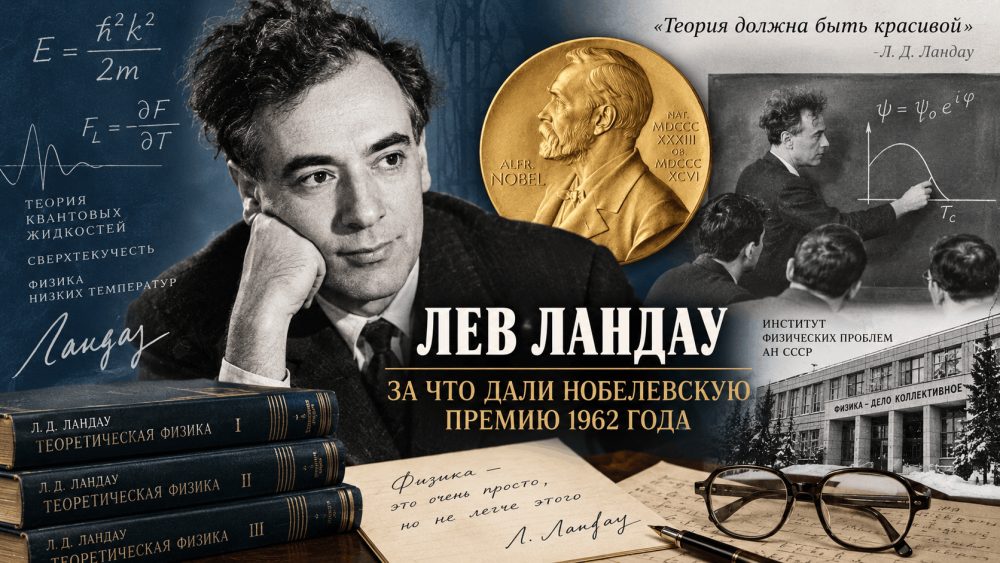
His story complements that of another Soviet theorist, Lev Landau. In each case, the scientific contribution involved a way to describe problems and derive conclusions that could be examined. Their subjects were different: quantum liquids for Landau and choices under resource constraints for Kantorovich.
Sources
- Nobel Foundation: Leonid Kantorovich, biographical facts and the 1975 award.
- Leonid Kantorovich's Nobel autobiography.
- Royal Swedish Academy of Sciences, prize announcement, October 14, 1975.
- Leonid Kantorovich, Mathematics in Economics: Achievements, Difficulties, Perspectives, lecture of December 11, 1975.