The 1965 Kosygin Reform: Planning, Profit and Enterprise Funds
How did the 1965 Kosygin reform change enterprise incentives? Explore profit, sales, three enterprise funds and the limits of autonomy within Soviet planning.
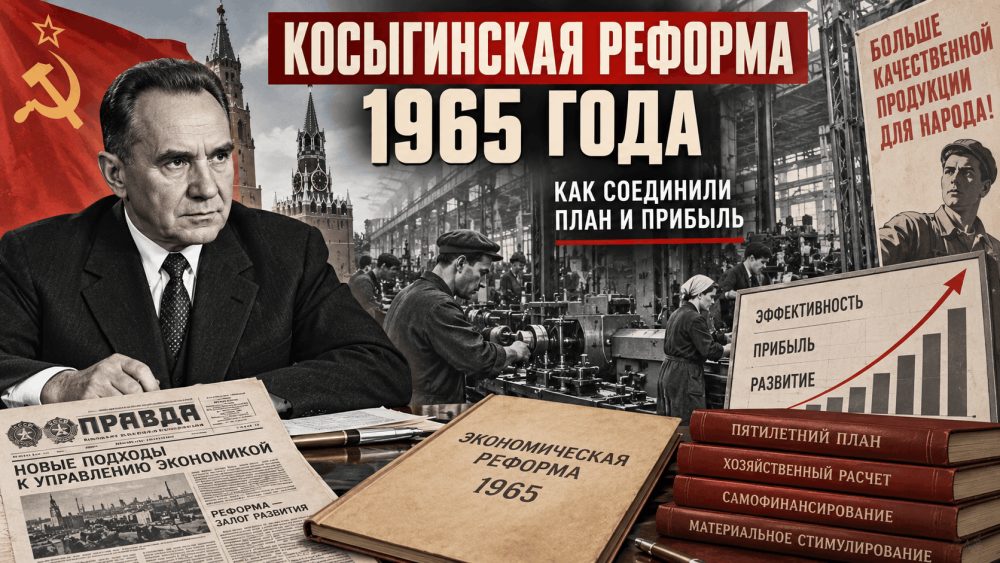
The Kosygin reform of 1965 is often described as an attempt to combine planning with profit. That formulation needs a qualification: profit already existed in Soviet economic accounting. The reform changed the importance attached to it when evaluating enterprises, distributing resources and rewarding employees.
It did not turn a state factory into a private company. Its central concern was incentives within a planned economy. Three questions make the proposal easier to understand: what counted as a successful result, which resources could an enterprise retain, and who set the rules?
The problem identified by the authorities
Resolution No. 729 of the CPSU Central Committee and the USSR Council of Ministers, dated 4 October 1965, criticised existing industrial management quite directly. It pointed to excessive reliance on administrative methods, the emphasis on quantitative targets and unnecessary restrictions on enterprise initiative. Employees, it argued, had insufficient material interest in the enterprise's overall results.
These criticisms matter because they appear in the reform's own official document. They were not solely judgments made later by observers of the Soviet economy. The same resolution nevertheless called for improvements in centralised planning and retained a unified state policy for prices, finance, credit and pay.
The proposal thus concerned the mechanisms of the planned economy, rather than its replacement. The familiar name associates it with Council of Ministers chairman Alexei Kosygin, while the formal decisions were issued by party and government bodies.
Why producing more was not enough
Imagine a hypothetical factory increasing its output while leaving some of the goods without a useful destination. Its physical production total might suggest success. Its ability to meet required deliveries and cover costs could tell a different story. This is an illustrative example, not a claim about a particular Soviet plant.
The resolution proposed evaluating enterprises through realised output, profit and profitability, while retaining obligations for important categories of deliveries. The reform therefore did not amount to a rule that selling anything at all would satisfy every requirement.
Realised output connected production with its sale rather than its manufacture alone. But the purchaser could be another state enterprise, with prices and supply relationships still regulated. The presence of a sale did not automatically imply a freely competitive consumer market.
This distinction is important when translating Soviet economic terminology. A familiar commercial word can describe an activity taking place within a very different institutional setting.
Profit and profitability measured different things
Profit is a monetary result derived from the relevant income and costs. Profitability relates a result to a specified base. Depending on the measure, that base may involve costs or productive resources. An absolute sum and a ratio should not be treated as interchangeable.
Two hypothetical enterprises could earn the same profit while using very different amounts of equipment and working capital. Equal monetary results would not then establish equal returns on resources. A historical comparison must identify the method of calculation before ranking the figures.
In a regulated economy, recorded results also depended on administered prices and accounting rules. A rise in monetary profit does not by itself establish a matching rise in physical output or product quality. Resolution No. 729 included a separate section on wholesale prices, recognising pricing as part of the problem.
The three enterprise funds
The resolution provided for three funds drawn from profit and other resources available to the enterprise: a material incentive fund, a fund for social and cultural measures and housing construction, and a production development fund.
They had different purposes. The first supported bonuses, annual rewards and assistance to employees. The second concerned housing and social facilities. The third financed technical improvements, modernisation and related production measures.
Saying that part of the profit remained with the factory therefore does not mean that management could spend it without restrictions. Rules governed the creation and use of each fund. At the same time, unused balances were to carry over to the following year, rather than disappear at the end of a reporting period.
That carryover mattered to the proposed incentive. If an improvement produced resources that could support future development, its value to the enterprise extended beyond an immediate accounting result.
The connection between collective performance and individual payments also adds context to Soviet wages and prices. A basic pay rate, personal output and a reward tied to the enterprise's results represented different elements of an employee's income.
The limits of enterprise independence
Resolution No. 731, adopted on the same day, approved regulations for the socialist state production enterprise. They combined economic initiative with direction by a superior body. The enterprise operated with state property, maintained its own balance sheet and had legal personality.
This defined it as a participant in economic relations without making it the private owner of the factory. Managing property within prescribed limits is different from an unrestricted right to dispose of the enterprise or change its purpose.
Comparisons with the New Economic Policy consequently require care. Both episodes involved discussion of economic incentives, but they operated under different institutional conditions and arrangements for private activity. A shared interest in incentives does not make the two programmes identical.
Contracts still operated within planning
Resolution No. 729 sought a greater role for contracts between producers and customers, together with financial responsibility for failures to fulfil obligations. Its provisions explicitly included goods subject to central allocation. Contractual relationships were intended to function within that supply system.
The arrangement raises a practical issue: a fund containing money is not the same as an available machine, a stock of building materials or a contractor ready to undertake work. Modernising a workshop requires financial and physical resources together.
The later Resolution No. 774 of 10 August 1967 addressed this relationship. It required calculations of enterprise funds and the resources needed to use them, and refined arrangements for bringing enterprises into the new system.
The reform was therefore a process of implementation and adjustment. It should not be imagined as an instantaneous switch affecting every factory on 4 October 1965. The existence of a later implementing decision is itself evidence that further coordination and rules were required.
What the documents can establish about results
The resolutions identify objectives, measures and authorised actions. They cannot, on their own, establish that every subsequent increase in production was caused by the reform. Assessing its effects requires comparable evidence across enterprises, industries and periods, including attention to changes in prices and other conditions.
Likewise, explaining its fate with a single word such as sabotage avoids the institutional questions. The rules had to combine employee incentives, mandatory deliveries, pricing and resource allocation. These problems interacted and involved several levels of administration.
The later period of perestroika returned to questions of enterprise autonomy. Its legislation should not be read backwards into 1965. This is especially important when using electronic legal collections, which may present an older resolution together with amendments from the 1970s and 1980s.
Reading the sources with the date in view
First establish whether a source is an original act, a later consolidated version or a report on implementation. The electronic texts of Resolutions Nos. 729 and 731 listed below identify subsequent amendments. This article uses their general provisions on the reform's aims, enterprise funds and state-enterprise structure; it does not present later amendments as new decisions taken in October 1965.
The bibliographic record of the resolution in a collection published in 1968 offers another route into the documentary history. A catalogue record confirms the identity and publication of an item, but should not be confused with having examined every page of the collection.
The central interest of the Kosygin reform lies in its attempt to influence enterprise behaviour through evaluation and resource distribution. It illustrates how profit could operate without a private owner, and how greater initiative could remain tied to mandatory planning. That combination is more historically precise than a story about the sudden arrival of a market economy.
Sources
- Resolution No. 729 of 4 October 1965, a consolidated text with subsequent amendments, covering objectives and incentives.
- State production enterprise regulations, Resolution No. 731, with later amendments, for property, management and enterprise autonomy.
- Resolution No. 774 of 10 August 1967, for further implementation and adjustments.
- Electronic Library of Historical Documents: the 1965 resolution, its bibliographic record in a collection published in 1968.
The cover is an original diagram of the three enterprise funds, not a reproduction of a historical poster.