Nikolai Vavilov: Why Crop Diversity Was Worth Collecting
Explore Nikolai Vavilov’s work on crop diversity, the purpose of seed collections, his imprisonment and how historical samples support modern research.
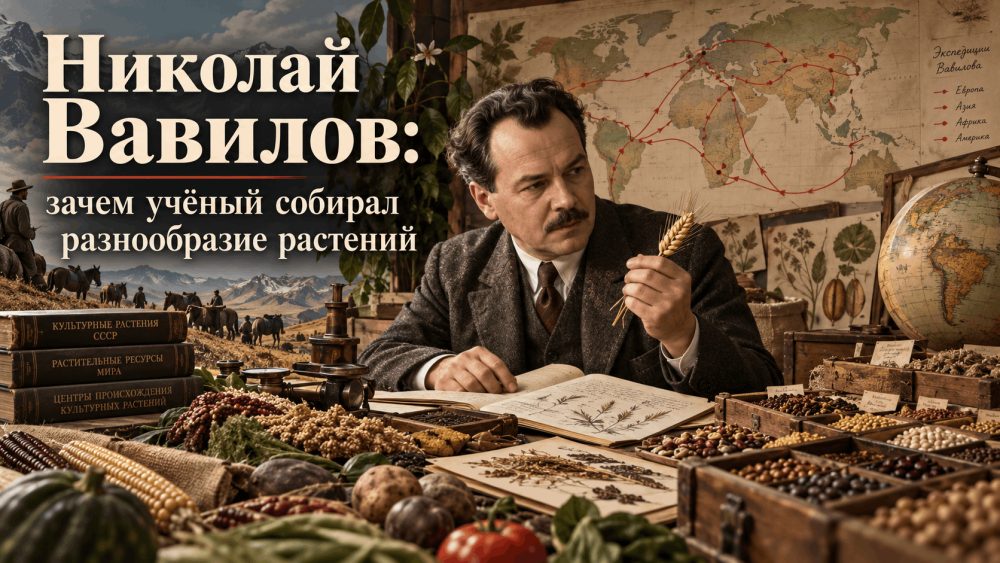
A packet of seeds may look like a supply for the next growing season. For Nikolai Vavilov, it could also be material for comparison: where a plant was grown, how it differed from related forms and which characteristics it carried. His work helped make the diversity of cultivated plants a central object of agricultural research.
More than a famous name
Born in 1887, Nikolai Ivanovich Vavilov worked across botany, genetics, crop science and geography. His scientific contributions included studies of plant immunity, the law of homologous series in hereditary variation and investigations into the origins of cultivated plants. In 1920 he became head of the Bureau of Applied Botany, continuing the work of an existing institution.
That continuity is important. The collection did not result from a single journey, and the institute cannot be reduced to its director's biography. Collecting expeditions, identification, growing trials and publications required many people's work. Vavilov combined investigation with the organisation needed to support it.
A useful account therefore asks two questions together: what did the scientist seek to understand, and what kind of institution made that research possible? The second question explains why the work could continue beyond an individual expedition or career.
What was worth collecting?
Cultivated plants, their different forms and their wild relatives offered material for research. An accession's scientific value was not determined only by a large grain or an attractive fruit. Characteristics that were less immediately visible could matter to the study of inheritance and crop improvement.
Consider two samples of the same crop. One may appear more productive under favourable conditions, while another may be interesting for a different trait. Keeping only the first reduces the range available for future comparison. A collector preserving research material is therefore making a different choice from a buyer selecting the best-looking harvest today.
Information about where a sample came from is part of its value. Without that record, it becomes harder to connect the plant's characteristics with the history of its cultivation. Seeds and provenance data work together as a scientific source. Losing a label can mean losing information even when the physical sample survives.
This is one reason a seed collection is more than a store of food. It preserves distinctions which would disappear if everything were mixed into a single bulk supply.
Diversity has a geography
Vavilov investigated patterns in the distribution of crop diversity. His work on centres of origin connected field botany to questions about the long history of agriculture. It offered a framework for deciding where to look for informative material.
Origin and diversity should not, however, be treated as automatically interchangeable. A 2017 study of historical chickpea accessions distinguishes Turkey, associated with primary origin, from Ethiopia as an important area of secondary diversification. A rich range of forms in a particular place still needs a historical explanation.
The durable lesson for readers is a method of investigation rather than a map to memorise as a final answer. Crops travel with people, and farmers select plants under different conditions. A preserved collection allows researchers to revisit earlier questions with additional evidence and new methods.
A collection needs continuing care
A herbarium specimen and living seed material serve different purposes. If an investigator needs to grow a plant again and compare its characteristics, viable material is necessary. Long-term conservation is consequently more demanding than putting packets on a shelf.
The Germplasm Resources Unit at the John Innes Centre offers a present-day example. Its description includes cool, dry storage, planned regeneration and a database of associated information. These are examples of current practice, not a claim that Vavilov used the same facilities or equipment.
The underlying requirement is straightforward: the material must remain useful for study, and the researcher must know what it represents. Maintaining that relationship takes work between collecting trips and major discoveries. Without it, an impressive inventory can become progressively less informative.
A concrete example from later research
A paper by Elena Plekhanova and colleagues in Scientific Reports demonstrates a specific use of Vavilov's legacy. The researchers examined 147 chickpea accessions from Turkey and Ethiopia, combining genetic information with plant characteristics and records of the material's origins.
The study was not a claim that old seeds alone had solved food insecurity. It investigated associations between genetic variation and observable traits. The authors discussed limitations arising from their sample size and warned that statistical associations could not automatically identify causal relationships.
That precision is valuable. Historical material becomes the basis of a new experiment; the resulting interpretation then requires further testing. There is substantial scientific work between a conserved accession and a useful new variety.
The example also shows why preservation and research are complementary. Without the material there is nothing to grow or analyse. Without analysis, potentially informative differences remain poorly understood.
Arrest and the collection's survival
Vavilov was arrested in 1940 and died in imprisonment in Saratov in 1943. The memorial office at the institute preserves documentation of his imprisonment and subsequent rehabilitation. His fate is inseparable from the history of Soviet political repression.
His personal fate must also be distinguished from the collection's survival during the siege of Leningrad. Institute staff preserved it while Vavilov was in prison. He should not be described as personally guarding the seeds during the siege, and the people who continued that work should not disappear behind his name.
The history brings scientific cooperation and state violence into the same account. Recognising the value of the collection does not excuse repression. Equally, explaining the repression should not obscure the substance of the research that was interrupted.
What the legacy means in practice
Vavilov's work poses a simple question: what opportunities disappear when only what is most useful today is retained? In crop science, that question concerns the material available to future investigators.
A collection's value is not adequately described by a large total in a publicity statement. It becomes meaningful when samples remain usable, their origins are documented and they support research. Through that continuing work, an expedition from the past can contribute to an experiment in the present.
Related reading
- Collective farms and Soviet agriculture
- The Virgin Lands campaign
- The Gulag and forced labour
- The siege of Leningrad
Sources
- VIR: Vavilov's biography and scientific work, in Russian
- VIR: the memorial office and documents about his life
- Plekhanova et al.: Genomic and phenotypic analysis of Vavilov's historic landraces, 2017
- John Innes Centre: Germplasm Resources Unit
- Russian Academy of Sciences Archive: biography and imprisonment