The Virgin Lands: a steppe plowed in a single summer
A territory the size of several European countries, raised by the plow in a handful of years. A record harvest that turned into dust storms, and grain that was literally blown away by the wind. The story of Khrushchev's great gamble and what it did to the steppe.
What the Virgin Lands were
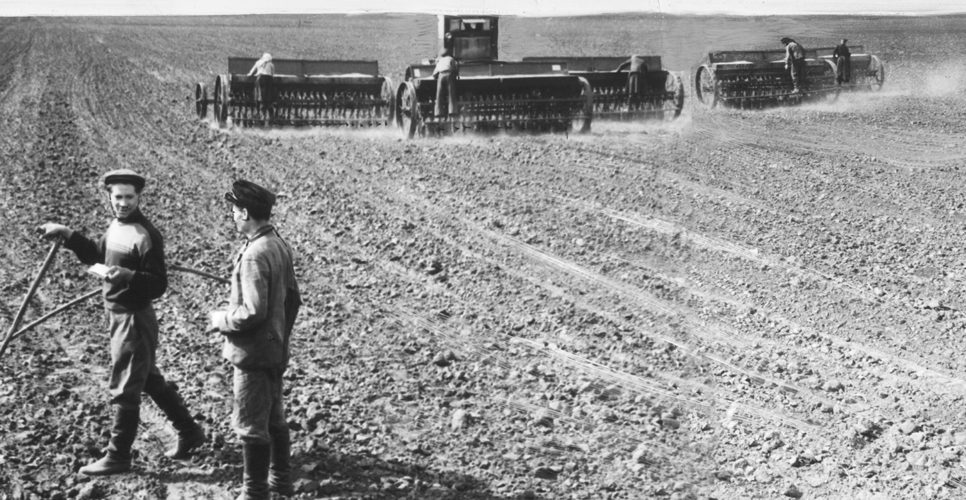
The Virgin Lands campaign (from "virgin and fallow lands") was the vast drive to plow up never-cultivated steppe launched in the USSR from 1954. In a few years the plow raised about 25 million hectares of untouched land in Kazakhstan, western Siberia, the Volga region and the Urals, an area comparable to several European countries at once. It was Khrushchev's first major reform and his most visible: the country was solving the eternal problem of bread not by improving what it had but by seizing new space.
The campaign's verdict is double, like almost everything in Soviet history, and both assessments are alive to this day. Some remember record harvests, tents on the steppe and youth on a great project. Others remember dust storms, blown-away black earth and grain that within ten years had to be bought abroad. We present both sides, because both are documentary fact.
Khrushchev's gamble
By the mid-1950s the country could not feed itself. The collective-farm village produced little, the cities were growing, and the memory of the postwar famine of 1946 and 1947 was fresh. Khrushchev, newly in power, sought a quick answer, and found it not in reforming the kolkhozes, which would have taken time and concessions, but in geography. In September 1953 he proposed plowing up the empty steppes of the east: sow grain across an area the size of a whole country, and the harvest would solve the problem at a stroke.
The calculation was extensive in the pure sense: not higher yield per hectare but more hectares. In February and March 1954 the Central Committee plenum approved the program, and the machine spun into motion at unheard-of speed. Economically and agronomically the project was barely worked out: there was neither time nor desire for preparation. Khrushchev presented the Virgin Lands as a return to the Leninist spirit, a mass impulse in place of Stalinist caution, and that was part of the design: the reform was meant to thunder.
A landing party to the east
The Virgin Lands were raised by people, and that is their brightest page. The Komsomol declared the land drive an all-Union shock task, and young people rode east by the trainload, by call-up, by assignment, by the pull of romance and earnings. In the first couple of years alone, hundreds of thousands of volunteers arrived, and millions took part in all. Machine operators and agronomists came, school-leavers and demobilized soldiers; cinema sang the Virgin Lands epic, songs were written about it, and it earned medals of its own, including "For the Development of the Virgin Lands."
Daily life was harsh and little like the poster. The first settlers lived in tents and trailers in the middle of bare steppe, wintered in dugouts, and worked without roads, machinery or spare parts, in dust and wind. Kazakhstan turned from a periphery into the country's chief grain workshop, and its population and ethnic composition changed forever: the incoming Slavic settlers largely redefined the republic's demography. Romance and disorder stood side by side here, as always on the great Soviet projects.
The record of 1956 and the price of the soil
The very first full-scale season tested the program's strength. The 1955 harvest came out meager, and the party leadership began speaking of a failed gamble. But 1956 overturned everything: the country gathered about 125 million tons of grain, the largest harvest in Soviet history to that point, and more than half came from the new lands. Khrushchev's gamble seemed brilliantly vindicated.
Then came the problems built into the very haste. The steppe was plowed frontally, without crop rotation, without shelter belts, without anti-erosion measures: wheat was sown year after year on the same ground. The dry continental climate and the wind finished the job. By the early 1960s a catastrophe broke out that historians call outright the "Soviet Dust Bowl," by analogy with the American one: the fertile topsoil rose into the air by the millions of tons and blew away. Yields fell, the land degraded, and part of the plowed area simply had to be abandoned. Soviet specialists later borrowed anti-erosion experience from the Canadians, the very people from whom they had lately been buying grain.
The forgotten builders of the Virgin Lands
Virgin Lands romance has a dark line the Soviet showcase did not display, and which we are obliged to. Alongside the volunteers and the native Kazakhs, the land was raised by deported peoples who found themselves in Kazakhstan against their will. According to historians, the Virgin Lands were worked by Chechens and Ingush, Kalmyks, Crimean Tatars, Volga Germans and others: people expelled from their home regions before or during the war and living as special settlers, many under supervision, close to the system of the Gulag. A campaign that propaganda painted as a festival of free labor rested in large part on the labor of the unfree. Both realities existed at once, and an honest account of the Virgin Lands includes the second alongside the first.
The verdict: grain that blew away
The economic judgment on the Virgin Lands was passed by the same countryside for whose sake it had all begun. The surge of the early years did not become durable: harvests swung from record to failure at the whim of the steppe weather, and soil degradation ate the gains. From the early 1960s the country with the world's largest black-earth belt began regularly buying grain abroad, and that dependence, paid for later with oil, stayed with the USSR to the end. The failed harvest of 1963, when the Virgin Lands choked in dust, was one of the blows that cost Khrushchev his power.
And yet the Virgin Lands cannot be subtracted from history. Kazakhstan did become one of the world's largest exporters of quality wheat, and that legacy of the Virgin Lands plowing works to this day. Millions of people lived their best years on the Virgin Lands and remember them without irony. The verdict is honest precisely in its doubleness: the Virgin Lands fed the country for one record year and undermined the steppe for decades, gave Kazakhstan a grain base and took from it its untouched steppe. Like the whole Khrushchev era, it was an impulse in which daring and recklessness turned out to be the same motion.
Frequently asked questions
What was the Virgin Lands campaign, in simple terms? The mass plowing of never-cultivated steppe in Kazakhstan, Siberia, the Volga region and the Urals, begun in 1954 under Khrushchev to raise grain output quickly. In a few years about 25 million hectares were raised.
Who launched the campaign and why? Nikita Khrushchev, in 1954, as a fast way to solve the country's bread problem through new land rather than reform of the collective farms. The motives were both food and the political effect of a loud reform.
Was the project a success? Partly. The 1956 harvest was the largest in Soviet history, but plowing without crop rotation or soil protection then caused erosion and dust storms, and part of the land degraded. From the early 1960s the country again bought grain abroad.
What was the "Soviet Dust Bowl"? The term historians use for the ecological catastrophe of the early 1960s: frontal plowing of dry steppe without anti-erosion measures sent the fertile topsoil into the air by the millions of tons, by analogy with the American Dust Bowl.
Who worked on the Virgin Lands? Hundreds of thousands of Komsomol volunteers and settlers, the native Kazakhs, and also deported peoples (Chechens, Ingush, Kalmyks, Crimean Tatars, Volga Germans) living in Kazakhstan as special settlers.
How are the Virgin Lands connected to Khrushchev's fall? The failed 1963 harvest, when the Virgin Lands choked in erosion and the country had to buy grain in an emergency, was one of the causes of the collapse of trust in Khrushchev and his removal in 1964.
Related
- Nikita Khrushchev: the author of the Virgin Lands gamble.
- The Komsomol: the force that raised the steppe on an all-Union call.
- The kolkhoz: the village whose reform the Virgin Lands replaced with plowing.
- The oil needle: what the grain imports were later paid for with.
Sources
The facts in this article can be verified against authoritative sources:
- Seventeen Moments in Soviet History (Michigan State University), "Virgin Lands Campaign": https://soviethistory.msu.edu/1954/virgin-lands-campaign/
- Encyclopaedia Britannica, "Virgin and Idle Lands Program": https://www.britannica.com/topic/Virgin-and-Idle-Lands-Program
- Gale Academic OneFile, Marc Elie, "The Soviet Dust Bowl and the Canadian erosion experience in the New Lands of Kazakhstan, 1950s-1960s": https://go.gale.com/ps/i.do?id=GALE%7CA432765291&p=AONE&sw=w
- ResearchGate, "Environmental consequences of Khrushchev's Virgin Land Campaign in Kazakhstan (1950s-1960s)": https://www.researchgate.net/publication/351742239_Environmental_consequences_of_Khrushchev's_Virgin_Land_Campaign_in_Kazakhstan_1950s-1960s
- Wikipedia, "Virgin Lands campaign": https://en.wikipedia.org/wiki/Virgin_Lands_campaign
Where assessments diverge (the campaign's success against its ecological price), we present both sides with their arguments.