Nelli Kim: Five Olympic Golds and the Scores Behind Them
How Nelli Kim won five Olympic golds: Montreal and Moscow results, perfect marks, cumulative scores and her shared floor title with Nadia Comaneci.
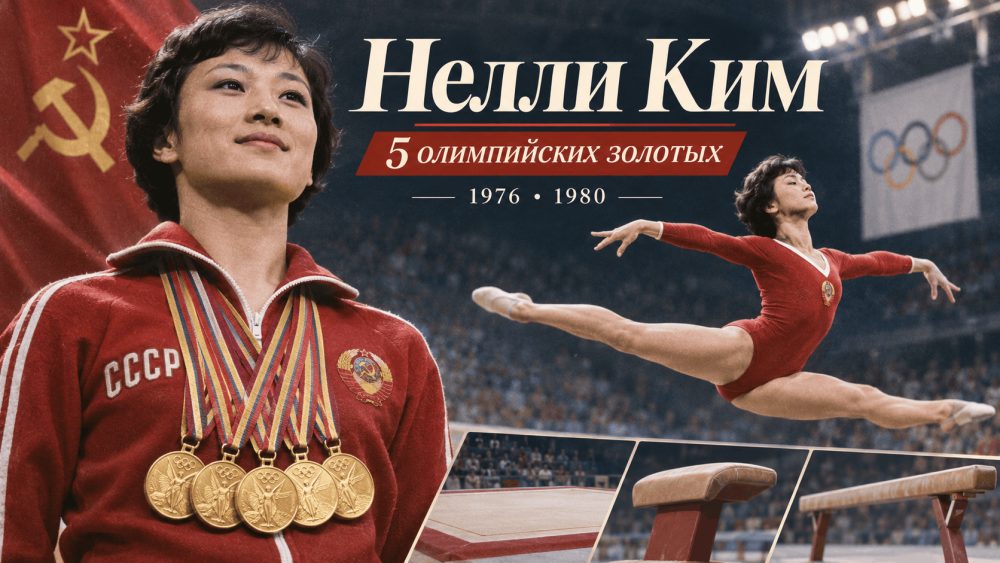
Nelli Kim won five Olympic gold medals across Montreal in 1976 and Moscow in 1980. Three came at her first Games and two at her second. Yet the familiar total conceals several distinctions: two golds were team medals, three were individual titles, and her last individual victory was shared with Nadia Comaneci.
The competition records also need careful reading. An apparatus final total of 19.850 was not the mark awarded to a single routine on a ten-point scale. Carried-over qualification scores contributed to the final standings.
Four medals in Montreal
In 1976, Kim won the team competition, vault and floor exercise. She also took silver in the individual all-around. Her Montreal collection therefore comprised four medals, not simply the three golds usually highlighted.
The all-around final took place on 21 July. Comaneci won with 79.275, Kim scored 78.675 and Ludmilla Turishcheva finished with 78.625. Kim's margin over her Soviet teammate was just 0.050, compared with a 0.600 gap to the champion.
Those figures describe different contests within the same event: the silver-medal margin was much narrower than the gap between first and second. They also represent an all-around total, which should not be treated as a judgement of one isolated performance.
A perfect ten is not the same as a final total
Kim received 10.00 for vault during the all-around. Naming the stage matters. That performance on 21 July should not be conflated with the separate apparatus final held the next day.
On 22 July, she won the vault final with a total of 19.800. Turishcheva and Carola Dombeck shared silver on 19.650. The winning margin in that final was consequently 0.150.
A compressed account can easily merge the perfect mark, the apparatus title and the cumulative score into one event. All belong to Kim's Montreal story, but they are different pieces of it. The event name, competition stage and kind of score are necessary to identify a result correctly.
Why the floor title came down to 0.025
The floor final, also held on 22 July, provides a clear example of the scoring calculation. Kim's qualification total was 19.70. Half of it, 9.850, carried forward. She then received 10.00 in the final, producing an overall 19.850.
Turishcheva carried a stronger 9.925 into the final but scored 9.90 for that performance. Her resulting 19.825 earned silver. Comaneci took bronze with 19.750.
Kim's winning margin was therefore 0.025. The final routine was decisive, but the standings cannot be explained by looking at it alone: the earlier component remained part of the calculation. Nor can a cumulative score near twenty be read as if the judges had abandoned a ten-point scale.
This is why the score columns matter as much as the medal column when reconstructing a close result. The same table records a starting position, a subsequent performance and the total used to award places.
Moscow and a shared championship
Kim won team and floor gold again in 1980. The Moscow floor final took place on 25 July and ended with identical winning totals: 19.875 for Kim and Comaneci. Both were Olympic champions.
Each received 9.95 in the final and had a qualification total of 19.85, half of which carried into the deciding score. Nataliya Shaposhnikova and Maxi Gnauck shared bronze on 19.825. No silver medal was awarded in that distribution of places.
Saying that Kim won the Moscow floor title is correct. Saying that she was its sole winner is not. Including Comaneci preserves an essential feature of the result rather than adding a minor footnote.
Reading the five-gold total
Kim's complete Olympic medal tally was five golds and one silver. The team golds came in 1976 and 1980; her individual titles were vault in 1976 and floor at both Games.
This breakdown distinguishes repeated success in one discipline from the team contribution and from her all-around silver. It also explains why a famous perfect score cannot stand in for the entire Olympic record. A routine mark, an apparatus total and a medal count answer different questions. Keeping them separate makes the achievement easier to understand without diminishing it.