Zhores Alferov: Heterostructures, Laboratory Work and the Nobel Prize
How Zhores Alferov’s work advanced practical semiconductor lasers, what a double heterostructure does and what the 2000 Nobel Prize recognized.
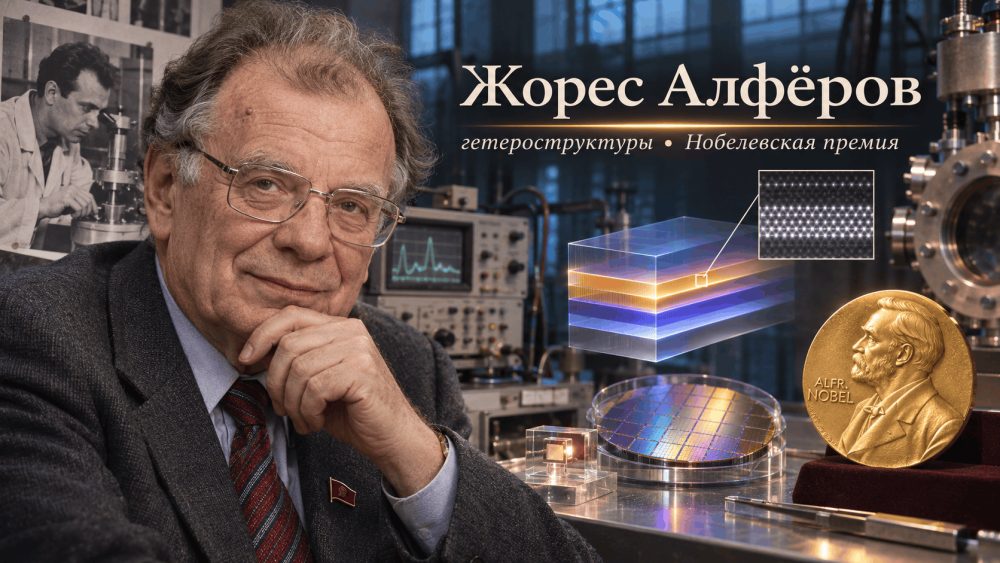
Zhores Alferov received the 2000 Nobel Prize in Physics for developing semiconductor heterostructures for fast electronics and devices that interact with light. The award recognized work whose central stages belonged to the Soviet period. Understanding the achievement begins with the layers inside a device rather than a list of honours.
From engineering education to the laboratory
The Franklin Institute's biographical entry records Alferov's birth in Vitebsk in 1930, graduation from the Leningrad Electrotechnical Institute in 1952 and arrival at the Ioffe Institute in 1953. In 1971, the Franklin Institute awarded him its Ballantine Medal for the double-heterostructure injection laser. International recognition of that result therefore preceded the Nobel Prize by decades.
Why combine different semiconductors?
A heterostructure combines layers of different semiconductors. Choosing their properties makes it possible to control the behaviour of charge carriers. In a double structure, an active region lies between two other layers. Suitable boundaries help confine both carriers and light within it. This describes the principle, rather than providing a complete device design.
The Nobel scientific review traces the double-heterostructure laser proposal to 1963: Herbert Kroemer and, independently, Alferov with Rudolf Kazarinov developed the idea. A proposal and a working device were different achievements, with substantial experimental work between them.
The significance of 1970
The Kyoto Prize account highlights continuous operation of semiconductor lasers at room temperature in 1970. Alferov's Soviet group and the American researchers Izuo Hayashi and Morton Panish reached this milestone at almost the same time.
Their structure placed an active gallium arsenide layer, GaAs, between AlGaAs layers. This double heterostructure reduced the threshold current density needed for lasing. The achievement was consequently more than producing light in an experiment: sustained operation helped open a route towards practical devices. The 2001 Kyoto Prize recognized all three researchers.
Beyond one laboratory device
The Nobel Prize's popular account connects heterostructures with fibre-optic communications, optical-disc reading and light-emitting diodes. It also emphasizes their value for fundamental research on systems in which electron motion is confined.
A scientific principle, a particular component and a complete communications system occupy different levels of technological development. Many specialists contribute between those levels. Describing Alferov as a creator of an important technological foundation is more accurate than crediting him with the invention of every product using such structures.
This distinction does not diminish the original result. It explains why a development inside a semiconductor can matter far beyond the laboratory that produced it, without turning later engineering work into an automatic consequence of one person's idea.
The award and the scientist's own account
In 2000, Alferov and Kroemer shared one half of the Physics Prize. Jack Kilby received the other half for his contribution to the integrated circuit. These were distinct achievements within the wider field of information technology.
In the interview published by the Nobel organization, Alferov described himself primarily as an experimentalist whose proposals became devices through the work of a growing team. He recalled competition with Bell Laboratories alongside reciprocal visits and shared seminars during the Cold War. His recollection is a participant's account, not proof that political barriers to scientific exchange were absent.
The history brings together a useful concept and the ability to manufacture the material it required. The cover shows the simplified sequence AlGaAs / GaAs / AlGaAs. It illustrates the active layer's position without claiming to reproduce a particular historical device to scale.
Related articles
- Basov, Prokhorov and quantum electronics
- The Cherenkov effect
- Lev Landau and quantum liquids
- Pyotr Kapitsa and superfluidity