The Cherenkov Effect and the 1958 Nobel Prize: Light, Speed and Detectors
Why Cherenkov, Frank and Tamm won the Nobel Prize: the radiation threshold, light cone and why particles do not exceed the speed of light in a vacuum.
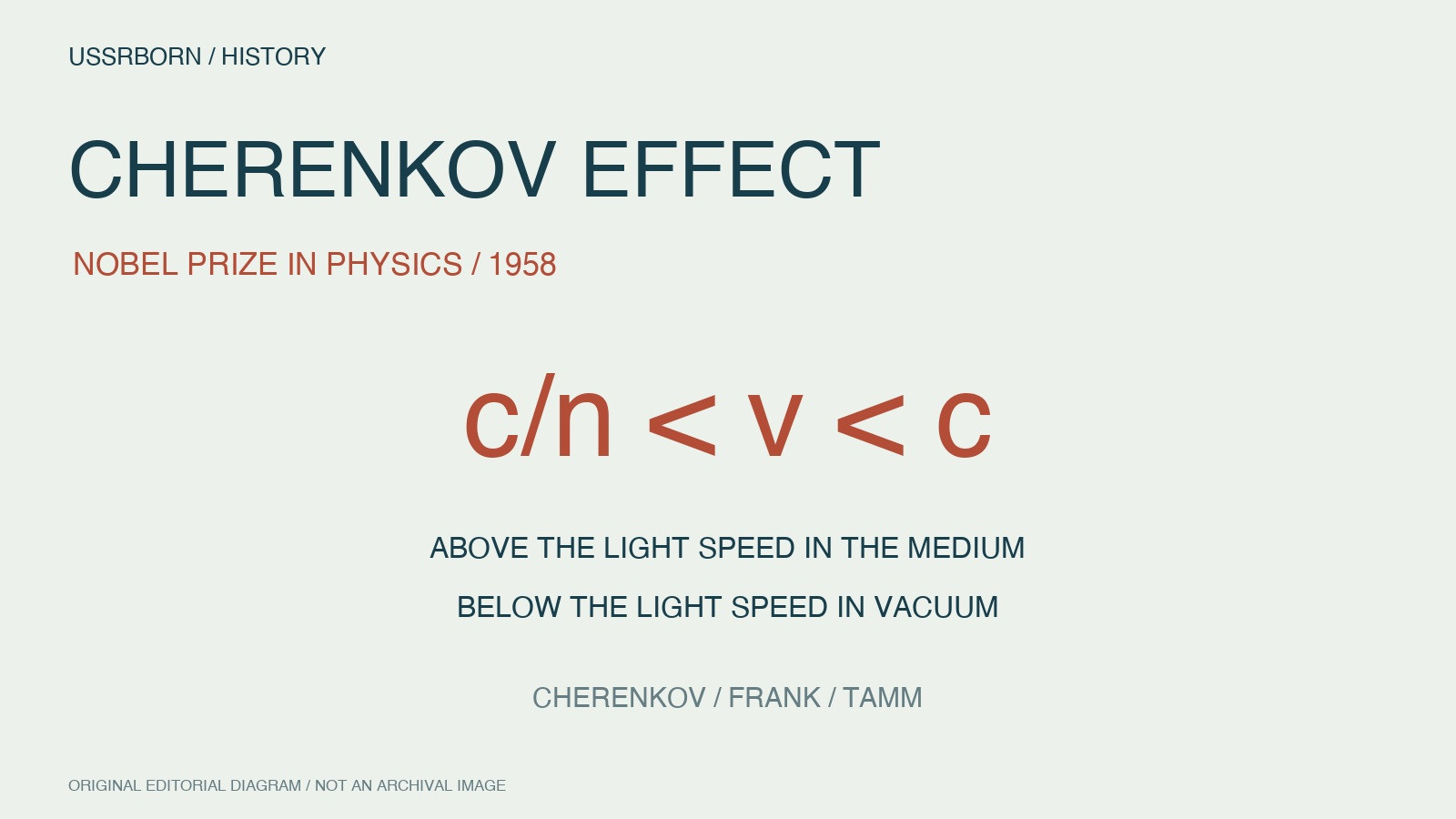
Pavel Cherenkov, Ilya Frank and Igor Tamm shared the 1958 Nobel Prize in Physics for discovering and explaining the Cherenkov effect. Each received one third of the prize. The phenomenon is easy to describe misleadingly: a fast charged particle can outrun light in a material, but that does not mean it travels faster than light in a vacuum.
Observation, explanation and recognition
The Nobel archive dates Cherenkov's discovery to 1934 and the theoretical explanation by Frank and Tamm to 1937. At the time of the award, Cherenkov was affiliated with the P. N. Lebedev Physical Institute in Moscow. These dates distinguish the observation, the theory and the later prize; the award did not recognize a single experiment performed in 1958.
The presentation speech describes Cherenkov's work under Sergei Vavilov. Studying irradiated liquids, he investigated whether their faint light could be explained as ordinary fluorescence. Observations in carefully purified water helped test the suggestion that fluorescent impurities were responsible. Systematic experiments isolated a distinct phenomenon and connected it with fast electrons.
The achievement was consequently more than noticing an attractive color. The experimental problem was to establish the conditions producing the light and to test explanations that initially appeared plausible. This is why the award's scope joined discovery with interpretation.
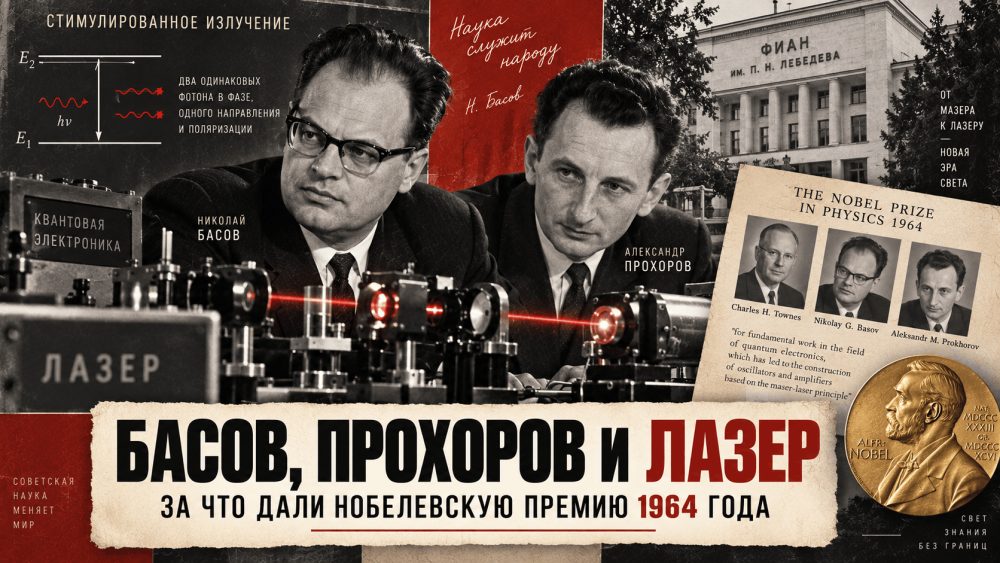
The story complements that of Basov, Prokhorov and quantum electronics, but the mechanisms must remain distinct. Cherenkov radiation is not the name of a type of laser. Placing both in the history of Soviet physics does not make them the same optical process.
Faster than light in a material
The speed of light in a vacuum is denoted by c. In a transparent medium, the phase velocity of light at a specified wavelength can be lower, expressed as c/n, where n is the refractive index. Cherenkov emission requires a charged particle to exceed that speed in the medium.
The compact threshold condition is v > c/n. A massive particle still has v < c. There is no contradiction because the two comparisons involve different quantities: the vacuum speed and the phase velocity in a particular material.
Consider a hypothetical medium with n = 1.5 over the spectral range being discussed. Its threshold is approximately 0.667c. A charged particle moving at 0.8c can exceed that threshold while remaining slower than c. A particle moving at 0.6c would be below threshold for the same refractive index. These are calculated examples, not specifications of Cherenkov's historical apparatus.
The spectral qualification should be retained. Refractive index depends on wavelength, so a real material cannot always be represented by one number across every color. The simplified example isolates the relationship between the speeds without claiming to describe all details of a detector material.
Why the radiation forms a cone
Cherenkov photons are emitted in directions forming a cone around the particle's path. The standard relationship for the angle theta between the particle direction and the emitted light is cos(theta) = 1/(n beta), with beta = v/c. The Geant4 Physics Reference Manual gives this relation.
For the example above, n = 1.5 and beta = 0.8 give cos(theta) approximately 0.833, corresponding to an angle of about 34 degrees. As the particle approaches the threshold from above, the angle decreases. Below threshold, the expression no longer produces a physical Cherenkov cone: its right-hand side would exceed one.
The calculation demonstrates why an explanation matters to an experiment. The light does more than announce that a particle passed through a material. Its geometry connects an observable signal with velocity. However, the radiation cone and a ring registered on a light-sensitive surface are not identical objects: the recorded image also depends on the detector's arrangement.
A useful way to read a detector diagram is therefore to identify the particle's direction, the emitting material and the surface on which light is measured separately. Combining them into one unexplained shape makes it harder to see what the instrument actually determines.
From a phenomenon to a measuring method
Ring Imaging Cherenkov detectors, abbreviated RICH, use the connection between angle and particle velocity. The AMS experiment's detector description identifies two radiator materials, sodium fluoride and aerogel, with different refractive indices. Their threshold velocities consequently differ. Choosing the material is part of the measurement method rather than an incidental construction detail.
If the refractive index is known, measuring the angle helps determine speed. A bright spot alone, however, cannot answer every question about a particle. Geometry, calibration and other experimental information are needed. A recorded image becomes a measurement when its relationship to a physical quantity has been established.
It is also necessary to distinguish the discovery of a phenomenon from the construction of a particular instrument based on it. The 1958 Nobel Prize concerned the effect and its explanation. A contemporary RICH detector should not be presented as an apparatus built in that year by the three laureates.
The historical sequence is especially instructive because it connects experimental discrimination, mathematical interpretation and later measurement practice. Those are related stages, but they are not interchangeable achievements. Understanding the distinction avoids treating the prize as an isolated ceremony detached from the research it recognized.
What blue light does not establish
Blue light is familiar from photographs of water-filled nuclear installations. Color alone does not identify the radiation mechanism, establish the type of reactor or measure a hazard. The defining ingredients of the Cherenkov effect are a charged particle, a medium and the threshold condition, not simply a blue appearance in a photograph.
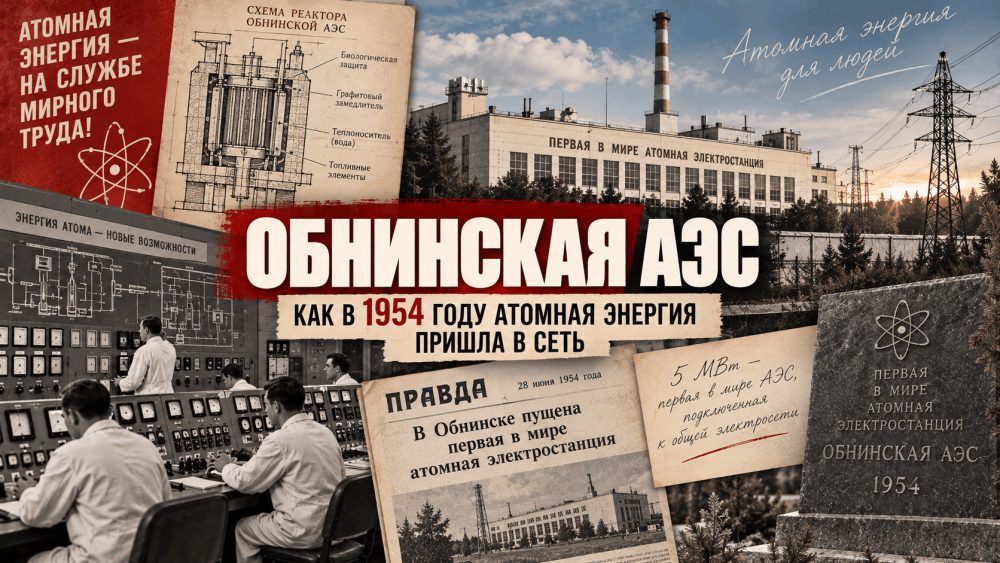
The effect must also be distinguished from a nuclear chain reaction. The history of Obninsk's nuclear power plant concerns a technological application of nuclear energy. This article concerns the light associated with a particle's motion through a medium. A shared setting does not erase that difference.
Other Soviet Nobel-winning research explored very different phenomena, including Lev Landau's work on quantum liquids and Pyotr Kapitsa's investigations of superfluidity. What these histories share is the importance of connecting observations with testable explanations. Their physical mechanisms and experimental methods should still be understood on their own terms.