Luna 24: The 1976 Sample Return and Its Drill Core
How Luna 24 returned about 170 grams of material from Mare Crisium, and why a drilling depth of two metres differs from the length of its recovered core.
On 22 August 1976, Luna 24’s return capsule brought approximately 170 grams of lunar material to Earth. The spacecraft completed its task without a crew: it landed, collected a sample and sent it home. This was the third successful Soviet lunar sample-return mission and the last Soviet expedition to the Moon. Its importance lies in where and how the material was collected, rather than in a record-breaking cargo weight.
The August 1976 journey
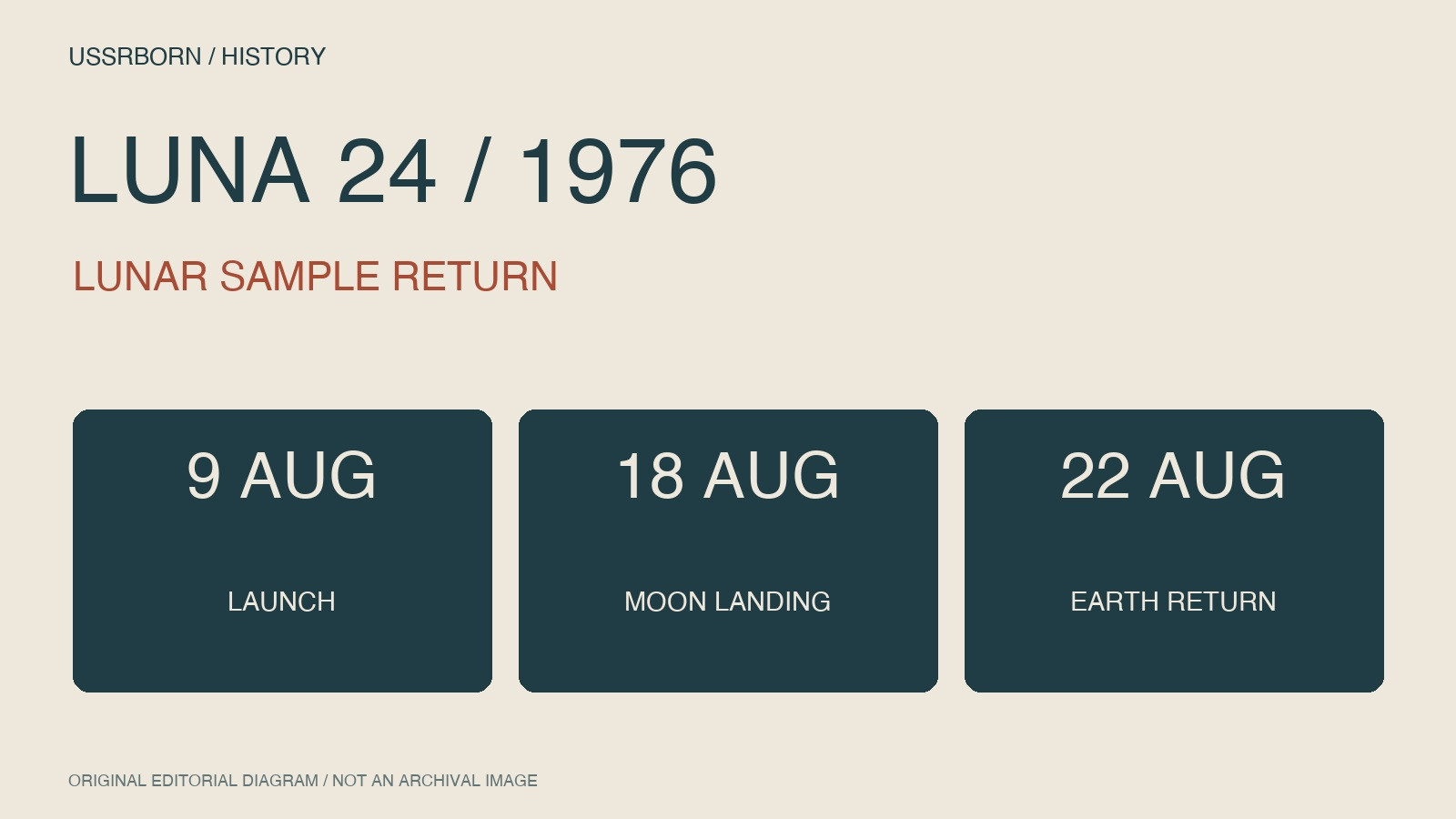
Luna 24 launched from Baikonur on 9 August. It landed in Mare Crisium, the Sea of Crises, on 18 August, and its capsule returned to Earth on 22 August. NASA’s mission register classifies the flight as a successful sample return. The DLR archive separately identifies the landing region, drilling equipment and amount of material recovered.
These dates describe different stages. Reaching the surface successfully does not by itself complete a sample-return mission. After landing, the spacecraft still needs to obtain material, secure it in the returning component and complete the journey back. Describing Luna 24 merely as a soft landing therefore leaves out a central part of its achievement.
The history of Luna 9 provides a useful comparison. Sending information from the surface and delivering physical material to a laboratory are different methods of investigation. One supplies measurements where the spacecraft is operating; the other lets researchers work with the sample itself on Earth.
Why two metres and 160 centimetres are different measurements
The Lunar Sample Compendium distinguishes three quantities: a drill penetration of approximately 225 centimetres along an inclined path, a vertical depth of about 200 centimetres and a returned core approximately 160 centimetres long. A core is a column of material obtained by drilling. The three measurements should not be substituted for one another.
An inclined line is longer than its vertical projection. The distance travelled by a drill and the material actually recovered are also different measures. The statement “it drilled two metres, so it returned a two-metre sample” is therefore unreliable. A number only becomes informative when its measurement is identified.
The cover for this article shows the sequence of the journey. It is not an engineering drawing of the drilling equipment or a reconstruction of the sample’s actual layers.
What a small sample can reveal
The compendium describes basalt fragments with very low titanium content among the Luna 24 material. That is a finding about composition rather than transport weight. The Lunar and Planetary Institute’s catalogue connects lunar samples with descriptions, photographs and scientific publications, and includes the Luna 24 core in its listings.
Consider two questions. The first asks how much material was brought back. The second asks which minerals and fragments it contains and how parts of the sample relate to one another. Weight answers the first question, but cannot settle the second. A small consignment may contain several types of material, while equal masses from two locations need not contain equivalent scientific information.
A single collection point nevertheless does not represent the entire Moon. Findings have to be connected to the landing region and the circumstances of collection. That limitation does not diminish the expedition’s value. It clarifies which questions its evidence can answer.
The catalogue is useful for the same reason. A sample identifier is a route into a documented collection, not just another name for “Moon rock.” It helps readers move from a general mission story to the particular material under discussion.
A continuation of sample return, not its beginning
Luna 16 and Luna 20 had already returned lunar material automatically before Luna 24. The story of Luna 16 explains an earlier stage in that work. The 1976 spacecraft should not be given a first that belongs to its predecessor.
Lunokhod 1 represents another approach to working on the surface. Travelling across terrain and bringing a sample home serve different purposes. Calling both machines robotic does not make their functions interchangeable. The useful questions are what each could observe, collect or transmit.
A broader account of the Soviet space programme places these projects alongside crewed flights. Luna 24 demonstrates why the history of space exploration cannot be reduced to the presence of a person aboard. Its engineering task was to complete a sequence of operations without a crew at the landing site.
What “the last Soviet mission” means
This describes the boundary of the Soviet lunar programme, not the end of humanity’s investigation of the Moon. The country, period and type of mission must remain attached to the statement. Otherwise, a precise historical description becomes a false claim about a worldwide first or the end of lunar science.
The flight ended when the capsule returned, but research was not confined to that date. Preserved material and its documentation can support questions long after a spacecraft stops operating. The connection between an expedition and subsequent laboratory work is what makes sample return a distinct form of space exploration.