Maya Plisetskaya and Carmen Suite: Creating the Role in 1967
How Maya Plisetskaya’s initiative brought together Alberto Alonso, Rodion Shchedrin and Boris Messerer: the music, design and later life of Carmen Suite.
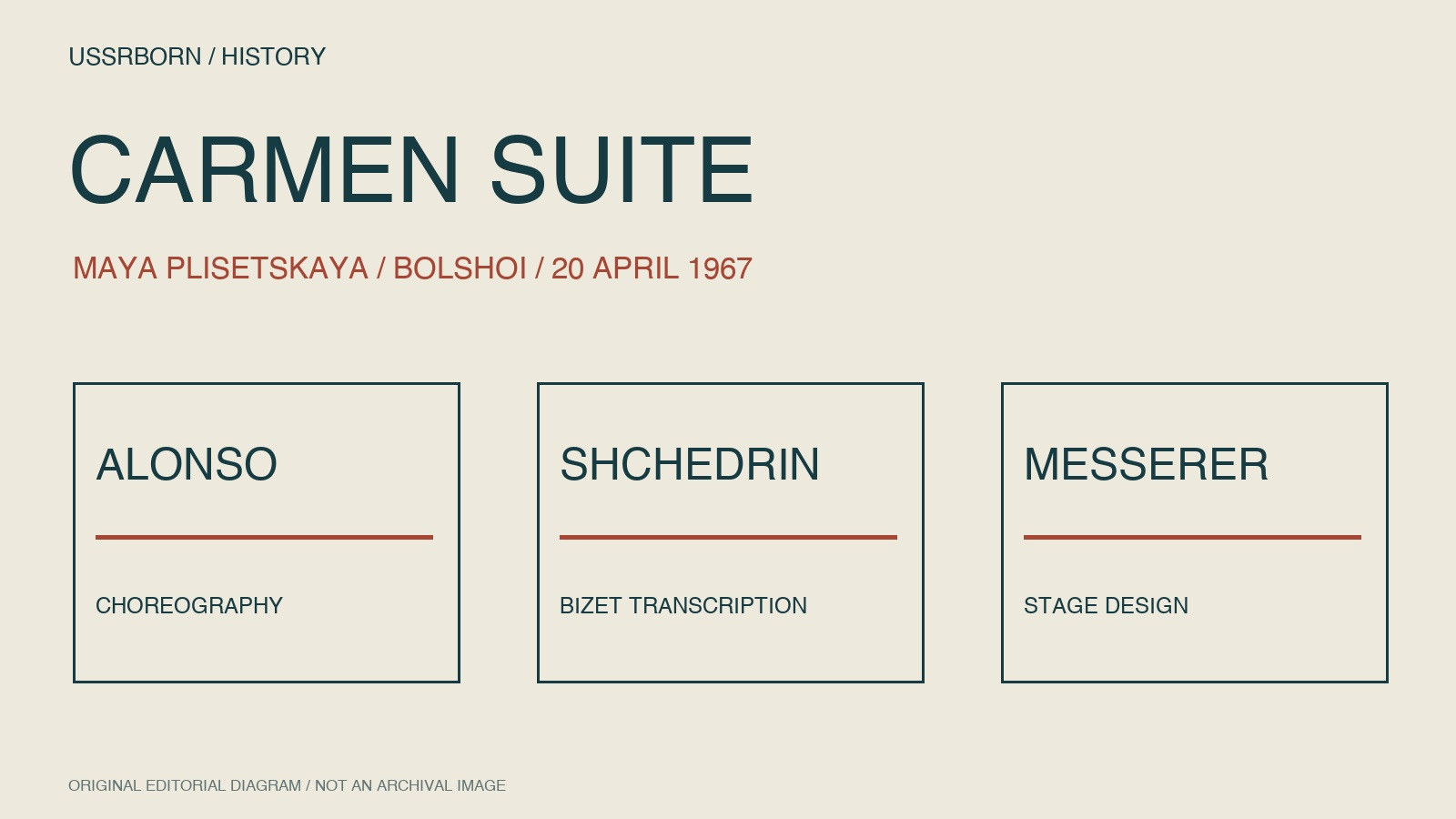
Carmen Suite premiered at Moscow’s Bolshoi Theatre on 20 April 1967 with Maya Plisetskaya. In her career, the production mattered as more than a celebrated role. Plisetskaya helped initiate the project: her wish to dance Carmen brought together Alberto Alonso’s choreography, Rodion Shchedrin’s musical transcription and Boris Messerer’s stage design.
Plisetskaya helped bring the work into being
An account of a ballerina often concentrates on performance: technique, expression and stage presence. Carmen Suite raises another question: how can a performer help a work come into existence? Plisetskaya did not simply receive a role from an established repertory. The ballet was created for her and at her initiative, a point emphasised in the Mariinsky Theatre’s production history.
That does not make her the sole author of everything the audience saw. Her contribution becomes clearer when the different creative tasks are distinguished. She was the project’s central performer and motivating presence; other artists developed the choreography, score and theatrical space.
This is a useful way to read an artistic biography. A performer’s influence is not always measured by the number of works performed. It can also lie in the relationships and commissions that make a particular work possible.
Whose music and choreography is it?
Carmen Suite is a one-act ballet. Georges Bizet supplied the original musical material, while Shchedrin made a transcription for strings and percussion. The publisher Boosey & Hawkes identifies the 1967 work in those terms. Cuban choreographer Alberto Alonso created the choreography, and Boris Messerer designed the scenery.
Calling it simply “music by Bizet” or “music by Shchedrin” leaves out part of that relationship. One name identifies the original material; the other identifies the composer responsible for its new instrumental form. Both credits tell the audience something essential about the work being presented.
The distinction is helpful when approaching Soviet ballet more generally. Composer, choreographer and dancer do not perform the same creative function. Collaboration makes those differences visible within a single performance rather than abolishing them.
Why strings and percussion matter
A ballet has no operatic singers carrying the familiar vocal parts. That creates a separate artistic problem: what happens when the audience hears the music alongside movement rather than sung words?
Shchedrin’s instrumental combination makes the change of medium audible. Strings and percussion provide a different palette from that of an opera orchestra. Yet it would be misleading to understand the transcription merely as an opera with the voices removed. Reworking the instrumentation can reorganise the listener’s attention to material that is already familiar.
A comparison with Prokofiev’s music and his return to the USSR points to the different routes composers took toward the theatre. Carmen Suite represents one specific approach: making a new theatrical work out of existing music. It should not be mistaken for a universal method of composing a ballet score.
A Carmen expressed through movement and space
Writing for the Mariinsky Theatre, musicologist Inna Sklyarevskaya draws attention to the heroine’s unusual movement and interprets the production through the idea of freedom. That is a critical reading, rather than a neutral record of every creator’s intentions.
Belcanto’s account describes Messerer’s setting as an arena surrounded by spectators who also suggest judges. The design invites attention to the public character of the conflict: what happens between individuals unfolds before a watching community. The space contributes to the storytelling alongside the dancers.
Reducing the ballet entirely to a political illustration would miss much of that artistic construction. The Khrushchev Thaw provides context for preceding changes in cultural life, but the premiere itself took place in 1967. A stage image cannot be translated completely into a political slogan without losing the relationships among movement, sound and design that make it theatre.
The role after its first interpreter
The Mariinsky’s history records a Bolshoi revival in 2005 for Plisetskaya’s eightieth birthday. The Mariinsky premiere followed on 19 April 2010, with Ulyana Lopatkina as Carmen. These dates belong to the ballet’s later stage history, not its original creation.
A revival presents a productive tension. Preserving choreography does not require reproducing the personality of the first dancer. The audience can recognise the role’s movement while encountering a different performer. That possibility of renewal distinguishes a living repertory from the commemoration of one unrepeatable appearance.
Different forms of musical memory can be compared, including the story of Shostakovich’s Seventh Symphony in Leningrad. A work has a creation history, particular performances and a changing reception. Plisetskaya and Carmen are closely connected, but keeping those strands distinct allows both her personal contribution and the ballet’s continuing life to be understood.