Prokofiev Returns to the USSR: The Move in 1936 and Its Aftermath
Prokofiev’s move to Moscow: earlier tours, Peter and the Wolf, ballet, film music and the pressures of Soviet cultural policy in 1948.
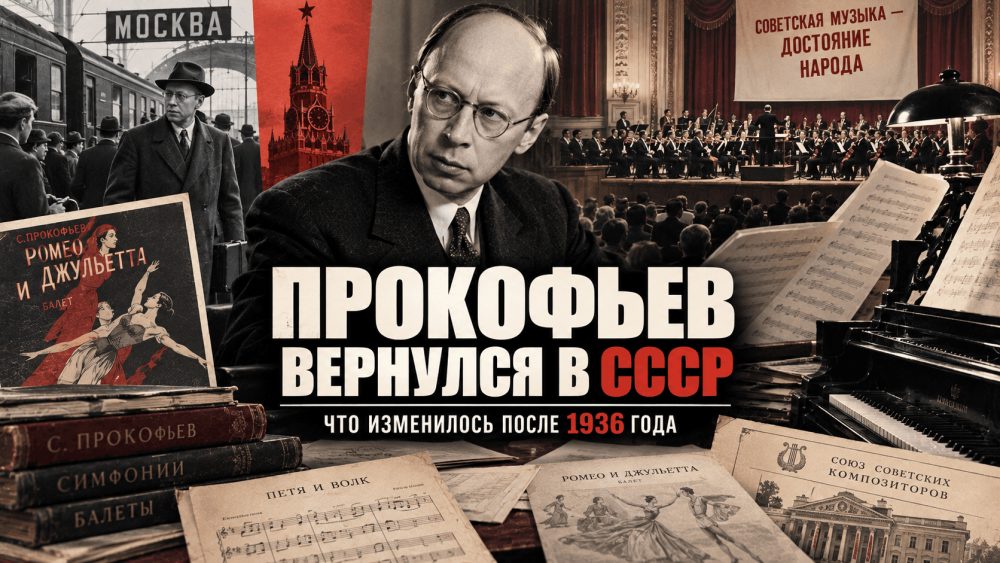
Sergei Prokofiev settled with his family in Moscow in 1936. He returned as a composer with an international career, not as a beginner. He had already worked in America and Europe, performed as a pianist and written for the stage. His Soviet years brought new works alongside dependence on the state's cultural policies.
A gradual return
Prokofiev left Russia in 1918 and established himself in Paris in 1923. His successful Soviet visit in 1927 was not a permanent move: he continued working abroad afterward. Connections with Soviet musical life became closer in the early 1930s. IRCAM's biography records further visits in 1929 and 1932, followed by the family's settlement in Moscow in 1936.
Asking when he returned therefore requires a more specific question. Was it his first tour after leaving, or the point when he established a permanent home? Those dates describe different stages. Reducing the decision to one motive is equally difficult. Commissions, working conditions and relationships with audiences formed its professional context, but do not reveal every private consideration.
Concert hall and theatre
Universal Edition's biography emphasizes the variety of Prokofiev's work abroad, including the operas The Love for Three Oranges and The Fiery Angel, symphonies and ballets. His move did not divide one fully formed artist from an entirely different one. Genres and projects crossed the geographical boundaries of his life.
Romeo and Juliet illustrates why composition and production dates must be distinguished. Deutsche Grammophon places work on the score in the summer of 1935; its Soviet staging came later. Finishing a score did not settle a work's theatrical future. The history of Soviet ballet provides a wider setting.
Peter and the Wolf: learning by recognition
In spring 1936 Prokofiev created Peter and the Wolf using his own prose narrative. The PBS essay about the piece explains its educational principle: a character has a particular instrument and theme. Repetition enables listeners to recognize that character through sound as well as the narrator's words.
The bird is associated with the flute, the duck with the oboe and the cat with the clarinet. Differences in instrumental colour become part of the action. A useful first encounter begins with the individual themes and continues by noticing their return during the story.
This is an invitation to listen actively. Instead of memorizing an abstract list of instruments, a child recognizes a familiar orchestral voice. The article on the Pioneer movement explores another aspect of Soviet childhood, although the musical tale should not be reduced to a single political interpretation.
Working with cinema
Collaboration with Sergei Eisenstein produced the music for Alexander Nevsky in 1938. Prokofiev subsequently reworked material from the film as a cantata. Film score and concert work are connected, but they operate differently. In a film, music interacts with editing and images; in the concert hall, listeners encounter a work without that screen narrative.
The distinction offers a practical route into his music. A melody encountered in concert can lead back to its cinematic setting, without assuming that the two versions are identical in every detail. The overview of Soviet cinema places this collaboration within a broader medium.
Recognition offered no protection
In February 1948 Prokofiev was among the composers condemned during the campaign against formalism. A political accusation affected performances and the composer's professional standing. It should not be treated as a neutral musical category or as evidence of a work's artistic value.
Nevertheless, his late creative work did not disappear. The Polish Music Library describes his collaboration with Mstislav Rostropovich and cello compositions including the Symphony-Concerto. An account of these years must consider both constraints and the particular music he continued to write. The article on Shostakovich's Seventh Symphony offers a different case involving music, war and art's public significance.
A route through the Soviet years
Three listening approaches provide a starting point: recognizing timbres in Peter and the Wolf, following stage action in Romeo and Juliet, and comparing the cinematic and concert forms of Alexander Nevsky. This is a route between genres, rather than a ranking of masterpieces.
The year 1936 marks a change in where Prokofiev lived. It does not automatically explain every note he wrote, every subsequent success or every restriction. An accurate account keeps several timelines distinct: the composer's biography, work on a score, its premiere, and its later performance history. Putting those timelines together is more revealing than expecting one date to explain an entire creative life.
The cover is an original editorial timeline, not an archival image.