Botvinnik in 1948: How a Tournament Decided the World Title
How Botvinnik won in 1948: five players, The Hague and Moscow, 14 points from 20 games, systematic preparation and FIDE’s new championship cycle.
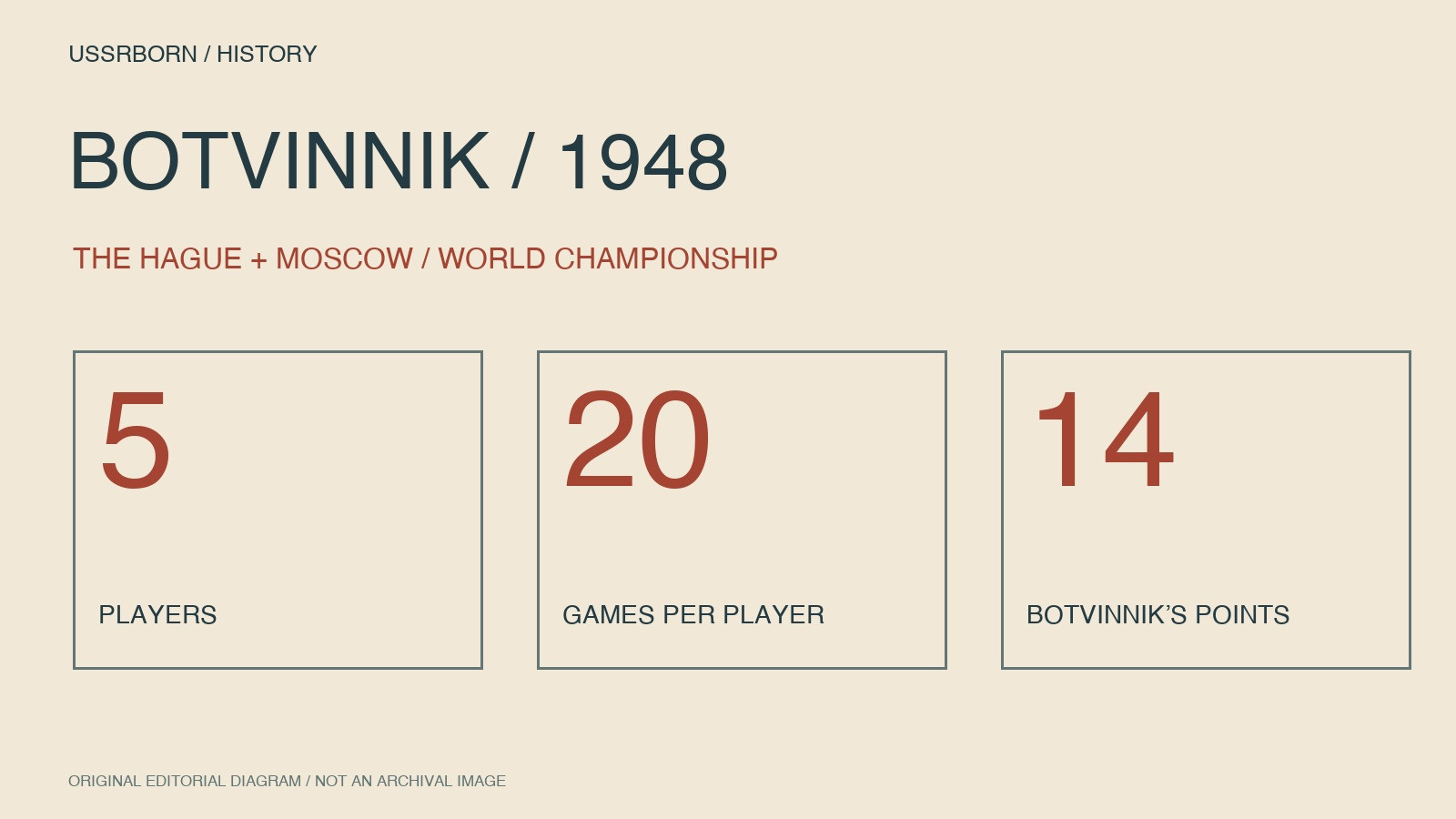
Mikhail Botvinnik became the sixth World Chess Champion in 1948. He won the title through an unusual competition: instead of a match between a reigning champion and one challenger, five players contested a tournament in The Hague and Moscow. Botvinnik finished with 14 points from 20 games.
The victory matters beyond one player's biography. It accompanied the International Chess Federation's assumption of responsibility for the world title. The organization of the championship and the route by which future challengers would qualify were changing together.
Why a tournament replaced the usual match
Alexander Alekhine died in 1946 while still holding the title. A conventional challenge against the reigning champion was no longer possible. Botvinnik, Vasily Smyslov, Paul Keres, Samuel Reshevsky and Max Euwe competed to determine his successor.
Each player faced every other participant five times. Four opponents multiplied by five games produced twenty games per player. The format combined repeated encounters between each pair with a single overall table. A championship bulletin preserved by the FIDE museum documents this transitional event.
Fourteen points did not mean fourteen wins
A chess score combines full points for victories with half-points for draws. The phrase fourteen points should therefore not be rewritten as fourteen wins. It is a small distinction that materially changes what a tournament result means.
The format also differed from a short knockout event. Losing one game did not end a player's participation, and opponents met repeatedly. To understand this kind of result, imagine a succession of encounters against several rivals rather than one decisive evening.
Preparation as sustained work
The World Chess Hall of Fame emphasizes Botvinnik's theoretical study and physical discipline. His approach connected the opening with plans extending into later stages of a game. It was broader than memorizing a sequence of opening moves. He subsequently taught younger players, including Garry Kasparov.
The FIDE museum also describes his electrical engineering education and later work on computer chess. These interests should not be turned into a claim that a single scientific formula explained his victories. They show a sustained concern with analyzing decisions and organizing work around them.
An amateur can draw a practical lesson from this subject without pretending to reproduce the champion's routine. After a game, identify a moment of choice and write down why a particular move seemed attractive. Comparing that reasoning with the outcome can reveal recurring habits. This is an editorial suggestion about reflective practice, not an exercise quoted from Botvinnik.
A route to the next title match
FIDE's retrospective on the 1950 Candidates Tournament describes the development of a championship cycle involving Zonal, Interzonal and Candidates events. Previously, a prospective challenger had needed to negotiate with the champion, find funding and arrange a match.
The first Candidates Tournament took place in Budapest in 1950. A subsequent playoff between David Bronstein and Isaac Boleslavsky determined the challenger, with Bronstein earning the right to face Botvinnik. Selecting a new champion in 1948 and selecting a challenger afterwards were therefore separate stages in the new structure.
The years 1948 to 1963 were not one uninterrupted reign
Botvinnik retained his title after drawn matches against Bronstein in 1951 and Smyslov in 1954, as the rules then allowed. He lost to Smyslov in 1957 and regained the championship in 1958. A defeat by Mikhail Tal in 1960 was followed by victory in their 1961 rematch.
Tigran Petrosian took the title in 1963. Botvinnik's championship periods are consequently listed separately: 1948-1957, 1958-1960 and 1961-1963. This is more accurate than an unqualified continuous date range and preserves his rivals' victories in the historical record.
Placing chess alongside other sporting achievements
Botvinnik's success can be considered alongside the Soviet Olympic debut in 1952, Soviet hockey and Larisa Latynina's Olympic career. Their measurements remain different: chess points, team championships and Olympic medals cannot be combined into one meaningful score.
The history of everyday life in the USSR offers a broader setting. Yet a champion's biography alone cannot establish how frequently chess was played in every household. Recognizing the importance of the 1948 victory should begin with accurately describing the competition itself.
Sources
- FIDE museum: 1948 championship bulletin: participants, format, venues and score.
- World Chess Hall of Fame: Mikhail Botvinnik: preparation and teaching.
- FIDE museum: Botvinnik biography: engineering and computer research; championship dates cross-checked against FIDE's timeline.
- FIDE: the first Candidates Tournament: the cycle and the 1950 qualification contest.
- FIDE: World Champions Timeline: matches and separate championship periods.
The cover is an original diagram of the tournament format, not a photograph or a reconstruction of a historical chess position.