Shostakovich’s Seventh Symphony in Besieged Leningrad
Karl Eliasberg led the Seventh Symphony in Leningrad on 9 August 1942. The concert followed its world premiere and carried a meaning of its own.
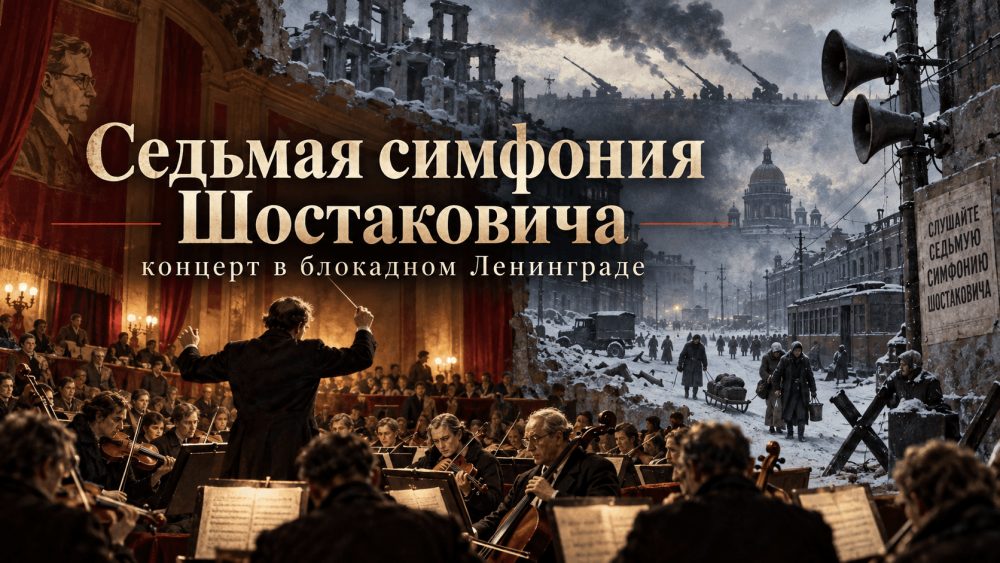
On 9 August 1942, Dmitri Shostakovich's Seventh Symphony was performed in besieged Leningrad, with Karl Eliasberg conducting. The concert became one of the most remembered musical events of the war. It was not, however, the work's world premiere. That had taken place five months earlier in Kuybyshev.
The distinction makes the Leningrad musicians' achievement clearer. They were not introducing an unknown score to the world. They were bringing music dedicated to their city back to a place where sustaining a large orchestra after a winter of starvation was itself an enormous undertaking.
Where the Seventh Symphony was written
Symphony No. 7, Op. 60, was composed in 1941. Shostakovich wrote its first three movements in Leningrad and completed the work after evacuation to Kuybyshev, now Samara. The symphony is dedicated to Leningrad.
The familiar description “written in the besieged city” therefore tells only part of the story. Work began before the siege closed around Leningrad and continued after the composer left. Its relationship to the city rests on experience, dedication and subsequent performance history, as well as the physical location in which its pages were written.
In published statements, Shostakovich connected the composition with the war, his contemporaries and the defense of his city. Those statements are important evidence of how he publicly explained the work. They do not require the listener to turn every musical passage into a literal picture of a battlefield.
Three performances to distinguish
- 5 March 1942: the world premiere in Kuybyshev, performed by the Bolshoi Theatre orchestra under Samuil Samosud.
- 19 July 1942: the American performance in New York by the NBC orchestra under Arturo Toscanini.
- 9 August 1942: the Leningrad premiere in the Philharmonia's Great Hall, conducted by Karl Eliasberg.
The symphony already had an international audience before the August concert. Its performance in the city belongs within the wider history of the Great Patriotic War, when the same cultural event could carry local, national and international significance. Those different audiences did not necessarily hear the music in the same way.
The orchestra inside the siege
The performing group was built around the Leningrad Radio Committee orchestra. It should not automatically be identified with the evacuated Leningrad Philharmonic orchestra. A venue's name and an ensemble's identity are separate details, particularly in wartime, when different groups appeared on the same stage.
The Philharmonia's institutional history records the interruption of rehearsals during the winter of 1941 to 1942, amid hunger and deaths among musicians. The orchestra returned to work in the spring. Preparing the new symphony required additional players, including musicians recalled from military service, and supplementary food for the performers.
These practical details give the famous concert its human scale. A symphony requires more than a score, a conductor and an available hall. Players must have the strength to rehearse, sustain a phrase, follow their parts and listen to one another across a long performance. Under the conditions of the siege of Leningrad, assumptions that ordinary concert life takes for granted had become formidable problems.
There is no need to invent an exact emotional response for every person in the audience to recognize this achievement. The documented circumstances already show why performing the work was an act with consequences beyond the usual judgment of a successful or unsuccessful concert.
A performance beyond the concert hall
The music was transmitted by radio and loudspeakers. It became an audible sign that the city continued to live. For the authorities, the event had an evident role in sustaining morale; for players and listeners, it was also a direct encounter with a demanding work of art.
Those functions can coexist. A concert may be used for public messaging while remaining a deeply personal experience for someone who has lost family or survived extreme hunger. Recognizing the state's interest does not explain away the audience's experience. Recognizing the audience's experience does not remove the political circumstances.
A related question arises when examining Soviet posters: who is being addressed, what feelings are being invited, and how does the setting affect the message? Music adds another dimension. It unfolds over time, asking listeners to move through changes of tension, restraint and intensity that cannot be contained in a short slogan.
Listening beyond the invasion episode
The Seventh has four movements. Its best-known passage, commonly called the invasion episode, comes in the first. Repetition and a growing orchestral presence produce an impression of mounting pressure. Familiarity with that passage can help a new listener enter the work, but it can also obscure everything around it.
One useful approach is to follow contrasts rather than assign a fixed meaning to every theme. When does a repeated figure stop sounding reassuring? What happens after a loud climax? How does a quieter passage change the memory of what came before it? These questions keep attention on musical relationships instead of demanding a one-to-one translation into historical events.
Shostakovich described the second and third movements as a lyrical relief from continuous tension. The slow movement gives grief room to develop; the finale restores the scale of a large public statement. Yet the emotional course should not be reduced to a simple equation of war followed by an accomplished victory. In 1942, victory still lay in the future.
The distinction matters for listening today. Knowing how the war ended can make a conclusion sound inevitable. The first audiences did not possess that hindsight. Hearing the piece with that uncertainty in mind offers a different perspective on its force.
Symbol and interpretation
The Seventh became a symbol of resistance to Nazism. Shostakovich's music also invites debate about the wider experience of fear and coercion under Stalin. Three kinds of evidence should be kept distinct: documented performance circumstances, the composer's public explanations, and later critical interpretations.
An interpretation can be persuasive without being proof of a single concealed intention. Conversely, a work need not have one final interpretive key to be meaningful. Its historical setting provides a starting point for listening, while the music allows questions that extend beyond the immediate circumstances of its first reception.
Frequently asked questions
Was the Leningrad concert the world premiere? No. The first performance was in Kuybyshev on 5 March 1942. Leningrad heard the symphony on 9 August.
Who conducted inside the besieged city? Karl Eliasberg. Samuil Samosud conducted the earlier world premiere.
Was the whole symphony written in Leningrad? No. The first three movements were written there; the work was completed after evacuation to Kuybyshev.