Lev Yashin and the 1963 Ballon d’Or: Dynamo, the USSR and Wembley
Dynamo’s championship, the Wembley centenary match and Yashin’s Ballon d’Or: the 1963 season in the context of Olympic gold and European success.
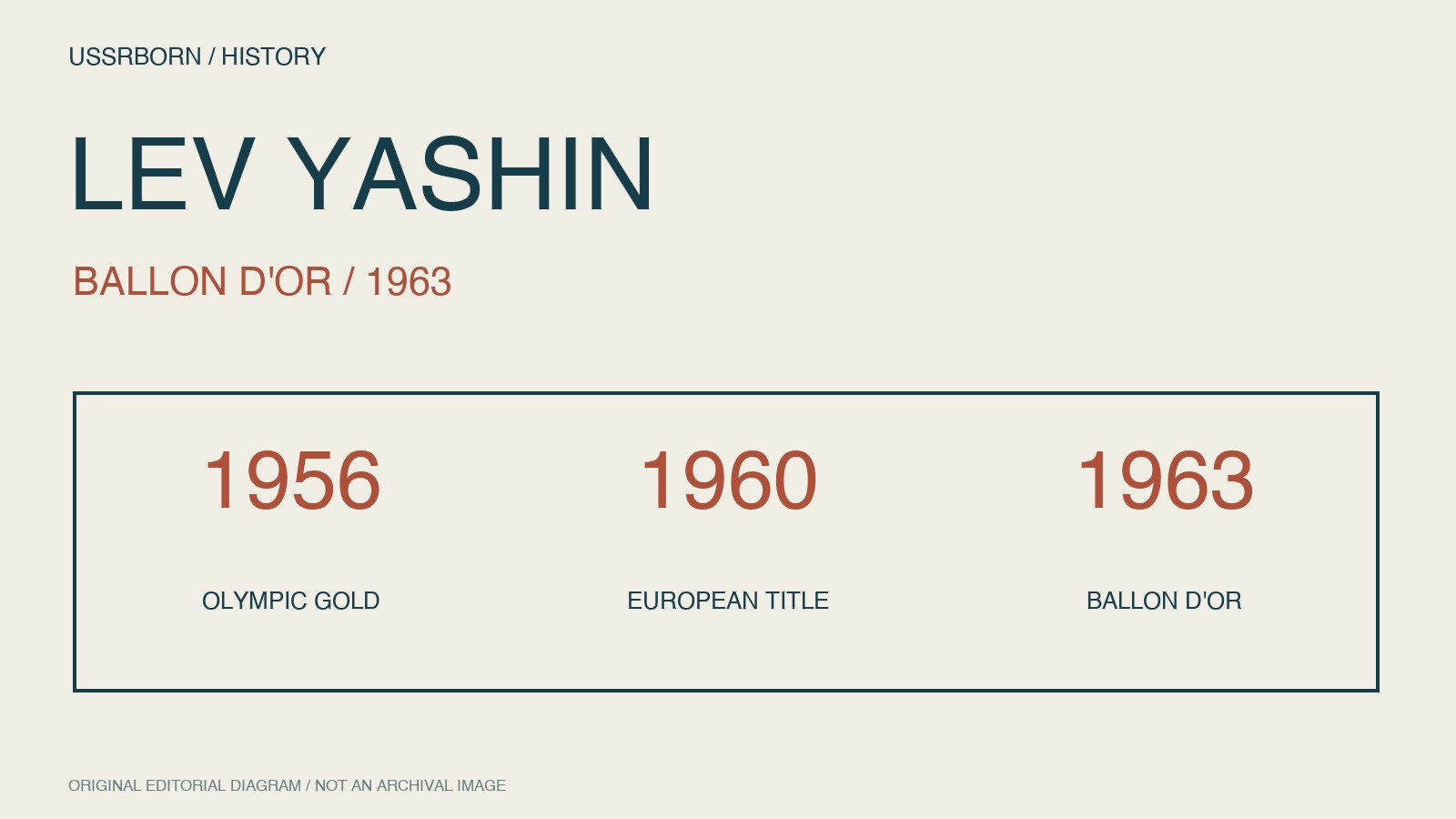
In 1963, Lev Yashin won France Football's Ballon d'Or. A goalkeeper's success in the European Footballer of the Year award brought an unusual kind of contribution into focus. Individual football honors readily invite discussion of goals and attacking creativity; Yashin's job was to prevent the opposition from scoring. Understanding the significance of his award means connecting his club career, the Soviet national team and the international stage.
What the 1963 award represented
The list of winners published by UEFA identifies Yashin, the Soviet Union and Dynamo Moscow for 1963. France Football established the award in 1956. Yashin's success belongs to the European competition of that period, rather than to the arrangements governing today's global football awards.
It was an individual honor, not a trophy awarded to the Soviet national team or the winner's prize from a particular tournament. A league championship records a team's performance under the rules of a competition. An award for the best footballer expresses a comparative judgment about an individual. Neither can simply stand in for the other.
Yashin's selection invites attention to how a goalkeeper contributes to collective success. That contribution cannot be expressed through the attacking statistics normally associated with star players. The interest of the award lies partly in this change of perspective: recognition could center on the person responsible for stopping goals.
Dynamo Moscow and the championship season
According to Dynamo's club biography, Yashin won five Soviet league titles: in 1954, 1955, 1957, 1959 and 1963. His Ballon d'Or year was therefore also a championship year at home. Early in his career he played ice hockey as well, winning the Soviet hockey cup in 1953 as a goalkeeper.
The presence of two sports in the same biography is a reminder that specialization does not always emerge immediately. It would nevertheless be too simple to make hockey the sole explanation for his football ability. A biographical connection and a demonstrated cause are different propositions; the latter would require considerably more evidence.
The wider history of Soviet football places those club achievements within the domestic game. International visibility did not remove the demands of a league season. Points earned in an ordinary round of fixtures mattered to the team even when a prestigious exhibition match attracted more attention abroad.
Wembley and the Football Association's centenary
On 23 October 1963, England played a Rest of the World team selected by FIFA at Wembley. The occasion was the centenary of the English Football Association. England won 2-1. The date, participants and result are documented in the FA's institutional history.
Yashin appeared for the world selection. The fixture must therefore not be described as England against the USSR. Nor should its final score automatically be treated as the number of goals conceded by one goalkeeper: Dynamo's biography records that Yashin did not concede during his time on the field.
The London match provided an international stage for a Soviet player. It was not, however, a match whose official winner's prize was the Ballon d'Or. A memorable appearance can become the image through which supporters remember a season without accounting for the whole season. Keeping the domestic title, the international occasion and the separate individual award in view gives a fuller picture of 1963.
This distinction also helps when reading the caption of an old photograph. A national-team player wearing a world selection's colors is still the same person, but the sporting context has changed. The opponent, occasion and identity of the team should be established before using the image to illustrate a particular international rivalry.
An Olympic and European record before 1963
Yashin had already won Olympic football gold in Melbourne in 1956. Olympedia's athlete record documents that victory and identifies it as his only appearance at an Olympic Games. The achievement preceded the Ballon d'Or by seven years.
His Olympic success belonged to the expansion of Soviet participation in international sport following the USSR's Summer Olympic debut at Helsinki in 1952. An Olympic tournament and an individual football award should nevertheless not be collapsed into one ranking system. They have different formats and determine success in different ways.
The Soviet Union then won the inaugural European Nations' Cup in 1960. UEFA includes Yashin in its Team of the Tournament and highlights his performances against Czechoslovakia and Yugoslavia. His international reputation thus had a substantial competitive history before the London appearance of 1963.
Assessing a goalkeeper beyond the legend
Goalkeeping presents a particular problem for anyone assessing a player's contribution: a good decision can make danger less visible. Positioning or coordination with defenders may prevent a spectacular shot from occurring at all. A compilation of dramatic saves consequently captures only part of the work. This is a general point about analyzing the position, not a claim that Yashin invented every element of it.
Statistics also need definitions. Which competitions are included? Do exhibition games count? How are substitutions handled? Figures bearing the same label can refer to different sets of matches if those questions are left unanswered. The confirmed titles and award provide enough evidence to explain the significance of this season without adding uncertain career-record totals.
Comparison with other sports can clarify the issue. Larisa Latynina's Olympic medals and Mikhail Botvinnik's world chess title represent different forms of achievement from a vote for footballer of the year. A medal, a championship and an individual award each record something specific. Yashin's 1963 season is especially revealing because team success and personal recognition meet in the career of a goalkeeper.