Sholokhov’s 1965 Nobel Prize: Quiet Don and Two Speeches
Why Sholokhov received the 1965 Nobel Prize: the publication history of Quiet Don, the Swedish Academy’s explanation and the writer’s banquet speech.
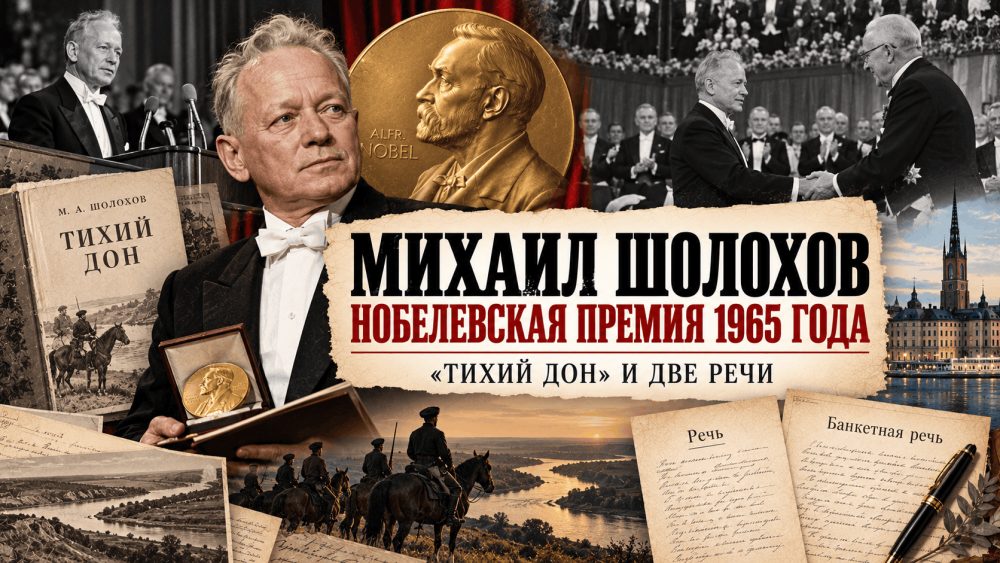
Mikhail Sholokhov received the Nobel Prize in Literature in 1965 as its sole recipient. The Swedish Academy’s award citation recognised the artistic strength of his Don epic and its portrayal of people experiencing historical change. The central work in that recognition was Quiet Don, also familiar to English-language readers as And Quiet Flows the Don.
Understanding the award requires separating three connected stories: the novel’s creation, the Academy’s explanation of its decision and the writer’s own public statement. None can simply stand in for the others.
Why 1965 was not the novel’s publication date
The Nobel biographical account states that Sholokhov began Quiet Don in 1926 and that its parts appeared between 1928 and 1940. It also dates the early collection Tales from the Don to 1926. By the time of the award, he had a substantial literary career behind him.
The 1965 prize was consequently not a response to a newly published novel. A quarter of a century separated the end of the publication sequence from the award. The year attached to a Nobel Prize identifies the recognition of an author, not necessarily the public’s first encounter with a work.
Literary chronology rarely fits into a single date. Writing a manuscript, publishing instalments, issuing a book and gaining international recognition may follow different timelines. Similar care is necessary when considering the first publication of The Master and Margarita, although the circumstances of the two works were substantially different.
For readers approaching Sholokhov through the prize, establishing the sequence prevents a misleading starting point. The novel belonged to an earlier literary and historical setting than the ceremony through which they may have discovered it.
How the Academy explained its choice
In his presentation speech, Anders Österling of the Swedish Academy discussed Quiet Don as a broad depiction of the Cossack world overtaken by world war, revolution and civil war. His reading connected Grigory Melekhov’s personal tragedy with historical upheaval. He also drew attention to the landscape and the narrative’s realist power.
This was the Academy representative’s interpretation, not a compulsory verdict for every reader. It identifies qualities placed at the centre of this particular act of literary recognition.
“Epic” is useful here as a description of narrative scale. Private lives extend beyond the boundaries of one family because characters make decisions within a changing social world. Yet scale does not turn a novel into a substitute for historical research. Fiction constructs scenes and characters; historical scholarship tests evidence and asks where it came from.
Both forms can matter to the same reader. Recognising a novel’s artistic persuasiveness does not remove the need to investigate its historical context. Equally, asking historical questions need not reduce literature to a checklist of independently verifiable events.
The award materials are best used to understand a critical response to the novel. They cannot settle every question about its interpretation simply because they accompany an internationally prominent prize.
What Sholokhov said himself
At the Nobel banquet in Stockholm City Hall on 10 December 1965, Sholokhov spoke as a Russian and Soviet writer. He connected his recognition with the work of fellow writers, defended the continuing value of the novel and discussed realism, explicitly including socialist realism. Readers, working people, truth and hopes for peace were central to his account of a writer’s responsibilities.
This was a banquet speech, not a Nobel Lecture. The Nobel archive presents it separately from the Academy’s presentation speech.
The distinction is substantive as well as archival. The Academy explains a choice through a literary work; the author states his own view of literature’s purpose. Reading the documents together reveals different perspectives on one event rather than producing a single uncontested judgement about Soviet literary life.
The history of Pasternak’s 1958 Nobel Prize is a reminder that one laureate’s circumstances cannot simply be transferred to another. Sharing a country of origin and receiving an award with the same name did not make the experiences identical.
Quiet Don within a wider body of work
The Nobel biography also discusses Virgin Soil Upturned and The Fate of a Man. The former concerns collectivisation; an explanation of how the kolkhoz worked provides useful historical background. The latter invites comparison between a literary text and its screen adaptation within the broader history of Soviet cinema.
These connections offer ways to explore Sholokhov beyond the prize’s most recognisable association. They should not, however, obscure why an account of the 1965 award keeps returning to Quiet Don. The citation singles out the Don epic, and the presentation speech develops an explanation of its importance to the Academy’s decision.
The biographical account is itself a document of its period. It helps show how the author was introduced at the time of his recognition. It should not be treated as a final reference work incorporating every later investigation of his life and writing.
A useful order for reading the award documents
Start with the official facts page for the year and citation. The Academy’s speech then explains the literary reasoning, while Sholokhov’s banquet address provides his own statement of purpose. The biography places these documents alongside the publication history.
This approach keeps different kinds of evidence in view. A date establishes chronology, a presentation speech records a critical interpretation and an author’s address expresses a public position. None automatically proves everything the others might leave uncertain.
The result is not a replacement for reading the novel. The prize marks one important episode in its international reception, while the work itself remains open to questions that an award ceremony cannot exhaust.