The BAM: the last great construction project of the USSR
Three thousand kilometers across permafrost, seven mountain ranges and hundreds of rivers. A railway begun by prisoners, built by "the whole country," and finished in the year the country ceased to exist. The story of the project of the century, with its romance, its camp past, and a "what for" that was answered only recently.
What the BAM is
The BAM, the Baikal-Amur Mainline, is a railway of more than four thousand kilometers from Taishet to Sovetskaya Gavan, running north of the Trans-Siberian across Eastern Siberia and the Far East. Its main section, 3,145 kilometers of new track, was built between 1974 and 1984, and it was the Soviet Union's last great construction project: in scale, in cost, and in its place in the biography of an entire generation.
The line was driven through places where one does not build: permafrost, seven mountain ranges, seismic zones of up to nine points, hundreds of rivers. The route carries more than four thousand bridges and dozens of tunnels, including the Severomuysky, over 15 kilometers through a mountain range and the longest tunnel in Russia. The project received the official title of "the construction project of the century," and for once the official phrase did not exaggerate.
The first BAM: the camp one
The romantic project had an unromantic beginning, and we state it plainly. The idea of a northern twin for the Trans-Siberian, which ran vulnerably close to the Chinese border, predated the war, and the first sections of the BAM in the 1930s through the 1950s were built by BAMlag: prisoners of the Gulag, joined after the war by prisoners of war. The conditions were murderous and the death toll enormous; historians are refining the exact figures to this day. After Stalin's death in 1953 the project was simply abandoned: the rails rusted in the taiga for twenty years, and some were pulled up and hauled away to rebuild other lines.
When the project was resurrected in 1974, Brezhnev pronounced a phrase that was a direct disavowal of the first BAM: it would be built "with clean hands only." Camp labor was excluded as a matter of principle; the new railway was declared the work of youth and enthusiasm.
The project of the century
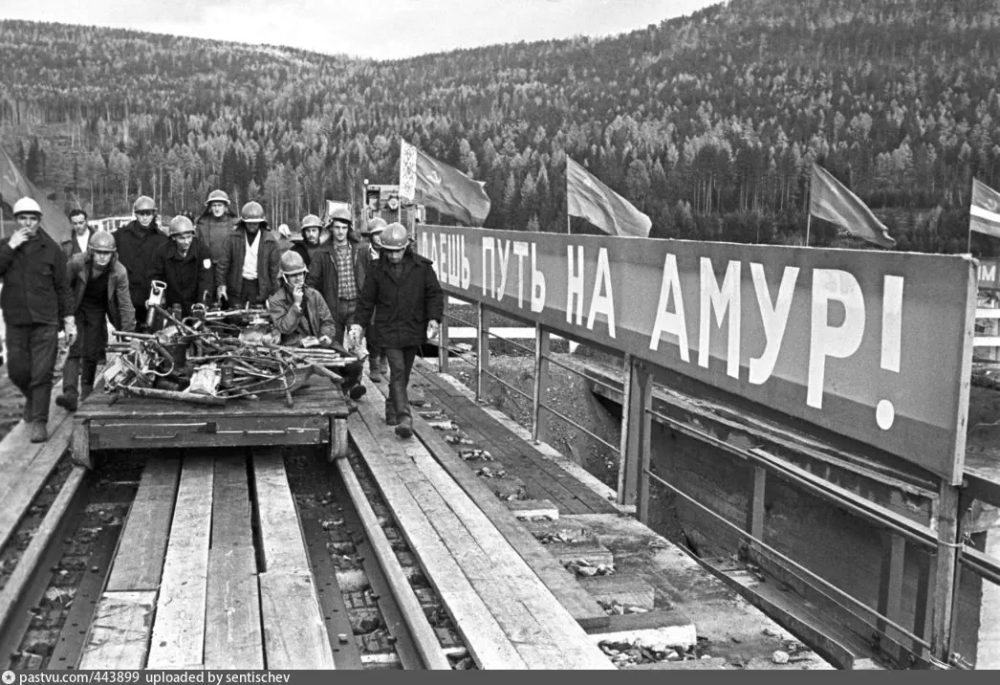
On July 8, 1974, the government decree on the mainline's construction was issued, and the Komsomol declared the BAM an all-Union shock project: the first detachments left for the east straight from the Komsomol congress. Over the decade, by official count, more than two million people passed through the project. They came for the romance and for the money, northern wage bonuses let a worker save up for a car in a few years, and often stayed for life: the bamovtsy, as the builders call themselves, developed an identity of their own that sociologists study to this day.
The project had a feature unique even for the USSR: it was assembled by the whole country in the literal sense. Sections and stations were assigned to republics and cities: Tynda was built by Moscow, Severobaikalsk by Leningrad, Novaya Chara by Kazakhstan, Taksimo by Latvia; every station on the line carries the architectural signature of its patrons, and to ride the BAM is still to ride across the map of a vanished country. Daily life, meanwhile, was anything but ceremonial: tents and trailers at minus fifty, makeshift barracks, years of waiting for housing. Romance and disorder, campfire songs and high turnover: both truths of BAM life are documented, including studies of crime and padded reports on the project. The showcase and the reality lived side by side here, as everywhere in the USSR.
As engineering, the road was a feat without quotation marks: permafrost construction techniques, singular bridges, tunnels through seismic ranges. The most stubborn of them, the Severomuysky, never submitted to the Soviet era at all: it took 26 years to cut and opened only in 2003, while trains crawled over a dizzying bypass with gradients at the edge of the possible.
The golden link and the "road to nowhere"
In the autumn of 1984, at the remote Balbukhta passing loop in Transbaikalia, two crews met that had spent ten years advancing toward each other from west and east. The country celebrated the "golden link" ceremony as a victory: the project of the century completed ahead of schedule. Reality was more modest than the parades: by the early 1990s only part of the mainline was properly operating, and the road was officially declared complete only in 1991, the year the state that built it disappeared. History arranged the coincidence without scriptwriters: the country and its last great project crossed the finish line together.
Then came the BAM's worst years. There was no freight, the settlements emptied, and the railway that had consumed enormous sums was branded in the 1990s press "the road to nowhere," a monument to planned gigantomania. Economists argued in earnest whether the BAM had been needed at all, and the skeptics' case looked solid: the mainline ran at a deep loss.
The answer to "what for"
The answer arrived thirty years later, and it proved more prosaic than the romance and more convincing than the skepticism: coal. With Russia's trade pivot to the east, the BAM turned from a road to nowhere into a bottleneck choking on freight: coal, ore and containers now move along it to the Pacific ports, and the mainline is being expanded with second tracks, new tunnels and the Eastern Polygon program. The railway that missed its own era by half a century lived to see its demand.
The BAM's verdict is double, like all of late Soviet history. It is at once a monument to a system that could mobilize millions without counting money, and to people who built sincerely and remember the project as the best years of their lives. An engineering feat, and an economic gamble vindicated thirty years after its commissioner's death. Along rails laid by Komsomol volunteers on the bones of the first, camp-built BAM, coal trains run today. That one sentence holds nearly the entire history of the country this site tells.
Frequently asked questions
What is the BAM and where does it run? The Baikal-Amur Mainline is a railway from Taishet to Sovetskaya Gavan, north of the Trans-Siberian, across Eastern Siberia and the Far East. Its main 3,145-kilometer section was built in 1974 to 1984.
Why build the BAM if the Trans-Siberian existed? The Trans-Siberian runs close to the Chinese border for long stretches and was vulnerable; the BAM created a northern twin and opened access to Siberian resource deposits. The military and economic motives worked together.
Is it true that prisoners began the BAM? Yes: the sections of the 1930s to 1950s were built by BAMlag with prisoner labor, joined after the war by POWs, at an enormous cost in lives. The 1974 project used no camp labor: "clean hands only," in Brezhnev's formula.
What was the golden link? The meeting of the eastern and western construction crews at the Balbukhta loop in the autumn of 1984 and the laying of a symbolic "golden link" of track. The road was fully completed by 1991.
Why was the BAM called the "road to nowhere"? In the 1990s the mainline ran at a deep loss: freight vanished and the settlements emptied. The eastward pivot of trade changed everything: today the BAM is overloaded with coal and is being expanded.
What is the Severomuysky Tunnel? Russia's longest tunnel (over 15 km) through the Severomuysky range. It took 26 years to build and opened only in 2003; until then trains used a steep bypass.
Related
- The Komsomol: the organization whose greatest project the BAM became.
- The Gulag: the mainline's camp beginnings.
- Leonid Brezhnev: the era that proclaimed the project of the century.
- The dissolution of the USSR (1991): the finish that coincided with the railway's completion.
Sources
The facts in this article can be verified against authoritative sources:
- Encyclopedia.com (Encyclopedia of Russian History), "Baikal-Amur Magistral Railway": https://www.encyclopedia.com/history/encyclopedias-almanacs-transcripts-and-maps/baikal-amur-magistral-railway
- Sibirica (academic journal, Berghahn), "The Baikal-Amur Mainline": https://www.berghahnjournals.com/view/journals/sibirica/18/1/sib180103.xml
- Seventeen Moments in Soviet History (Michigan State University), "The Baikal-Amur Mainline": https://soviethistory.msu.edu/1980/bam/
- Rusmania, "History of Baikal-Amur Railway (BAM)": https://rusmania.com/history-baikal-amur-railway-bam
- Academia.edu, Christopher J. Ward, "Baikal-Amur Magistral (Mainline) Railway (BAM)": https://www.academia.edu/12092684/Baikal_Amur_Magistral_Mainline_Railway_BAM_
The camp prehistory, the economic controversy and the railway's present revival are covered from academic sources.