Sovnarkhozy, 1957-1965: Reorganising Soviet Industry
How the 1957 reform transferred enterprises to territorial councils, which functions remained central and why national planning continued.
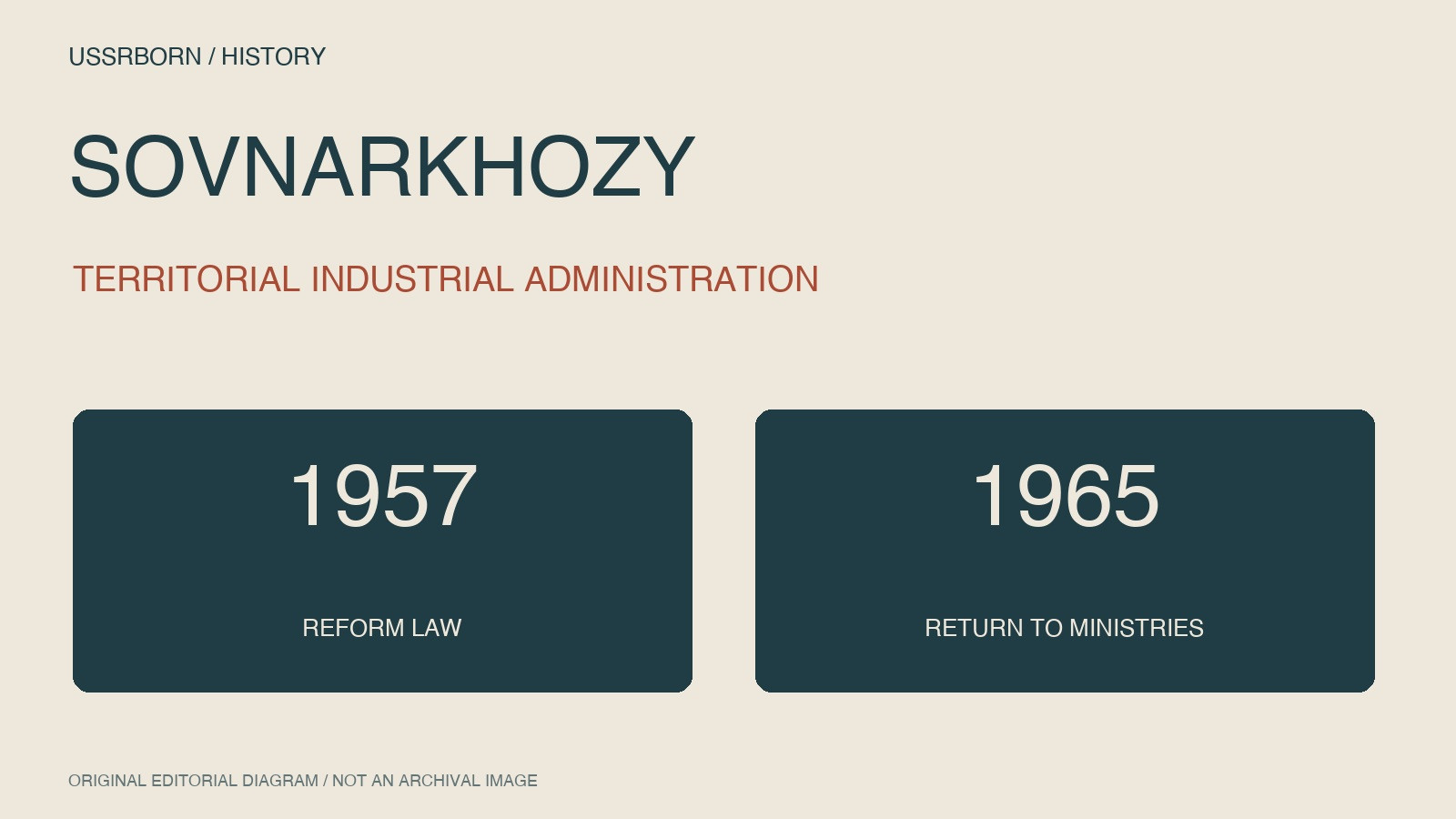
In 1957, the Soviet government reorganised the administration of industry and construction. Many enterprises that had reported to ministries organised by industrial branch were placed under territorial councils of the national economy, known as sovnarkhozy. The reform changed the administrative map of production while retaining state ownership and national planning.
The problem the reform was intended to solve
The law of 10 May 1957 presented the change as a way to bring management closer to factories and construction sites. Its preamble identified departmental barriers as obstacles to specialisation, cooperation and the use of productive capacity. These were the reformers' stated aims, not proof that the new arrangements immediately achieved them.
An illustrative comparison makes the distinction clearer. Under a branch-based system, engineering plants in several regions might report to the same specialist ministry. Under a territorial system, enterprises from several industries within one region might share a directing authority. The first arrangement offers an overview of an industry; the second may make local connections easier to coordinate. Neither arrangement eliminates the need to obtain supplies from elsewhere.
The reform is associated with Nikita Khrushchev, but understanding it requires more than knowing who promoted it. The essential questions are which powers were transferred and which remained at higher levels of government.
Who established the councils?
Article 2 assigned the formation of economic administrative regions to the Supreme Soviets of the union republics. Each region was to have a council of the national economy. The relevant republican Council of Ministers appointed its chairman, deputy chairmen and members.
A territorial council reported directly to its republic's government. The USSR Council of Ministers directed the councils through those republican governments. This expanded the republican level's role, but it did not turn an economic region into an independent state or a self-governing commercial association.
Article 8 authorised councils to issue resolutions and orders within their competence and in implementation of superior legislation and government decisions. The republican government could revoke their decisions; the USSR government could suspend them. The new responsibilities therefore remained embedded in a hierarchy of administrative supervision.
The term council can be misleading if read as a general promise of local autonomy. In this case, the law specified an appointed administrative body with a defined chain of command. Its geographical proximity to factories did not remove that chain.
Ministries abolished and functions retained
The law listed the ministries to be abolished, including those responsible for the automobile industry, machine tools and heavy engineering. A separate list covered union-republican ministries, including coal, ferrous metallurgy and non-ferrous metallurgy. Enterprises belonging to abolished ministries were to be transferred to the appropriate territorial councils.
However, it is inaccurate to say that every industrial ministry disappeared in 1957. Article 10 merged certain ministries. Article 13 retained branch-planning and technical-development functions for the ministries it named, while providing for listed enterprises to be placed under territorial administration. Industrial specialisation consequently remained part of the original design of the reform.
At council level, the law also provided for a technical and economic advisory body. Advisory work should not be confused with a separate line of authority over a factory. The legislation distinguished consultation, operational administration and supervision by higher government bodies.
Why national planning remained central
Article 18 reorganised the commission responsible for long-term planning into Gosplan, the USSR State Planning Committee, and defined its responsibilities. They included current and prospective economic plans, assessment of economic needs, the location of productive capacity, material supply and supervision of discipline in deliveries.
The reform was therefore not a transition to a free market. It rearranged administration within the planned economy. Changing the authority to which an enterprise reported did not automatically make it an independent seller released from state production obligations.
Consider a hypothetical engineering plant whose metal supply comes from another region. Bringing its supervising council closer does not, by itself, allocate the required metal. An interregional plan, agreed deliveries and responsibility for fulfilling them are still necessary. This example explains a structural issue; it is not a claim about a particular documented dispute.
The distinction between proximity and coordination is important. A local authority may understand the needs of its factories more closely, while a wider authority is still needed to reconcile demands from several regions. The 1957 law sought to accommodate both levels rather than simply remove the centre.
The first months were still a period of adjustment
Historian Mikhail Simonov's study of the USSR and RSFSR planning committees shows that the allocation of practical influence continued after the law was passed. He examines their attempts to take the initiative in directing the councils and meetings held during 1957. His interpretation is that the RSFSR planning committee was quickly pushed away from this work.
This helps distinguish the legal starting point from the subsequent administrative process. A law could define institutions without settling every question about how they would interact. Nor can a promise to remove departmental barriers establish a precise saving or production increase. Assessing outcomes requires separate evidence and comparable measurements.
The documentary sequence matters for another reason: the system should not be treated as completely fixed throughout its existence. The arrangements at the start of a reform and the way officials subsequently exercised authority are different subjects for investigation.
The return to branch administration in 1965
The law of 2 October 1965, No. 4041-VI, established and reorganised industrial ministries and provided for the abolition of economic-region councils and republican councils of the national economy. This marked the end of the territorial system discussed here, rather than a simple change in the names of its bodies.
The restoration of ministries coincided with the economic reform of 1965. Administrative subordination and enterprise incentives were nevertheless distinct questions. One asks who directs a factory; the other asks how its performance is assessed and encouraged. Combining them into a single undifferentiated change makes the history harder to follow.
The councils belong to a broader history of Soviet economic experiments, from the New Economic Policy to later reforms. The distinctive feature of the 1957 arrangement was an effort to move operational direction closer to production while preserving a national plan. The need to make those two levels work together shaped both its organisation and its difficulties.