The First KAMAZ-5320: Why the Factory Has Two Milestones in 1976
From construction in 1969 to the first KAMAZ: the 5320’s origins, the growth of Naberezhnye Chelny and the difference between launch and factory acceptance.
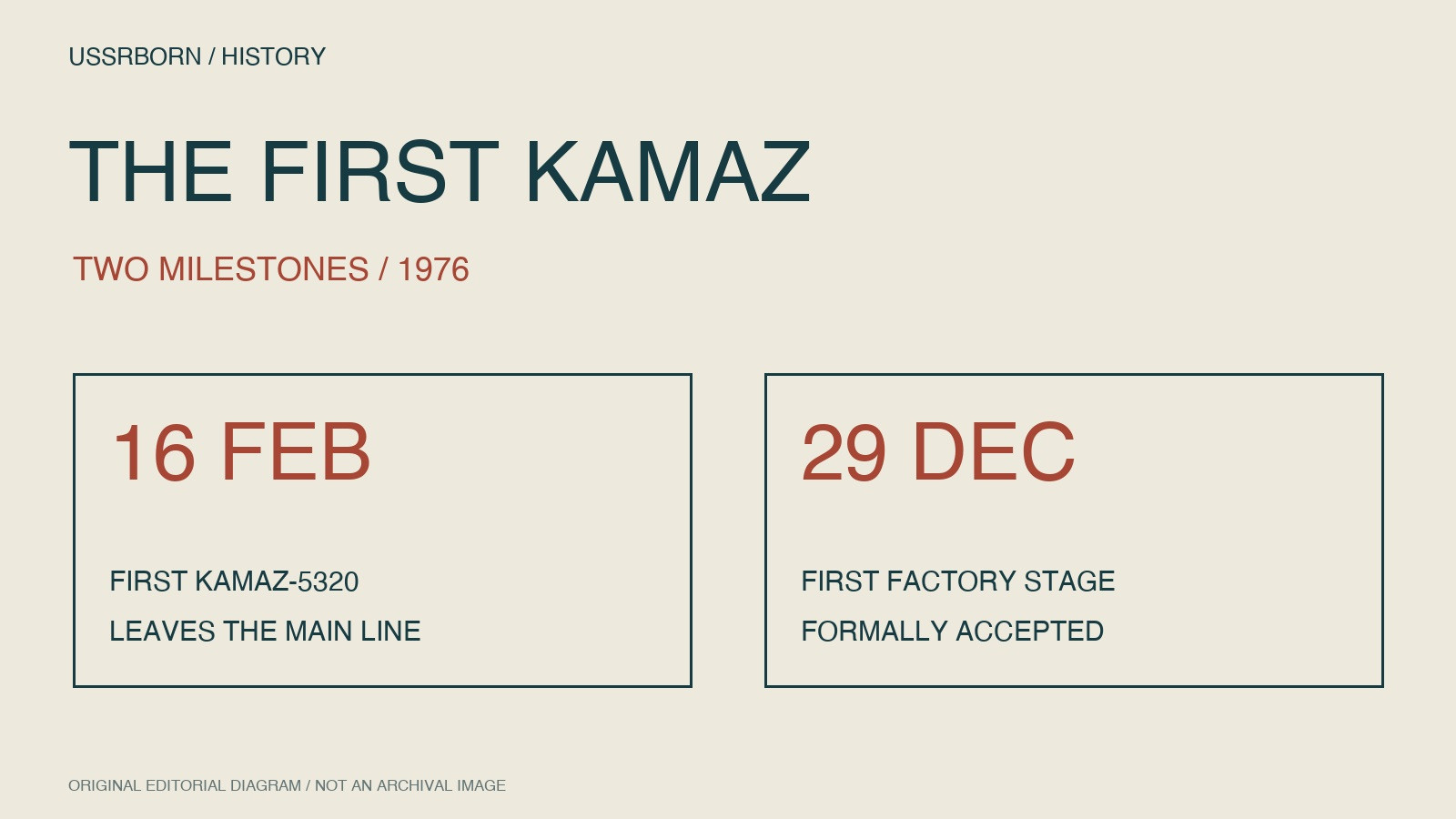
The first KAMAZ-5320 left the main assembly line in Naberezhnye Chelny on 16 February 1976. Yet the first stage of the factory complex was formally accepted on 29 December that year. Both dates are associated with the birth of KAMAZ, but they mark different events: the appearance of a truck and the official acceptance of a large production system.
Why did building the factory take years?
The decision to construct the complex was taken in August 1969, and excavation began on 13 December. More than six years separated the start of construction from the first truck. An automotive complex meant much more than a final assembly hall: it required engine, casting, forging, frame and tool production.
The Tatar Encyclopedia gives the planned annual capacity as 150,000 trucks and 250,000 diesel engines. These figures describe the intended capability of the completed production system, not its output in 1976. Confusing capacity with actual production erases the problem of bringing a new factory into operation. Starting a line and achieving its planned rate are separate accomplishments.
The project offers a useful way to understand the Soviet planned economy. A decision about a finished product had to become a division of work among many enterprises. A large assembly hall could not compensate for a missing component. Factory size therefore tells only part of the story; the connections between production stages matter too.
From the ZIL-170 to the KAMAZ-5320
The TASS historical account identifies the ZIL-170, developed at Moscow’s ZIL factory, as the basis of the first production KAMAZ. The Tatar Encyclopedia also records the involvement of ZIL and KAMAZ designers in the vehicle family and of the Yaroslavl engine plant in the engine’s development.
This complicates the familiar picture of a new factory creating an entirely new vehicle by itself. A badge identifies the manufacturer without naming every contributor to the design. The history of the model, the engineering and the enterprise overlap, but they are not interchangeable.
A comparison with VAZ, Fiat and the first Zhiguli cars is instructive, provided the differences are preserved. Purchasing foreign machinery does not, on its own, establish that a vehicle was manufactured under a foreign licence. For KAMAZ, the encyclopedia describes overseas firms participating in the construction and equipping of the complex. That is a claim about industrial facilities, not automatically about ownership of the truck design.
A city grew alongside the production facilities
KAMAZ’s official chronology connects the choice of Naberezhnye Chelny to transport advantages on the Kama, access to the Volga waterway and nearby rail links. Its entries also show urban and industrial development proceeding together: housing, a tram system and energy facilities appeared before the first truck.
These details help explain why an industrial history cannot stop at the factory gate. Workers need accommodation, transport to their shifts and everyday services. A production building depends on a functioning settlement around it. KAMAZ therefore belongs to the history of Soviet urban development as well as the history of vehicle manufacturing.
The opening of GAZ and its first truck in 1932 provides an earlier comparison. Asking the same questions of both projects is more useful than simply comparing anniversaries: which facilities had opened, what could be assembled and how did production subsequently increase?
What happened on 16 February?
A museum account published by Vesti KAMAZ specifies that the main conveyor began operating in a commissioning mode. The first truck’s ceremonial crew included test driver Valery Peretolchin and construction workers Rafis Sabirzyanov and Dmitry Zagrebelny.
The account also corrects a caption attached to a familiar photograph: one worker in the picture had repeatedly been misidentified as Zagrebelny. This is a small but revealing example of how industrial memory needs checking. A photograph may be authentic and its event correctly dated while the names supplied with it are wrong.
The cover accompanying this article is an original diagram of the two milestones, rather than an archival photograph. Its purpose is to make the distinction between them immediately visible, without implying that an illustration is documentary evidence.
From the first truck to an operating complex
The first stage was formally accepted on 29 December 1976. The official chronology records 22,000 trucks produced by the end of 1977 and the acceptance of the second stage in 1981. The sequence makes clear why the first vehicle should not be treated as the completion of the entire project.
Within the history of Soviet automobiles, KAMAZ brings together three stories: a vehicle’s design, the organisation of its production and the development of a city. February 1976 supplied a memorable symbol. The December acceptance and the subsequent growth in output explain the production system behind it.