Turksib: Construction, the 1930 Connection and Permanent Operation
Why Turksib was built, Tynyshpaev’s contribution and how the April 1930 track connection differed from permanent operation beginning in January 1931.
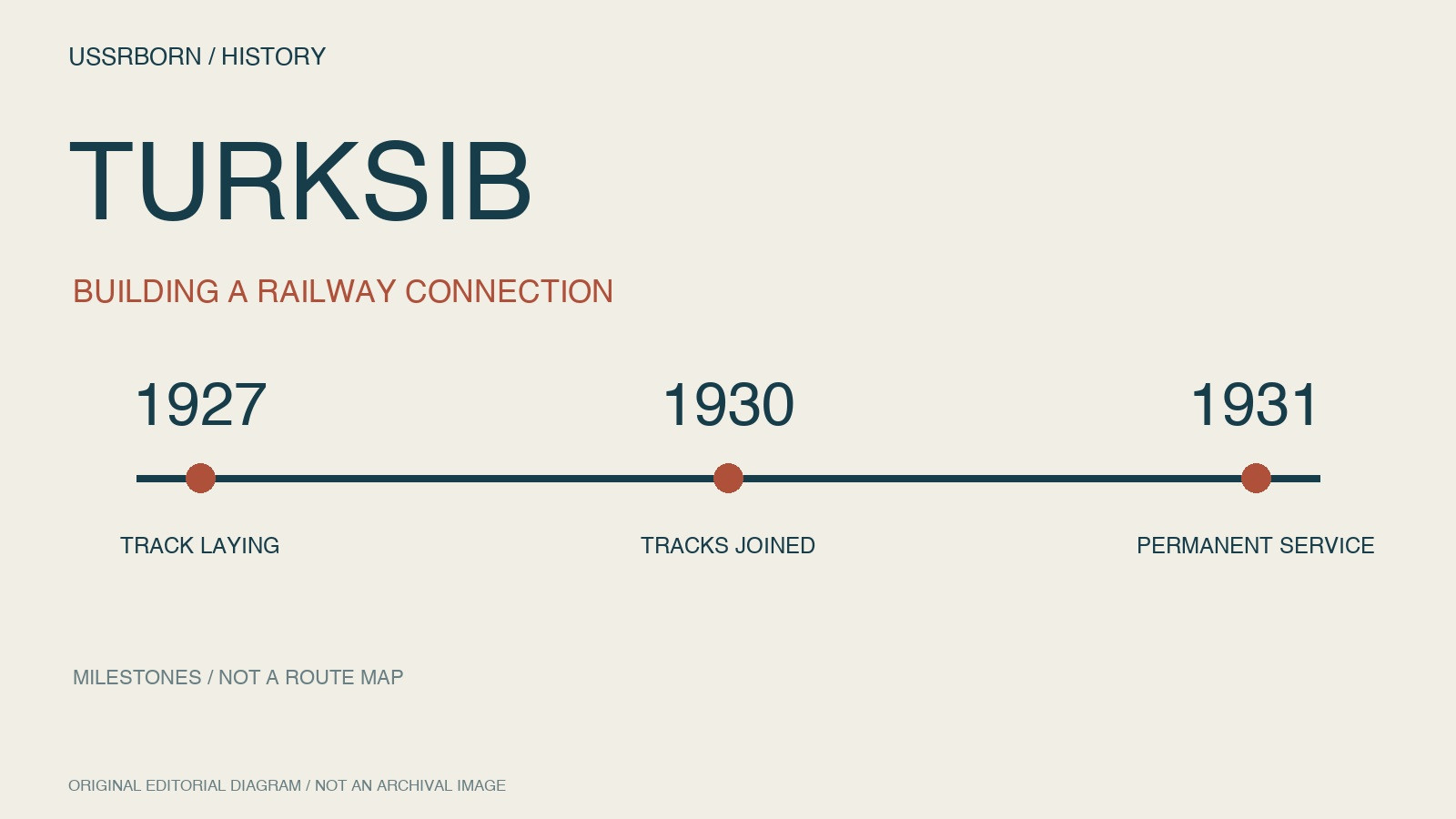
The Turksib railway is often remembered through the image of workers joining two advancing tracks. That moment was only one stage in the construction of the Turkestan-Siberian railway. The decision to build it, the first track laying, the physical connection and the start of permanent operation belong to different dates. Keeping those stages separate makes the project easier to understand as both infrastructure and a symbol of Soviet industrialization.
What the railway connected
Turksib linked railway routes serving Siberia and Central Asia through Kazakhstan. The new construction between Semipalatinsk, now Semey, and Lugovaya included the Alma-Ata area. Its economic rationale involved connecting regions with different agricultural resources, including grain and cotton. Proposals for such a connection predated the revolution; the first five-year plan did not create the idea from nothing.
A railway's economic role cannot be read from its length alone. The useful questions are which existing routes it joins, where freight can change direction and which producers gain access to transport. A line on a map acquires meaning through those connections. The name Turkestan-Siberian therefore describes a broader transport relationship, not a claim that an entirely new railway across both regions was constructed in a single campaign.
This is also a useful way into the history of the Soviet planned economy. Transport connects the activities of different branches of production. Building a route, however, is not itself evidence that every associated output target was achieved. Infrastructure and the economic results attributed to it require different kinds of evidence.
Construction from two directions
The government approved construction on 3 December 1926. Track laying began at Semipalatinsk on 15 September 1927 and at Lugovaya on 19 November. These starting dates appear in Qazaqstan Tarihy's account of the project.
Working from opposite ends allowed construction to proceed on two sections at once. It also made coordination essential: the separate works had to become a continuous railway. A diagram can reduce that task to two lines approaching each other, but the physical system includes embankments, bridges, stations and maintenance facilities as well as rails.
The distinction is comparable to that encountered in the history of Dneproges. A power station and a railway perform different functions, yet both can be misrepresented when a ceremony is treated as a complete account of their construction. An inauguration identifies a milestone. It does not describe everything needed to keep an installation working afterward.
The connection in 1930 and permanent operation in 1931
A 2010 bulletin of the Archive of the President of Kazakhstan distinguishes the physical joining of the tracks on 21 April 1930 from the ceremony on 28 April. The ceremonial silver spike was driven at Ogyz-Korgan, the station also associated with the name Aina-Bulak. The same account dates entry into permanent operation to 1 January 1931. This distinction follows the archive bulletin, printed page 89.
The answer to “When was Turksib built?” therefore depends on the event intended:
- 1927 marks the start of track laying from the northern and southern directions.
- April 1930 marks the connection and the public celebrations.
- 1 January 1931 marks the start of permanent operation.
These are complementary milestones rather than interchangeable opening dates. A photograph of a celebration, a newspaper report about the final rail connection and a station's operational record may all concern the same railway while documenting different stages.
For anyone examining family papers, this matters more than choosing a single anniversary. The date on an image should be connected to the occasion it depicts. A relative's presence at a construction site does not by itself establish participation in the opening ceremony, just as a ceremonial photograph does not prove the date on which that person began railway employment.
Mukhamedzhan Tynyshpaev and the engineering behind the route
Engineer Mukhamedzhan Tynyshpaev joined the committee assisting Turksib construction in January 1927. His work included route proposals, notably the Chokpar option, and the preparation of personnel for railway operation. These aspects are described in Qazaqstan Tarihy's biographical entry.
His participation draws attention to decisions that a completion photograph cannot show. Choosing a route affects both the amount of construction and the work required to maintain and operate the line. Personnel training belongs to infrastructure development for the same reason: track without people able to manage traffic and maintain it is not a functioning railway system.
An individual biography should nevertheless retain the limits of that person's responsibility. Proposing a route, directing a construction organization and working on a particular section are distinct contributions. Recognizing an engineer's role does not require assigning an entire collective project to him. The relevant question is which decisions and tasks the surviving evidence connects to that individual.
A railway represented in film
Viktor Turin's documentary Turksib dates from 1929, while construction was still underway. The British Film Institute describes its montage technique and its influence on British documentary filmmaking; John Grierson prepared the English version. The film's identification and description can be checked in the BFI catalogue.
That date establishes an important limit for interpretation. Images from the film cannot automatically be treated as evidence of a railway already in permanent operation. A documentary arranges recorded scenes into an argument: the choice of subjects, the order of shots and the rhythm of editing shape what the audience understands. Authentic images and an authored narrative can coexist.
The same distinction is helpful when approaching Soviet cinema more broadly. A film can be a source for the appearance of a construction site and for the way industrial development was presented, without functioning as an unedited record of every stage of the project.
Turksib can consequently be studied as a transport connection, an engineering undertaking and a public image of industrialization. For a comparison with a later railway campaign, see the Baikal-Amur Mainline. Comparing the purposes, operating conditions and stages of commissioning is more revealing than comparing slogans alone.