Leningrad Metro’s 1955 Opening: Seven Stations on the First Line
Why Leningrad Metro opened with seven stations although its first stage contained eight: 15 November 1955, Pushkinskaya’s delay and Avtovo’s architecture.
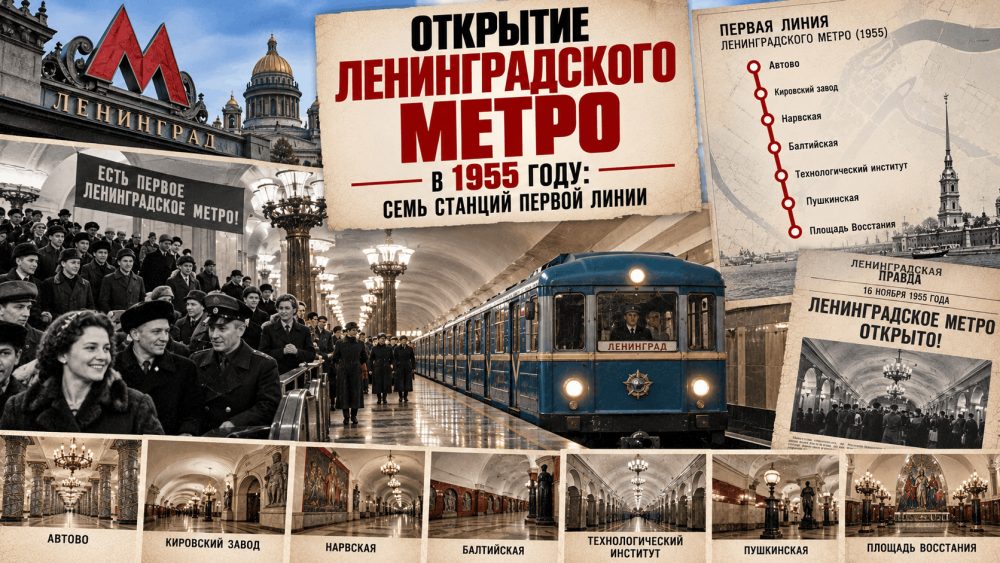
Leningrad’s metro opened to the public on 15 November 1955. Its initial 10.8-kilometre route connected Avtovo with Ploshchad Vosstaniya. A familiar description of its first construction stage as having eight stations needs qualification: seven opened that November, while Pushkinskaya began serving passengers on 30 April 1956.
The distinction reveals something important about a large transport project. Completion of a construction stage, trial running and the start of public service need not share the same date.
Construction and the meaning of an opening date
The Presidential Library dates the beginning of construction to 1941 and describes its interruption by the war. The project’s history therefore cannot be presented as an uninterrupted progression from initial work to the first passenger train. The war and the siege of Leningrad stand between those moments.
There is more than one possible milestone in a railway’s beginnings. A specialist historical chronicle records a trial train on 8 October 1955, an acceptance document on 5 November and journeys for invited passengers before the public opening. Regular public access began on 15 November. That is the relevant date when asking when residents could start using their new metro.
A trial run and a public opening answer different questions. Testing establishes how equipment and structures perform in operation. Opening a service means that the connected system must handle passengers according to an established operating arrangement. A photograph of an early train is consequently not sufficient evidence that the railway was already open to everyone.
Seven stations open, eight in the first stage
The metro’s official historical timeline lists seven stations for 1955: Avtovo, Kirovsky Zavod, Narvskaya, Baltiyskaya, Tekhnologichesky Institut, Vladimirskaya and Ploshchad Vosstaniya.
Pushkinskaya belonged to the first construction stage but opened later. The metro’s historical station project attributes the delay to quicksand encountered during construction of its inclined access passage. Its opening date was 30 April 1956.
Seven and eight therefore describe different totals. Seven counts the stations available to passengers in November 1955; eight describes the first stage including Pushkinskaya. Without identifying what is being counted, two individually meaningful figures can appear contradictory.
This is a useful distinction for transport history more generally. A construction programme is not necessarily a snapshot of the accessible network on opening day. The project’s boundaries, its intended stations and the entrances actually available to travellers are separate pieces of evidence.
A concise chronology is more useful here than choosing one number and discarding the other: public service began in November, and the additional station opened the following April.
What makes Avtovo memorable
Avtovo demonstrates that a metro station could be conceived as more than an engineering enclosure. Designed by Yevgeny Levinson and Andrey Grushke, it combines marble-clad columns with glass-clad ones. Sixteen of its 46 columns received glass cladding.
The distinction between material and appearance matters. The glittering finish is glass; its visual richness does not make the columns crystal. Light, surface treatment and the repetition of structural elements together create the impression of a ceremonial hall.
The history of the Moscow Metro offers another example of monumental settings built for everyday journeys. Yet Leningrad’s stations deserve attention as individual designs. The general phrase “underground palaces” can obscure the particular arrangement of a platform hall, access passages and entrance.
Passengers experience this architecture while moving. They enter, orient themselves, descend to the platform and identify their direction of travel. A handsome room becomes part of a useful transport experience through its relationship with that sequence.
Architectural description also has limits. An impressive photograph cannot tell us how crowded a platform was, how long someone waited or how convenient the station was for a particular neighbourhood. Those questions require different evidence.
The railway beyond the platform
The Presidential Library’s historical material includes workers’ biographies, documents and personal objects. This approach brings people back into a story that can otherwise become a collection of ceremonial interiors. Decoration alone could never operate a station.
Any passenger railway has activities largely invisible from its platforms: maintaining trains, checking equipment, preparing staff, cleaning and arranging movements. This is a general explanation of how a metro functions, rather than a claim about a particular incident on Leningrad’s first day. It helps explain why opening a line means bringing an interconnected system into service.
In the context of everyday life in the USSR, the metro is especially interesting as a recurring urban service. A journey to work or a mainline railway station depends on access and connections as well as the speed of a train between platforms. Without passenger or travel-time data, the first line should not be credited with a precise saving for the city as a whole.
Transport development can also be considered alongside mass housing construction. Where people live and how they reach their destinations are connected questions. That connection is a way to investigate urban history, not evidence that one initial line immediately solved the needs of every district.
Questions about the first line
When did the metro open? Public service began on 15 November 1955. Trial running preceded it.
Why do accounts mention both seven and eight stations? Seven opened in November 1955. Pushkinskaya, the additional station in the first construction stage, opened in April 1956.
Why distinguish these milestones? They describe different achievements: testing the railway, admitting the public and completing access to another station. Keeping them separate makes the beginning of Leningrad’s metro more intelligible without reducing its history to a single ceremony.