The Warsaw Pact: the alliance that fought only its own members
Moscow's answer to NATO: eight countries, a unified command and 36 years of standoff. The bloc's paradox is that in its entire history its armies fought together only once — against one of its own members.
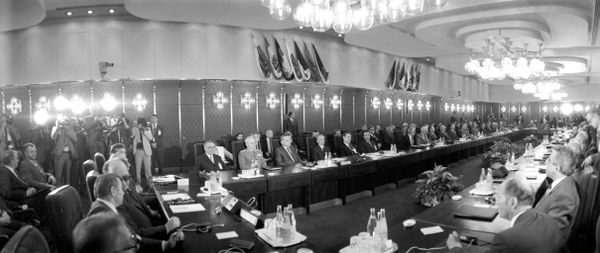
What the Warsaw Pact was
The Warsaw Pact was the military alliance of the USSR and the socialist countries of Eastern Europe, in existence from 1955 to 1991. Its official name was the Treaty of Friendship, Cooperation and Mutual Assistance; the alliance itself was known as the Warsaw Treaty Organization. It was NATO's mirror image on the eastern side of the Iron Curtain: a unified command, joint exercises, and a pledge of mutual defense in case of attack.
There were eight signatories: the USSR, Poland, East Germany, Czechoslovakia, Hungary, Romania, Bulgaria and Albania. On paper the alliance rested on equality and non-interference in internal affairs; in practice all decisions were made in Moscow, and the supreme commanders of the joint armed forces were always Soviet marshals — the first being Marshal Konev. It was along the line of confrontation between the Pact and NATO, through divided Germany, that the most heavily armed frontier on the planet ran.
Why it was created
The formal trigger was specific: in May 1955 West Germany joined NATO — with the right to rebuild an army. For Moscow and for Eastern Europe, where the memory of the war was fresh, German remilitarization sounded like an alarm bell; the treaty signed in Warsaw on May 14, 1955, named it explicitly as the chief threat.
There is also a less-known prehistory: in 1954 the USSR formally proposed itself for NATO membership — and was turned down. Only after that did Moscow build a bloc of its own. Khrushchev later claimed that the Pact's original purpose was a trade: the simultaneous dissolution of both blocs — and the treaty did indeed contain a clause providing for its termination if a general European security system were created. Skeptics reasonably object that Soviet control over Eastern Europe existed well before 1955 — the bilateral treaties and the garrisons were already in place — so the new alliance largely formalized what already existed. NATO officials nicknamed it a "cardboard castle" for that reason. We present both readings — defensive response and instrument of control — side by side: in reality the bloc was both.
How the bloc worked
The supreme political organ was the Political Consultative Committee; the military one, the Combined Command of the armed forces, with its staff in Moscow and structures in Warsaw. The member armies were re-equipped to Soviet standards, their officers trained in Soviet academies, and huge joint exercises — Zapad, Dnepr, Shield — rehearsed war with NATO. Soviet troops were permanently stationed on the allies' territory: their presence, fixed by separate treaties, was at once a guarantee of "protection" and an instrument of supervision.
In sheer numbers in Europe the Pact outmatched NATO, above all in tanks — the tens of thousands of machines massed near the western borders remained NATO planners' chief nightmare for decades. The war plans of both sides, declassified later, envisaged rapid offensive operations with the use of nuclear weapons — Europe was mapped out for a war that, fortunately, never came.
Wars against its own
The Pact's central paradox: in 36 years the bloc never fought an external enemy — but it did use force within itself.
- Hungary, 1956. The uprising in Budapest and the Nagy government's declaration that it was leaving the Pact were crushed by the Soviet army; the treaty served as the political justification. Thousands of Hungarians died and hundreds of thousands fled to the West.
- Czechoslovakia, 1968. The Prague Spring — the attempt to build "socialism with a human face" — was flattened by a genuinely collective operation, Danube: the troops of five Pact countries. It was the bloc's only joint combat operation in its entire history — against one of its own members. Romania refused to take part, and Albania, after the invasion, finally left the organization (it had effectively distanced itself in the early 1960s, after Moscow's split with Beijing).
- Poland, 1980–81. An intervention against the Solidarity movement was prepared but proved unnecessary: the Polish general Jaruzelski imposed martial law himself — in the view of many historians, at least partly under the threat of "fraternal assistance."
After 1968 the practice acquired a name — the Brezhnev Doctrine: the sovereignty of a socialist country is limited by the interests of the socialist commonwealth. In plain terms: joining the bloc was easy; leaving was not an option.
The end of the bloc
The Pact rested on Moscow's readiness to use force — and it collapsed when Gorbachev renounced it. In the autumn of 1989 the communist regimes of Eastern Europe fell one after another, the Berlin Wall came down, and the alliance lost its meaning before everyone's eyes. In 1990 reunified Germany went to NATO whole — a scenario unthinkable five years earlier.
On February 25, 1991, in Budapest, the ministers of the remaining member states agreed on dissolution; on March 31 the military structures ceased to exist, and on July 1, 1991, in Prague — the very city the bloc had stormed in 1968 — Czechoslovak President Václav Havel signed the protocol formally ending the Warsaw Treaty Organization. Six months later the USSR itself was gone.
The final irony is well known: nearly all the Pact's former members — Poland, the Czech Republic, Slovakia, Hungary, Romania, Bulgaria, Albania, and even the former East Germany as part of reunified Germany — eventually joined NATO. The bloc created to oppose the North Atlantic alliance ended up as its recruiting pool.
Frequently asked questions
What was the Warsaw Pact, in simple terms? The military alliance of the USSR and Eastern Europe (1955–1991) — the eastern counterweight to NATO, with a unified command headed by Soviet marshals.
Which countries were in the Warsaw Pact? The USSR, Poland, East Germany, Czechoslovakia, Hungary, Romania, Bulgaria and Albania (which effectively stopped participating in the early 1960s and formally left in 1968). East Germany left in 1990 upon German reunification.
Why was the Warsaw Pact created? As a response to remilitarized West Germany's admission to NATO in May 1955 — and as the formalization of Soviet military control over Eastern Europe. Notably, a year earlier the USSR had itself applied to join NATO and been refused.
Did the Warsaw Pact ever fight NATO? No — there was never a direct clash between the blocs. The Pact's only joint combat operation was the invasion of Czechoslovakia in 1968 — against one of its own members.
What was the Brezhnev Doctrine? The principle formalized after 1968: the sovereignty of socialist countries is limited, and the bloc has the right to "defend socialism" by force in any of them. In the West it was called the doctrine of limited sovereignty.
When and how was the Warsaw Pact dissolved? After the revolutions of 1989 the bloc lost its purpose: the military structures were disbanded on March 31, 1991, and on July 1, 1991, the protocol formally ending the treaty was signed in Prague. Nearly all its former members later joined NATO.
Related
- The Cold War: half a century of confrontation — the conflict whose army the bloc was.
- The Iron Curtain — the border along which the Pact and NATO faced each other.
- Nikita Khrushchev — the leader under whom the bloc was created.
- Mikhail Gorbachev — the leader under whom it was let go.
- The dissolution of the USSR (1991) — the end of the country that outlived its alliance by six months.
Sources
The facts in this article can be verified against authoritative sources:
- Encyclopaedia Britannica, "Warsaw Pact": https://www.britannica.com/event/Warsaw-Pact
- Wikipedia, "Warsaw Pact": https://en.wikipedia.org/wiki/Warsaw_Pact
- U.S. Department of State, Office of the Historian, "The Warsaw Treaty Organization, 1955": https://history.state.gov/milestones/1953-1960/warsaw-treaty
- History Hit, "What Was the Warsaw Pact?": https://www.historyhit.com/what-was-the-warsaw-pact/
- HISTORY, "The Warsaw Pact is formed": https://www.history.com/this-day-in-history/may-14/the-warsaw-pact-is-formed
Where interpretations diverge (defensive alliance or instrument of control), we present both positions and the facts behind each.