The AK-47: the most mass-produced weapon in history
The son of dispossessed peasants conceived it on a hospital bed, and the world replicated it a hundred million times. The story of the AK-47 — from a secret design contest to the flag of Mozambique and its creator's letter to the Patriarch.
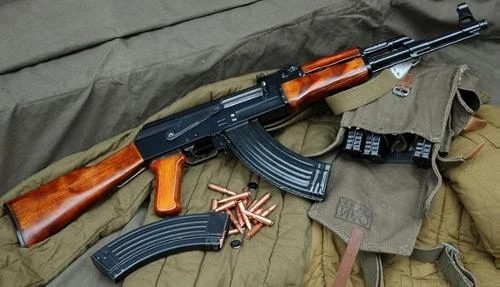
What the AK-47 is
The AK-47 — Avtomat Kalashnikova, "Kalashnikov's automatic rifle, model of 1947" — is the Soviet assault rifle chambered for the intermediate 7.62×39 mm cartridge and adopted into service in 1949. Together with its descendants — the modernized AKM, the AK-74 and countless copies — it forms the most mass-produced family of firearms in history: an estimated 70 to 100 million Kalashnikovs have been made, roughly one for every seventy people alive on Earth.
Alongside Sputnik and the T-34, the Kalashnikov is one of the most recognizable objects the USSR ever produced: the silhouette with the curved magazine is known on every continent, the word "Kalashnikov" has entered the dictionaries of dozens of languages, and the rifle itself appears on the flag of Mozambique and the emblems of several states. The story of that fame is a double one, and we tell both of its sides.
A sergeant on a hospital bed
The designer's biography reads like a Soviet novel with all its contradictions. Mikhail Kalashnikov was born in 1919 in the Altai village of Kurya, the seventeenth child of a peasant family — a family that was dispossessed as "kulaks" during collectivization and deported to Siberia. History's irony: the chief weapon-symbol of the Soviet state was created by the son of peasants it had repressed.
Self-taught, with no higher education, a tractor-station mechanic before the army, Kalashnikov commanded a T-34 tank in the war and was badly wounded near Bryansk in October 1941. By his own account, the idea was born in the hospital — from a bitter question asked by the soldier in the next bed: why do the Germans have automatic weapons while our men share one rifle among two or three? The wounded man's talent was noticed: from 1942 the sergeant was attached to the army's small-arms proving ground.
The secret contest and the birth of a legend
In 1946 the USSR announced a closed competition for an automatic rifle chambered for the new intermediate cartridge — the classic Stalin-era scheme of rival design teams. Young Kalashnikov and his group of engineers entered under the alias "Mikhtim" (from Mikhail Timofeyevich) — competing against far more celebrated gunsmiths. The decisive year was 1947: on the advice of his colleague Aleksandr Zaitsev, the design was radically reworked for reliability, and the new prototype won the grueling trials. In 1949 the rifle was adopted by the Soviet Army; production was established in Izhevsk.
The genius of the design lies in deliberate simplicity. Gas-operated action, a minimum of parts, generous clearances between them: where precision mechanisms jam with dirt, the Kalashnikov keeps firing — in sand, in swamp, in snow, after falls and without cleaning. It is cheap to make, strips in minutes, and a recruit masters it in hours. The design pays willingly in accuracy — the wager was placed on dependability, and it was dependability that made the AK global.
How the Kalashnikov conquered the planet
What followed was decided less by the weapon's qualities than by the politics of the Cold War. The USSR armed the Warsaw Pact with the rifle, then handed out the weapons themselves, the licenses, and entire factories to allies and "friendly movements" around the world — from China and Egypt to Cuba. No one thought to patent the design until 1997, and copies poured in from everywhere: roughly half of all Kalashnikovs were produced outside Russia, from state factories to backstreet workshops.
By the end of the 20th century the rifle had become a symbol with two opposite meanings. For some, a "weapon of liberation": anti-colonial movements fought with it, and it entered the flag of Mozambique as the mark of independence won. For others, a weapon of terror and chaos: the Kalashnikov became the principal tool of civil wars, insurgencies and crime on three continents, its price in conflict zones falling to a few tens of dollars. In Afghanistan, Soviet soldiers faced their own weapon in the hands of the mujahideen, for whom arsenals were bought up worldwide. Both meanings are true of one and the same object — and that is the AK phenomenon.
The designer and his conscience
Kalashnikov himself lived to 94, became twice a Hero of his country, a lieutenant general and a national symbol — and spent his whole life answering the same question: how does he sleep, knowing how many people his invention has killed? For decades the designer's answer was firm: he had created a weapon to defend his homeland, and politicians were to answer for whose hands it fell into. "I created a weapon of defense, not of offense" — that formula was his shield.
But in the last year of his life, in 2013, the 93-year-old Kalashnikov wrote a letter to Patriarch Kirill that traveled around the world's press: he confessed to unbearable spiritual pain and to an unsolvable question — if his rifle had taken people's lives, did that mean he bore the guilt for their deaths? He signed himself "a slave of God." Even the creator could not settle the eternal argument — does the weapon kill, or the man — and we leave the question open, as he left it.
The legacy
The AK long ago outgrew the status of a weapon and became a cultural phenomenon: it appears in hundreds of films and games, in museums from Izhevsk to the Smithsonian, in street art and on jewelry. The family lives on: the AKM of 1959, the small-caliber AK-74, the modern AK-12 — all direct descendants of the 1947 model, and dozens of the world's armies still carry Kalashnikovs of various generations.
In Soviet history the rifle stands beside the T-34: a simple, unfailing, mass-produced machine — the quintessence of the Soviet engineering school, which prized reliability and manufacturability above elegance. With one difference: the T-34 remained in its own war, while the Kalashnikov goes on firing in every war of the present day — perhaps the heaviest legacy of Soviet industry among all those that outlived the country.
Frequently asked questions
What does the name AK-47 mean? Avtomat Kalashnikova — "Kalashnikov's automatic rifle" — model of 1947, after the designer Mikhail Kalashnikov and the year of the final prototype. It was adopted into service in 1949.
Why is the AK-47 considered so reliable? Because of the deliberate simplicity of its design: few parts and generous clearances between them let the rifle work in mud, sand and with minimal care — where more precise weapons fail.
How many Kalashnikov rifles have been made? An estimated 70 to 100 million weapons of the AK family — more than any other firearm in history. About half were produced outside Russia, often without license.
Who was Mikhail Kalashnikov? A self-taught designer (1919–2013), son of dispossessed peasants, a tank commander of the Second World War. He created the AK-47 and an entire family of weapons, became a national hero — and at the end of his life wrote to the Patriarch about the torments of his conscience.
Why is the AK-47 on the flag of Mozambique? As a symbol of the armed struggle for independence: the rifle was the main weapon of Africa's anti-colonial movements. The AK also appears on the emblems of several other states.
How do the AKM and AK-74 differ from the AK-47? The AKM (1959) is a modernized, cheaper version with a stamped receiver; the AK-74 (1974) is chambered for the small-caliber 5.45 mm round. Both are direct developments of the 1947 design.
Related
- The T-34 tank — the other great symbol of the Soviet school of arms.
- The Great Patriotic War — the war whose experience gave birth to the rifle.
- The Cold War — the confrontation that carried the AK across the planet.
- The Soviet-Afghan War — where the Kalashnikov fired from both sides.
Sources
The facts in this article can be verified against authoritative sources:
- Encyclopaedia Britannica, "AK-47": https://www.britannica.com/technology/AK-47
- Wikipedia, "AK-47": https://en.wikipedia.org/wiki/AK-47
- Wikipedia, "Mikhail Kalashnikov": https://en.wikipedia.org/wiki/Mikhail_Kalashnikov
- Smithsonian Institution, "AK-47 Automatic Rifle": https://www.si.edu/object/ak-47-automatic-rifle:nmah_439260
- The Conversation, "World's deadliest inventor: Mikhail Kalashnikov and his AK-47": https://theconversation.com/worlds-deadliest-inventor-mikhail-kalashnikov-and-his-ak-47-126253
Where assessments diverge (a weapon of defense or the instrument of the world's conflicts), we give both frames — including the designer's own late reflection.