The Soviet dry law: the anti-alcohol campaign of 1985
A campaign that gave men two and a half extra years of life, cut down the vineyards of Crimea and blew a hole in the state budget. A rare case of a reform that saved millions of people and still went down in history as a failure.
The country and the bottle
By the mid-1980s alcohol was not a habit of Soviet society but its diagnosis. Consumption had risen for thirty years straight and passed 14 liters of pure alcohol per person per year: nearly double the American figure. Drink absorbed up to 15 or 20 percent of family income, vodka worked as a second currency for paying the plumber and the tractor driver, and male mortality made the USSR an anomaly among developed countries. Drinking on the job was so routine that it generated jokes rather than reports.
The leadership saw the numbers better than anyone: lost productivity, injuries, divorces, crime. Talk of drastic measures had begun under Andropov. Acting fell to the new general secretary.
The decree and the axe
On May 16, 1985, two months after Gorbachev came to power, the country read a decree on the struggle against drunkenness. The campaign's real engine was not so much Gorbachev as Central Committee secretary Yegor Ligachev, but popular memory pinned everything on the general secretary.
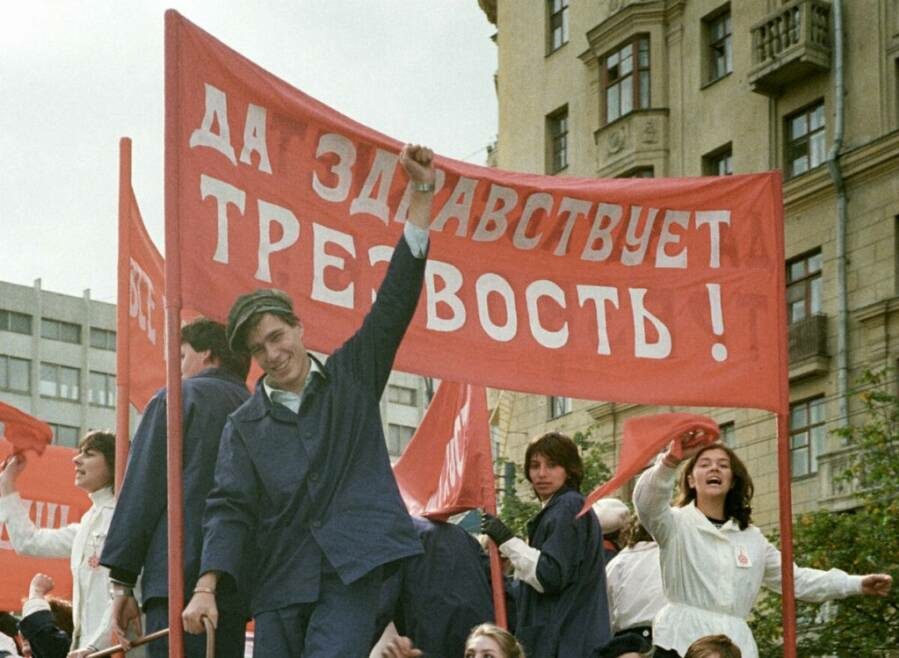
The measures landed all at once. Most liquor stores closed; the survivors opened at two in the afternoon, and the lines outside them became the longest lines in the country. Vodka prices multiplied. Appearing drunk at work or in public was punishable; every factory and institute was ordered to form a Sobriety Society. Weddings were prescribed dry, and drinking scenes were cut from old films.
The most irreversible measure was the axe. In Crimea, Moldova and the Caucasus, vineyards went under the blade, including unique heritage varieties bred over decades; there was even talk of destroying the legendary Massandra cellars with their century-old wines. Pavel Golodriga, director of the Magarach wine institute in Crimea, took his own life, unable to watch his life's work destroyed. The country's viticulture has not recovered from those years to this day.
What it achieved: life
Now the part of the story usually skipped, and wrongly so: the campaign worked. Alcohol sales collapsed, and after them the curves that had refused to move for decades finally bent. Male life expectancy rose by 2.6 years within two or three years: an unprecedented peacetime jump. Workplace injuries fell by about a fifth, road accidents by a third, and the birth rate climbed: the country lived through a brief "Gorbachev baby boom."
Later research judged the scale even more starkly. Economists who studied mortality region by region (the Bhattacharya, Gathmann and Miller study) concluded that the campaign saved on the order of a million lives a year, and that the terrible mortality surge of the Russian 1990s is explained in large part by its cancellation: people stopped drinking under Gorbachev and started dying when the restrictions ended. This inverts the familiar picture: perestroika's most ridiculed reform turns out to have been its most underrated.
What it achieved: everything else
The failure was as real as the success, and it came on three fronts.
First: people did not stop drinking, they stopped buying. The country switched to moonshine, and sugar vanished from the shops, followed by yeast; sugar went on ration cards. People drank surrogates too, from cologne to industrial fluids, with poisonings and deaths. The alcohol black market raised a whole generation of underground traders: the future cooperative businessmen and gangsters of the 1990s did their apprenticeships here.
Second: the budget. Alcohol duties supplied a huge share of state revenue, and the campaign blew a multibillion hole in it. By evil coincidence, oil prices collapsed in 1986, and the budget's other pillar vanished as well. With an emptying treasury the country entered the era of total shortages, and the lines for vodka gave way to lines for everything.
Third: authority. The people answered the campaign with the supreme Soviet weapon, the joke. Gorbachev was nicknamed the "mineral secretary," and the vodka line became a folklore genre of its own. A reformer who began by confiscating a familiar pleasure had spent his credit of trust before he even announced perestroika; historians count the campaign as the first blow to Gorbachev's standing at home.
By 1988 the campaign was quietly wound down: the budget shouted louder than the sobriety societies. Years later Gorbachev admitted that because of mistakes in execution, a good cause had ended badly.
The lessons of one campaign
The Soviet dry law became a textbook case in the world's debates over alcohol regulation, and both sides cite it with equal confidence. Opponents of prohibition point to the moonshine, the surrogates and the destroyed trust: demand does not disappear, it goes underground. Supporters answer with the mortality chart: restricting access saved more lives than any other measure in Soviet history, and the price of abandoning it was measured in the cemeteries of the 1990s.
Both truths are documented, and we will not choose between them. We will say only what follows from the facts: the campaign of 1985 saved people and wrecked the state at the same time, and in that it proved an exact model of perestroika itself.
Frequently asked questions
Was there a dry law in the USSR? Strictly speaking, no total ban existed: the anti-alcohol campaign of 1985 to 1988 sharply restricted sales and raised prices. The decree came on May 16, 1985; the campaign was wound down by 1988.
Who invented the anti-alcohol campaign? Its chief engine is considered to be Central Committee secretary Yegor Ligachev; the decision was taken by the party leadership under Gorbachev, and popular memory calls the campaign his.
Did the campaign help? Yes: alcohol sales halved, male life expectancy rose by 2.6 years, injuries and road accidents fell, and the birth rate climbed. Research puts the effect at hundreds of thousands of lives saved per year.
Why is the campaign considered a failure? Because of its price: a moonshine and surrogate boom, sugar rationing, multibillion budget losses on top of the oil price collapse, destroyed vineyards, and the erosion of trust in Gorbachev.
Were the vineyards really cut down? Yes: in Crimea, Moldova and the Caucasus the axe took, among others, unique heritage varieties. The director of the Magarach wine institute took his own life, unable to bear the destruction of his work.
How did the campaign end? It was wound down by 1988 for the sake of budget revenue. Alcohol consumption returned and exceeded the old level, and researchers link the mortality surge of the 1990s in large part to the lifting of the restrictions.
Related
- Mikhail Gorbachev: the leader whose name the campaign carries.
- Perestroika and glasnost: the reforms for which the campaign was the first bell.
- Shortages in the USSR: the ration card economy that began with sugar.
- The dissolution of the USSR (1991): the ending toward which the budget hole of 1985 also led.
Sources
The facts in this article can be verified against authoritative sources:
- Radio Free Europe / Radio Liberty, "Gorbachev Says He Botched Soviet Anti-Booze Effort": https://www.rferl.org/a/russia-gorbachev-admits-botching-anti-alcohol-campaign/27018247.html
- NBER (National Bureau of Economic Research), Bhattacharya, Gathmann, Miller, "The Gorbachev Anti-Alcohol Campaign and Russia's Mortality Crisis": https://www.nber.org/papers/w18589
- PMC / US National Institutes of Health, full text of the same study: https://pmc.ncbi.nlm.nih.gov/articles/PMC3818525
- Realnoe Vremya, "Sergey Khestanov about failure of anti-alcohol campaign": https://realnoevremya.com/articles/4483-sergey-khestanov-about-failure-of-anti-alcohol-campaign
- AllPerestroika, "Gorbachev's anti-alcohol campaign in 1985": https://allperestroika.ru/en/soviet-anti-alcohol-campaign-1985.html
Where assessments diverge (lives saved against a wrecked economy and trust), we present the data of both sides.