The Elbe Meeting in 1945: Strehla, Torgau and the Famous Handshake
Trace the Allied Elbe link-up on 25 April 1945: first contacts near Strehla, the handshake at Torgau, the commanders’ ceremony and the photographs.
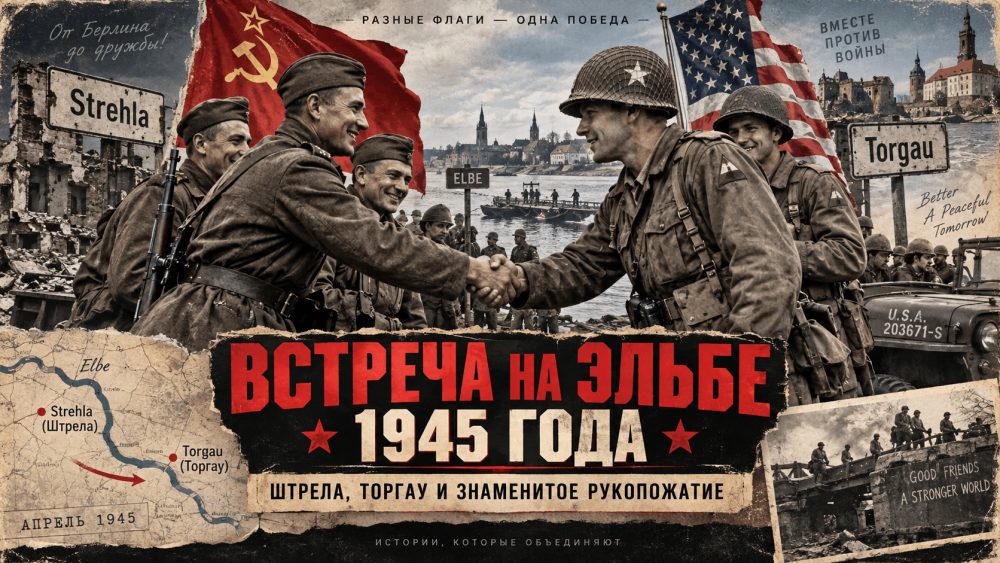
American and Soviet soldiers met on the Elbe on 25 April 1945. Public memory associates the event with Torgau and a handshake on a damaged bridge. Its history, however, extends beyond a single photograph. Several patrol contacts took place that day, followed by an official meeting between divisional commanders.
Keeping those stages separate makes the encounter more understandable without diminishing its symbolic importance.
The military setting
In the spring of 1945, the western Allies advanced into Germany from the west while the Red Army approached from the east. By late April, their forward troops were close enough to establish direct contact. Their link-up marked a further breakdown of the German front.
The wider eastern campaign is discussed in our account of the Great Patriotic War. On the Elbe, armies operating along different axes finally encountered one another. Allied cooperation had also taken other forms, including Lend-Lease supplies, but a meeting between soldiers provided a particularly immediate image of their common struggle.
This was not yet the end of all fighting. The appearance of an Allied soldier on the opposite bank did not mean that every German unit had surrendered or that everyone in the surrounding area was safe.
Why the story is not confined to Torgau
The US National Archives locates the first documented meeting on 25 April on the banks of the Elbe near Strehla. Its exhibition account refers to morning-report entries. This is an important distinction: the most famous location associated with an event is not necessarily the location of its earliest occurrence.
The US Army Center of Military History describes several contacts involving patrols from the 69th Infantry Division that day. “The meeting on the Elbe” consequently covers a sequence of encounters rather than a single ceremony arranged in advance.
At Torgau, American officer William Robertson and Soviet lieutenant Alexander Silvashko met on the damaged bridge. The Torgau memorial institution places this episode within the wider meeting of Allied forces along the river.
There is no contradiction in distinguishing the initial contacts around Strehla from Torgau's later prominence as the symbolic site. One question concerns chronology; the other concerns the way the event was remembered and represented.
From patrol contact to an official link-up
The American troops belonged to the 69th Infantry Division, while the Soviet formation involved was the 58th Guards Rifle Division. On 26 April, American divisional commander Major General Emil Reinhardt met his Soviet counterpart, Major General Vladimir Rusakov, at Torgau. The Army's historical account identifies this as the first official link-up ceremony.
The distinction between patrols and commanders explains the sequence. A patrol establishes contact, reports what it has found and helps clarify the position of Allied forces. Commanders subsequently confirm the meeting at formation level. A ceremony gives public expression to something that has already happened in the field.
Combining those stages produces a misleading picture in which the first soldiers somehow meet immediately in front of assembled commanders and photographers. The less ceremonial sequence is historically more revealing: contact had to be established before it could be formally celebrated.
It also explains why captions and short chronologies may use different dates while referring to related events. A patrol encounter on one day and a commanders' ceremony on the next are not alternative dates for an identical action.
The handshake and the photograph
The Torgau memorial account explains that the well-known handshake photograph was a reenactment for the camera. This does not invalidate the actual encounter of 25 April. It means that the meeting and the production of a particular photograph must be considered separately.
A wartime image can show real participants while repeating an earlier moment. Its caption therefore matters: who appears, where the photograph was made and when it was taken. A recognizable gesture cannot reconstruct every event of the day by itself.
The cover of this article is an original editorial sequence diagram, not a reconstruction of an archival photograph. It distinguishes patrol contact from the official commanders' meeting and does not claim to map the precise terrain.
The consequences of war behind the celebratory image
The Holocaust Encyclopedia's history of the 69th Division supplies essential context for its advance towards the Elbe. In April, its soldiers encountered the aftermath of crimes against prisoners at Leipzig-Thekla, a Buchenwald subcamp, and assisted survivors.
This prevents the final phase of the war from being understood solely as a series of joyful encounters. Liberated people needed food, medical treatment and the restoration of basic living conditions. Military victory and recovery from the consequences of war were connected, but they were not the same task.
An image of Allied soldiers greeting one another captures one real aspect of the period. It cannot stand for every experience unfolding nearby. The experiences of liberated prisoners belong in the same history, even when they fall outside the familiar photograph.
Nor did the end of combat mean an immediate journey home for every serviceman. The later process of Soviet demobilization in 1945 had its own rules, priorities and timetable. The Elbe encounter was a major step towards the war's conclusion, not a replacement for the decisions that followed.
Cooperation and later memory
The meeting retained its importance as a symbol of wartime cooperation even as relations between the former allies deteriorated. The history of the Cold War should not erase the reality of their shared struggle against Nazi Germany.
The reverse is equally important. A photograph of a handshake does not demonstrate that later political disagreements were impossible or insignificant. It belongs to a specific moment and a particular military achievement.
The encounter is best understood by preserving a few distinctions: Strehla and Torgau; patrol meetings and an official ceremony; an event and its photographic reenactment; the joining of forces and the end of the war. These distinctions allow the Elbe meeting to remain a powerful historical image without making it carry the whole complexity of April 1945.
Sources
- US National Archives. American and Russian Troops Meet at the Elbe.
- US Army Center of Military History. May 8: Victory in Europe Day.
- Torgau memorial institution. The handshake on the Elbe, 25 April 1945.
- US Holocaust Memorial Museum. The 69th Infantry Division during World War II.