Soviet Demobilization in 1945: The Law and the Return Home
What the Soviet law of 23 June 1945 promised demobilized soldiers: travel, payments, employment and housing, checked against its original publication.
Victory over Germany did not mean that the entire Red Army immediately went home. The Soviet law of 23 June 1945 authorized a first demobilization wave covering the thirteen oldest age cohorts of the active army. That wave was to be completed during the second half of 1945.
The document matters for more than the reduction of military personnel. It outlined a route from service to civilian life through transport, food, clothing, financial payments, employment and housing assistance. Separating those provisions reveals the practical tasks concealed within the simple phrase returning home.
Why the law specified a first wave
The law explicitly described a first stage rather than an immediate release of every serviceman. Age cohorts provided a principle for organizing the reduction of the active army. Other military personnel did not automatically become civilians because fighting against Germany had ended.
The broader military setting is covered in our history of the Great Patriotic War. Here the important distinction is between victory, the adoption of a demobilization measure and the arrival of an individual at home. Those are three different events, potentially separated by a substantial interval.
The Electronic Library of Historical Documents contains a catalog record for preparatory material accompanied by a note from Nikolai Bulganin and Aleksei Antonov to Stalin. It identifies June 1945 documents preceding the enacted law. That record helps trace decision-making, but it does not establish when a particular soldier was discharged.
The existence of a staged process also changes how family recollections should be interpreted. Someone remaining in service after May 1945 was not necessarily an exception to a supposed order releasing everyone. The assumption of universal immediate discharge is itself incorrect.
The journey was a state responsibility
The law required the state to pay for transport to the demobilized person's place of residence and for food along the way. It also required a complete set of uniform and footwear.
These provisions become more meaningful when returning home is viewed as a sequence of tasks. Discharge had to be processed; transport and provisions had to be arranged; and a person had to reach the place where civilian life would resume. The location of the unit and the location of family or employment could be very different.
The law did not assign one arrival date to all those covered. Nor does a requirement that the state pay establish that no delays occurred. A legal obligation and a record of each actual journey are different types of evidence.
This distinction is useful throughout the subject. The text tells us what institutions were instructed to provide. Transport records, correspondence and personal accounts are needed to reconstruct how the journey worked in a particular case.
A payment calculated from service, not one identical sum
The original law provided a one-time monetary reward based on wartime service and personnel category. For rank-and-file soldiers paid under the ordinary military scale, it specified an annual pay amount for each year of service. For rank-and-file personnel in special units receiving higher pay, the amount was six months' pay for each year.
Sergeants were covered by a six-month pay calculation for each year, with upper and lower limits stated in the law. Officers followed a different scale: one, two, three and four years of wartime service corresponded respectively to payments of two, three, four and five months' pay.
It is therefore misleading to say that every returning veteran received the same amount. Reconstructing a particular payment requires the relevant category, pay rate and length of service. A demobilization reward should also be kept distinct from a continuing pension, which is a different kind of benefit.
Historical money must be dated carefully. Ruble amounts from 1945 cannot simply be compared with familiar late-Soviet shop prices. The article on Soviet wages and prices explains why a nominal sum needs an income and consumption context.
An additional complication is that a surviving bank or military record may show several payments rather than one. Establishing which entry represents a discharge reward is a documentary question; the law supplies the rule but not the individual's complete financial history.
Employment within a month
The law placed a duty on authorities and the heads of urban enterprises and institutions to provide employment within one month of the demobilized person's arrival at their place of residence. Work was to take account of skills and experience acquired in the army and was not to be below the work performed before military service.
The starting point was arrival, not Victory Day or the date the law was enacted. That detail matters when reconstructing a biography. Departure from a unit and the beginning of the employment deadline were not necessarily the same date.
The provision also required living space and fuel. It did not promise a newly built separate apartment to every returning soldier. Replacing the law's language about accommodation with a modern assumption of independent housing would change the claim. The history of communal apartments offers context for the variety of urban living arrangements.
A one-month requirement establishes a standard of institutional responsibility. It does not prove universal compliance. Employment files, housing decisions, applications and complaints would be needed to determine what happened to particular individuals.
That is not a reason to dismiss the rule as irrelevant. A stated duty identifies which institutions were responsible and provides a benchmark against which their actions can be examined.
Returning to the countryside and rebuilding a home
The law separately required assistance with employment and establishing a household for demobilized peasants returning to villages. District and village soviets and collective-farm boards were named as responsible bodies. The wording recognized that rural reintegration differed from placement with an urban employer.
In areas affected by German occupation, people needing to build or repair housing were to receive free access to designated forest resources for obtaining construction timber. This was not the same as receiving a completed house. Timber still had to be cut, transported and put to use.
The communal and housing construction bank, Tsekombank, was instructed to offer qualifying demobilized people in those areas loans of 5,000 to 10,000 rubles for house construction or restoration, repayable over five to ten years. A loan was repayable assistance, not an unconditional cash grant.
The geographical and practical conditions matter too. The provision cannot be expanded into a promise to finance any purchase by any veteran anywhere. Its subject was specified housing work in areas that had suffered occupation.
These distinctions help explain why a list of benefits is not a full account of reconstruction. Access to timber and credit could be important, but a household still needed labor, materials, transport and time to turn them into usable accommodation.
Civilian life could also involve education
Employment was not the only possible route after service. Council of People's Commissars Resolution No. 1406 of 13 June 1945, reproduced in the published defense commissariat orders, established admission advantages for participants in the war entering higher and specialized secondary education.
Specified excellent school results could qualify applicants for admission without entrance examinations. War participants who passed entrance examinations could be admitted outside the general competitive ranking. The resolution also exempted them from fees for preparatory departments and courses.
These were conditional advantages, not automatic admission of every demobilized person to any institution regardless of prior education. Keeping the qualifications attached to a benefit is essential to describing it accurately.
The rules nevertheless identify another route toward a civilian future. An individual's choice could depend on education before the war, health and family responsibilities. The history of everyday life in the USSR begins where broad administrative arrangements meet those particular circumstances.
Why the original text matters
The law appeared on the first page of the Supreme Soviet's official gazette, issue No. 36 of 30 June 1945. That original publication contains the clauses on payments and construction timber. A later consolidated legal text marks some provisions as no longer in force after amendments made in 1947 and 1948.
Reading only the later version can therefore create the false impression that the initial law contained no such measures. Historical use requires attention to the enactment date, the version consulted and subsequent amendments. The June provisions discussed here were checked against the original printed publication.
The law presents demobilization as a transition connecting the army, transport, employment, housing and education. It cannot substitute for the history of actual difficulties and individual experiences. It does provide a precise foundation for asking what commitments were made, who was responsible and how those commitments were fulfilled locally.
Sources
- Supreme Soviet Gazette, 30 June 1945, No. 36, PDF, the original law on page one, held in Tomsk State University's digital library.
- People's Commissariat of Defense orders for 1945, reproducing the law and the resolution on educational advantages.
- Electronic Library of Historical Documents: preparatory demobilization material, the archival description of the note and draft.
- The law as consolidated on 25 December 1948, used for comparison with the original version.
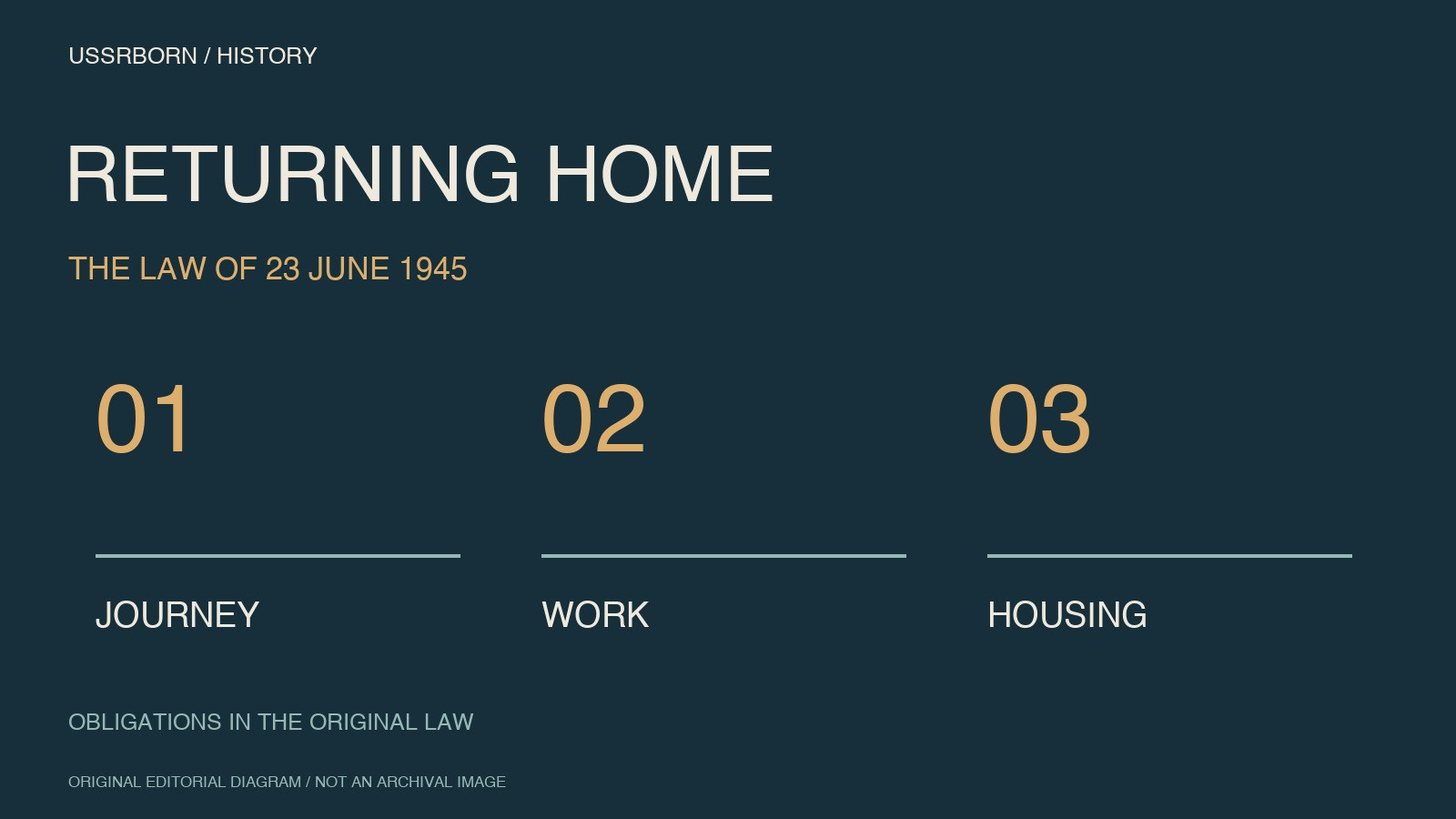
The cover is an original diagram of the transition to civilian life, not a historical poster.