Lend-Lease to the USSR: Supplies, Delivery and the Terms of Aid
How did Lend-Lease to the USSR work? Explore the 1941 law, weapons and materials, the Persian Corridor and postwar negotiations through primary documents.
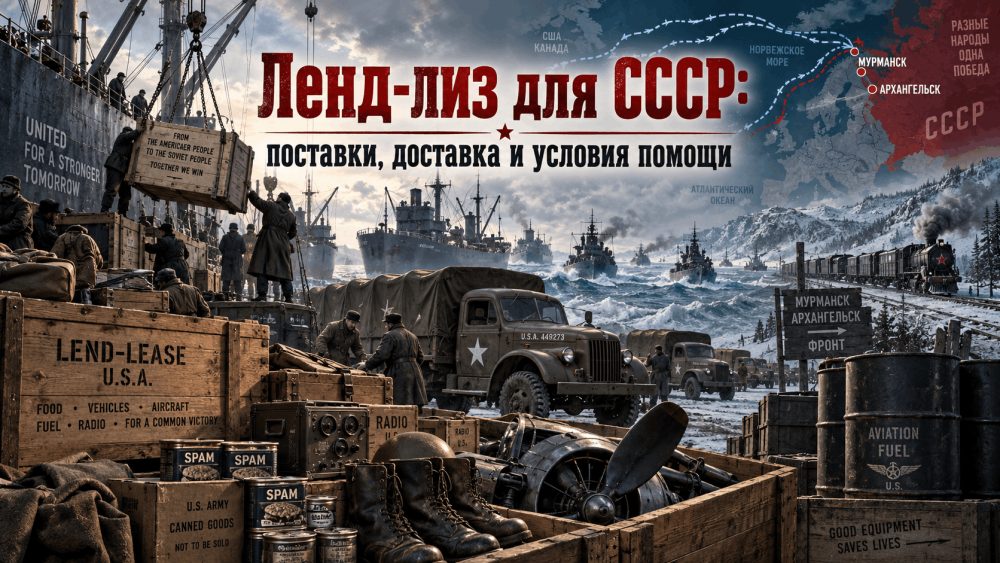
Lend-Lease aid to the Soviet Union formed part of the Allied supply effort during the Second World War. Its importance cannot be understood from a list of tanks and aircraft alone. The programme also involved raw materials, industrial equipment, food and services. Even after supplies existed, they still had to reach the people and organisations that needed them.
Debates often treat victory as something that can be divided into exact national percentages. The documents support more concrete questions: what authorised the transfers, which needs did they address, how did delivery work, and why did remaining equipment become a subject of negotiation after the war?
What the Lend-Lease Act authorised
The American law was approved on March 11, 1941, before Germany invaded the Soviet Union. It empowered the president to arrange assistance for countries whose defence was considered vital to United States security. The programme was therefore not created exclusively for the USSR.
The text published by the US National Archives shows how broadly defence supplies were defined. Weapons, vessels and aircraft were included, but so were machinery, tools, components, materials and agricultural commodities for defence purposes. The law permitted several forms of transfer rather than requiring every shipment to be an ordinary sale paid for immediately in cash.
Its strategic logic was that supporting countries resisting a common threat could strengthen American security. Describing the programme solely as charity misses that purpose. Describing it solely as a normal commercial transaction misses the legal arrangements that made it different. Wartime assistance and national interest operated together.
The distinction matters when reading the name. “Lend” and “lease” do not provide a complete account of the law's powers or the agreements subsequently made under it. The documentary terms, rather than a literal interpretation of the label, establish the arrangements.
When did it apply to the Soviet Union?
After Germany's invasion on June 22, 1941, relations between Moscow and the Western powers changed rapidly. Negotiations over aid, supply protocols and the formal application of American legislation were related steps, but they were not the same event.
On November 7, 1941, Franklin Roosevelt directed Lend-Lease Administrator Edward Stettinius to transfer defence supplies to the Soviet Union under the act. His instruction explicitly stated that he had determined Soviet defence to be vital to US defence. This is a specific legal decision, not a date that should stand for every Allied contact or every earlier arrangement to help the USSR.
A 1946 American diplomatic note referred back to the Moscow Protocol of October 1, 1941, subsequent protocols and the bilateral Master Lend-Lease Agreement of June 11, 1942. The programme developed through several instruments and decisions. Compressing them into one date obscures how international supply arrangements actually worked.
Why weapons totals are only part of the story
The 1946 note described assistance in categories including military supplies, raw materials, industrial equipment, food and services. That list offers a useful way to think about a war economy. Finished weapons are highly visible in photographs, but they are only one part of the system sustaining military operations.
A tank must be manufactured, transported, fuelled, repaired and supplied with ammunition. A truck cannot perform a tank's battlefield role, but it can carry loads necessary for that tank's operation. A machine tool does not participate directly in an offensive, yet production and repair capacity depend on equipment. These are different functions, not claims that every item has an identical military value.
The history of the T-34 helps explain why domestic production and external supply should not be treated as mutually exclusive alternatives. An industrial system uses many inputs. The relevant questions are which need a delivery addressed, when it arrived and how it was used, rather than only what share imported finished weapons represented in total output.
This approach also avoids turning every shipment into an isolated success story. A resource can matter because it supports other resources. Understanding those connections requires more than counting recognisable types of equipment.
The Persian Corridor shows the work behind delivery
The US Army's official history, The Persian Corridor and Aid to Russia, treats supply as an organisational undertaking in its own right. Cargo arriving at Persian Gulf ports had to be unloaded and moved through Iran to Soviet receiving points. Several countries and organisations participated in the process.
The history describes port and road construction, railway operation and the assembly of trucks and aircraft. Buying or manufacturing an item was only the beginning of its journey. If a port could not unload ships quickly enough, or onward transport could not carry the cargo, the presence of supplies did not yet amount to timely assistance at their eventual destination.
There was a political setting as well. Iran was under Anglo-Soviet occupation. The route did not pass through an empty, politically neutral space without local interests or competing national priorities. The American military history itself acknowledges the complicated conditions of cooperation.
The Persian Corridor was one supply route, not the whole programme. Studying it does not justify attributing all Soviet deliveries to that corridor. It does, however, make an essential distinction clear: shipped, unloaded, handed over to Soviet authorities and available to a military unit describe different stages.
A total recorded at one stage should not silently be presented as a total for another. The distance between those stages is precisely where much of the transport and administrative work took place.
How to read Lend-Lease statistics
Before comparing figures, establish what they measure. Monetary value, cargo weight, numbers of individual vehicles and shares of a particular supply category answer different questions. A ton of food and a ton of machinery have the same mass but different functions and prices.
Next, establish the period. A total covering the entire war does not show what was available during the summer of 1941 or at the start of a particular operation. Timing changes the meaning of a delivery. A cumulative figure cannot, on its own, explain a specific battle.
The boundaries of the programme also matter. American Lend-Lease and all British or Canadian assistance are not automatically identical statistical categories. A source may discuss a broader Allied supply effort while another reports only transfers under a particular national arrangement.
Finally, a carefully calculated share of supplies is still not a percentage of victory. Making that leap would require assumptions about timing, substitutes, casualties, enemy decisions and many other circumstances. Documenting the scale of assistance is one task; confidently describing a war that would have occurred without it is another.
What happened to obligations after the war?
The programme's name did not mean that every item consumed during wartime became an ordinary commercial debt. Nor is it accurate to describe the whole arrangement as a gift without any obligations. The law allowed different forms of benefit to the United States, while specific agreements governed the relationship between the governments.
The American note of September 14, 1946, illustrates the subjects of postwar discussion. It proposed negotiations on a final settlement under the 1942 agreement. It separately raised the purchase or return of merchant vessels and requested the return of three icebreakers.
This document shows that different categories of property could require different treatment. It does not establish the final amount or outcome of every later settlement. But it does show why a simple choice between “everything was free” and “every wartime item had to be repaid in full” fails to describe the documentary record.
Assessing assistance without a false choice
The history of the Great Patriotic War includes the immense efforts and losses of Soviet society, domestic industrial production and military operations. Lend-Lease adds an international system of resources and transport to that history. Recognising one does not require denying the other.
Wartime cooperation did not remove disagreements among the Allies. The later Cold War changed the political language in which assistance was remembered, but it does not erase the wartime documents. The most reliable approach distinguishes an established delivery, the function it performed and the wider interpretation of its importance to the war.
Sources
- US National Archives: the Lend-Lease Act of 1941, transcript and historical introduction.
- Roosevelt's instruction to Stettinius on Soviet aid, November 7, 1941.
- US note to the Soviet representative on a postwar settlement, September 14, 1946.
- T. H. Vail Motter, The Persian Corridor and Aid to Russia, Chapter I: US Army official history, digitised copy hosted by the Göttingen library.