Operation Barbarossa: Germany's 1941 Invasion of the Soviet Union
On 22 June 1941, Nazi Germany launched Operation Barbarossa, the vast invasion of the Soviet Union. The Wehrmacht won enormous early victories, but the plan for a quick war broke down before Moscow.
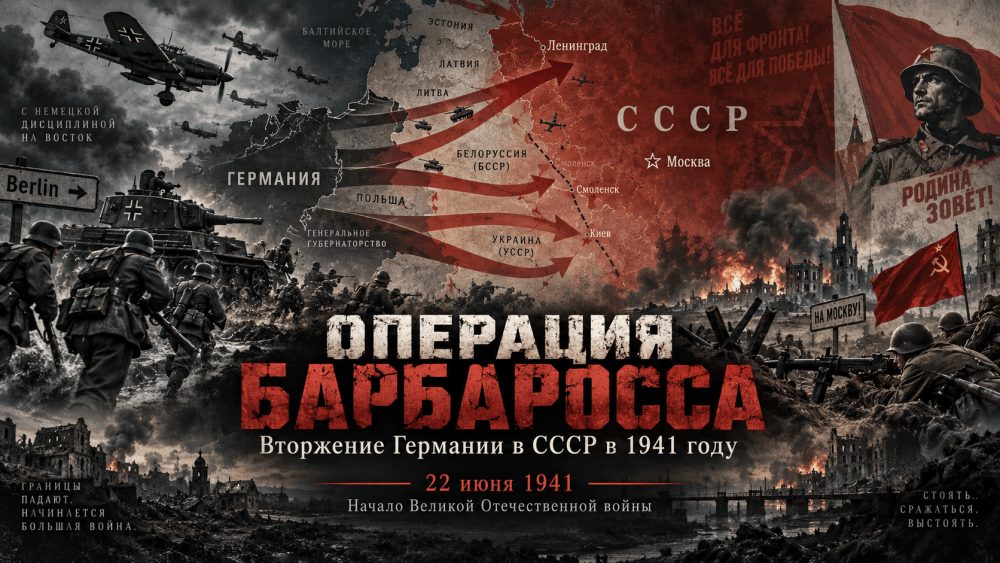
The morning that changed the war
By around three in the morning on 22 June 1941, fighting had begun across the Soviet western frontier.
German artillery opened fire. Aircraft struck airfields. Tanks and infantry crossed the border along a front stretching from the Baltic to the Black Sea.
Operation Barbarossa had begun.
Nazi Germany committed more than three million of its own troops to the invasion, with additional forces supplied by allies. It was a land campaign on a scale that Europe had never seen.
Berlin expected the Soviet Union to collapse within months.
It did not.
Why Hitler invaded the Soviet Union
The decision cannot be reduced to a single reason such as oil, farmland or a personal struggle between Hitler and Stalin.
War against the Soviet Union had occupied a central place in Nazi ideology long before 1941. Hitler and other Nazi leaders viewed Eastern Europe as territory for German expansion and colonization. Soviet land was also seen as a source of food, raw materials and strategic depth.
Anti-communism was equally important. Nazi propaganda presented Bolshevism as an existential enemy and combined that political hatred with racial antisemitism.
Yet Germany and the USSR had signed a non-aggression pact in August 1939. The agreement served tactical purposes for both governments, but it never removed the deeper conflict.
After Germany defeated France in 1940, Hitler moved toward an eastern war.
On 18 December 1940 he issued Directive No. 21. It ordered the armed forces to prepare to defeat Soviet Russia in a rapid campaign even before the war against Britain had ended.
The code name was Barbarossa.
What the German plan was supposed to do
The plan depended on speed.
German commanders aimed to destroy the main Red Army forces in the western Soviet Union before they could retreat into the country's enormous interior.
Armored formations would break through, drive deep into the rear and create vast encirclements. Infantry would follow and reduce the pockets.
The invasion was divided among three main army groups.
Army Group North
It advanced through the Baltic region toward Leningrad.
Its task was to destroy Soviet forces in the northwest and remove a major industrial city and naval base from the war.
Army Group Center
This was the strongest of the three main groupings.
It drove through Belarus toward Smolensk and ultimately Moscow. Some of the largest armored forces were concentrated here, and some of the most disastrous Soviet encirclements of 1941 occurred along this axis.
Army Group South
It attacked into Ukraine.
The south mattered for both military and economic reasons. Ukraine contained major agricultural areas and industry. Beyond it were the Donbas, the Black Sea region and eventually the oil fields of the Caucasus.
The problem was visible even in the list of objectives. Leningrad, Moscow, Ukraine, the destruction of the Red Army and the seizure of resources were all enormous goals.
The German plan assumed they could be achieved quickly.
Why the Soviet Union was caught so badly
Soviet leaders received warnings that an attack was coming.
Intelligence and diplomatic reports described the German buildup near the border. Stalin, however, feared that some warnings were provocations designed to push the Soviet Union into war with Germany before it was ready. Reported invasion dates also changed repeatedly.
As a result, many border forces were not fully prepared when the attack began. German aircraft struck Soviet airfields, communications broke down and command structures were disrupted in the opening hours.
But surprise alone does not explain the disaster.
The Red Army was in the middle of a huge expansion and reorganization. It suffered from shortages of trained officers, transport and reliable communications. The purges of the officer corps in the late 1930s had also damaged command experience. Large mechanized formations often possessed impressive numbers of tanks on paper but lacked spare parts, radios, recovery vehicles and trained crews.
The German army, by contrast, had already gained operational experience in Poland, France and the Balkans.
The first weeks: entire fronts collapsing
The opening phase was catastrophic for the Soviet Union.
German armored groups broke through in Belarus and created huge encirclements around Bialystok and Minsk.
Smolensk came next. Soviet resistance stiffened and the battle consumed time, but Germany still held the initiative.
In the south, Soviet forces also suffered enormous losses. The encirclement around Kyiv in September became one of the largest of the entire war. Hundreds of thousands of Red Army personnel were captured.
By the end of 1941, millions of Soviet servicemen had been killed, wounded or taken prisoner.
From Berlin, the early results seemed to confirm the original prediction. Soviet armies were disappearing one after another and immense areas of territory were being lost.
But the Soviet state itself did not collapse.
That proved to be the crucial miscalculation.
Barbarossa was also a war of annihilation
This was not simply a conventional campaign between two armies.
Nazi policy linked the eastern war to racial conquest, mass murder and the economic exploitation of occupied territory.
Einsatzgruppen, mobile killing units of the Security Police and SD, followed the front. They carried out mass shootings of Jews, Communist officials and other people designated as enemies.
Babyn Yar outside Kyiv became one of the best-known sites of these killings.
Soviet prisoners of war were subjected to catastrophic conditions. Millions entered German captivity, and enormous numbers died from starvation, disease, exposure and deliberate mistreatment.
Occupation plans also envisioned extracting food and resources for Germany even when doing so meant starvation for local civilians.
The Eastern Front was therefore a war of destruction from its beginning.
Leningrad did not fall
Army Group North advanced rapidly through the Baltic region and reached the approaches to Leningrad.
But it did not capture the city.
Instead, German forces and their allies tightened a blockade. By September 1941, the city's main land links with the rest of the Soviet Union had been cut.
The result was one of the deadliest sieges in modern history.
Hunger, cold and bombardment killed civilians in huge numbers, but Leningrad remained in Soviet hands.
Read more: The Siege of Leningrad.
Did the turn toward Kyiv cost Germany Moscow?
This question has been debated for decades.
During the summer, Army Group Center was moving along the main road toward Moscow. Hitler then redirected major mobile forces south to help destroy Soviet armies around Kyiv.
After the war, some German generals argued that this delay cost the Wehrmacht its chance to seize the Soviet capital.
The reality is less tidy.
The Kyiv operation did consume valuable time, but it also destroyed a huge Soviet force and protected the southern flank of Army Group Center. By August, the German army was already dealing with heavy casualties, worn vehicles, stretched supply lines and a Soviet ability to create new formations that had not been expected.
The failure cannot be pinned on one turn on the map.
The deeper problem was the original assumption that the Soviet military and state would disintegrate quickly.
Operation Typhoon and the drive on Moscow
The final major push toward Moscow began in the autumn under the code name Operation Typhoon.
At first, the Germans won again. Large Soviet forces were encircled near Vyazma and Bryansk.
Moscow began evacuating government offices, factories and parts of the civilian population. In October the capital experienced several days of fear and disorder.
But the offensive slowed.
Autumn rain turned unpaved roads into mud. Then temperatures fell. German troops lacked enough winter clothing, fuel and functioning vehicles.
More important, the Red Army was still fighting and receiving new formations.
German units reached the approaches to Moscow but could not take the city.
In early December, Soviet forces launched a major counteroffensive and pushed the exhausted attackers back.
For the larger context, see The Great Patriotic War.
Did "General Winter" defeat Germany?
Not by itself.
The winter of 1941 was a major problem. German equipment and supply systems were badly prepared for a prolonged cold-weather campaign.
But the weather did not arrive against an otherwise healthy army.
By the time the temperatures collapsed, German forces had already suffered serious casualties. Tanks and trucks were worn out. Supply lines stretched hundreds of miles. Soviet railways used a different gauge and had to be converted. Infantry formations had been marching and fighting for months.
Most important, the Red Army had not been destroyed.
Cold made existing weaknesses worse. It did not create them.
The factories that moved east
One of the least dramatic but most important Soviet responses happened far behind the front.
Factories from threatened western regions were dismantled and moved by rail toward the Volga, the Urals, Siberia and Central Asia.
It was a brutal improvisation. Machinery sometimes arrived before factory buildings were complete. Workers lived in temporary housing and restarted production under extraordinary conditions.
Yet the industrial evacuation worked well enough to matter.
By 1942, many relocated plants were producing tanks, aircraft, artillery and ammunition far beyond the immediate reach of German ground forces.
Barbarossa had assumed that seizing the western Soviet economic regions would cripple the country's ability to continue a major war. A significant share of that capacity literally moved away.
Why Operation Barbarossa failed
There was no single cause.
Several failures reinforced one another:
- Germany underestimated Soviet mobilization reserves.
- German planners expected the Soviet political system to collapse after major battlefield defeats.
- Distances were much larger than the logistics system could comfortably support.
- Rail conversion and motor transport became persistent bottlenecks.
- German casualties and equipment losses were heavier than expected.
- Soviet industry was partly evacuated eastward.
- The Red Army continued forming new armies after catastrophic losses.
- German strategy pursued several major objectives at once.
- Mud and winter weather magnified supply and equipment problems.
By December 1941, the central premise of Barbarossa had failed.
The Soviet Union had not been destroyed in one short campaign.
The war in the east would continue for years.
What came after Barbarossa
The setback outside Moscow did not end German offensive operations.
In the summer of 1942, Germany attacked again, this time concentrating much more heavily on the south. The campaign aimed toward the Caucasus and its oil resources.
That offensive eventually led to the Battle of Stalingrad, one of the decisive turning points of the war.
In 1943 came the Battle of Kursk, after which the strategic initiative increasingly shifted toward the Red Army.
The roots of those later battles lie in 1941. Barbarossa inflicted catastrophic damage on the Soviet Union, but it failed to achieve its primary purpose.
Frequently asked questions
When did Operation Barbarossa begin?
On 22 June 1941, when Germany and its allies attacked the Soviet Union across a front from the Baltic to the Black Sea.
When was the plan approved?
Hitler issued Directive No. 21 on 18 December 1940.
What were the main objectives?
To destroy the main Red Army forces in western Soviet territory and force a rapid Soviet collapse. The three main directions led toward Leningrad, Moscow and Ukraine.
How many German troops took part?
Germany committed more than three million troops. Including Axis allies, the invasion force was larger still.
Why did Barbarossa fail?
Because of Soviet resistance and reserves, German logistical limits, heavy losses, industrial evacuation, the size of the theater, conflicting objectives and weather that worsened existing problems.
Did the Russian winter alone stop the Germans?
No. The winter was severe, but by then the Wehrmacht was already exhausted, undersupplied and facing a Red Army that had survived the destruction of its original western formations.
Related articles
Sources
- German History in Documents and Images, *Directive No. 21: Operation Barbarossa*: https://germanhistorydocs.org/en/nazi-germany-1933-1945/ghdi:document-1547
- United States Holocaust Memorial Museum, *Invasion of the Soviet Union, June 1941*: https://encyclopedia.ushmm.org/content/en/article/invasion-of-the-soviet-union-june-1941
- United States Holocaust Memorial Museum, *The Soviet Union and the Eastern Front*: https://encyclopedia.ushmm.org/content/en/article/the-soviet-union-and-the-eastern-front
- The National WWII Museum, *Operation Barbarossa: The Biggest of All Time*: https://www.nationalww2museum.org/war/articles/operation-barbarossa
- U.S. Army Center of Military History, *Moscow to Stalingrad: Decision in the East*: https://history.army.mil/Publications/Publications-Catalog/Moscow-to-Stalingrad/