Moscow’s Parade of 7 November 1941: Preparation, Participants and Records
Who commanded the 7 November 1941 parade, what records reveal about preparation and numbers, and how to distinguish Moscow footage from other parades.
The military parade on Moscow's Red Square on 7 November 1941 took place during the Battle of Moscow. It marked the twenty-fourth anniversary of the October Revolution, but the approaching enemy gave the ceremony another purpose: publicly demonstrating that the capital continued to resist.
This event should not be confused with the Victory Parade of 24 June 1945. In November 1941, the war had not been won, and the German offensive directly threatened the city hosting the ceremony.
Morning on Red Square
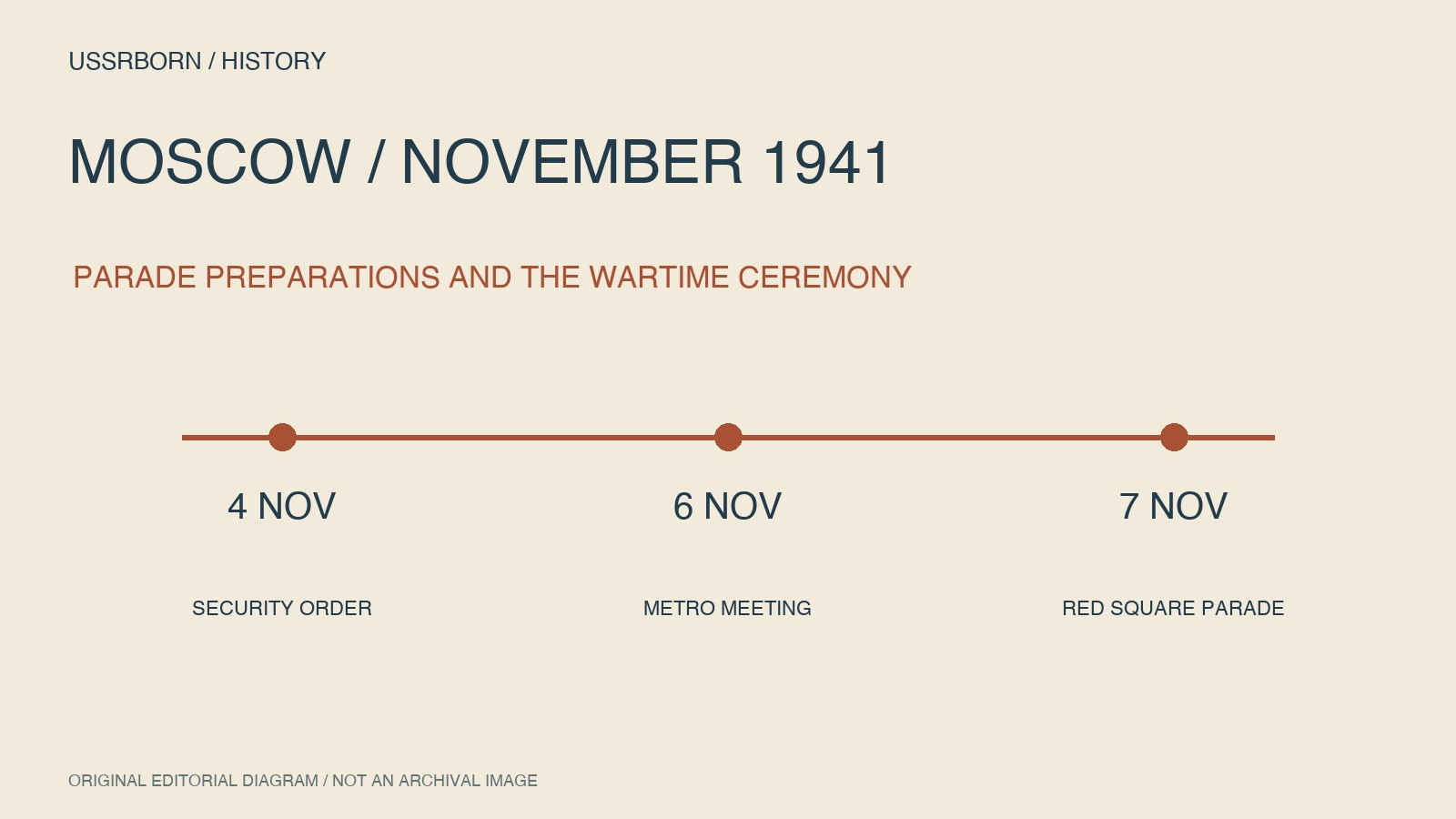
According to the Presidential Library's historical account, the parade began at eight in the morning. Lieutenant General Pavel Artemyev commanded it, while Marshal Semyon Budyonny reviewed the troops. Stalin addressed the assembled forces, and the event was broadcast by radio.
The preceding Moscow Soviet meeting on 6 November took place at Mayakovskaya metro station. It was a separate occasion, not the location of the parade itself. Distinguishing the two events helps identify photographs and reports of the anniversary celebrations in wartime Moscow.
What the security order establishes
The Presidential Library catalogues the original NKVD Order No. 001549 of 4 November 1941 concerning security on Red Square. It supplies an archival reference: the Central Archive of the Russian Federal Security Service, fond 66, inventory 1, file 583, sheets 166-174. The document includes an attachment allocating responsibilities and deadlines for preparing the metro station.
This record does more than illustrate the occasion. It shows that formal organisational decisions preceded the ceremonial scene. An archival description and the complete order are nevertheless different levels of evidence: specific instructions should only be listed after reading the relevant sheets.
How many people participated?
In its review of archival documents, the Russian Historical Society cites Moscow commandant Konstantin Sinilov's report: approximately thirty thousand personnel, 140 guns, 160 tanks and 232 vehicles were involved in the Moscow garrison operation.
That wording matters. The strength of the entire operation should not automatically be presented as the exact number of people who marched past the reviewing stand. Different totals may count different groups of participants and supporting units.
Moscow was not the only parade location
The same documentary review describes a parade of military reserves in Kuybyshev on 7 November. Unlike the Moscow event, it included an aerial component. Photographs of an aircraft flypast consequently require a location check: a shared year and anniversary do not establish that they show Red Square.
The Moscow event also has its own film record. The Presidential Library describes a segment of the newsreel XXIV October held by the Russian State Documentary Film and Photo Archive under record number 5614. Its catalogue specifies a running time of fourteen minutes and eighteen seconds and no sound. Those details identify that particular segment, not every later edited version.
Understanding the parade's significance
The ceremony helped express confidence in the capital's ability to defend itself. Its symbolic importance should not be converted into a claim that a single march decided the battle's outcome.
A verifiable account brings together several types of evidence: preparation orders, information about the operation's composition, radio material and film records. Comparing them reveals a specific wartime event behind the familiar image of Red Square, with its own organisers, constraints and purposes.