Germany’s Surrender in 1945: Reims and Karlshorst
Why surrender was formalised at Reims and Karlshorst, who signed the documents and how signing dates differ from the deadline for ending operations.
The unconditional surrender of Germany's armed forces in May 1945 was formalised in two stages, at Reims and Berlin-Karlshorst. These were not separate surrenders to the Western Allies and the Soviet Union. The Reims instrument already covered all forces under German control and expressly provided for surrender to both the Allied expeditionary commander and the Soviet High Command.
The document signed at Reims
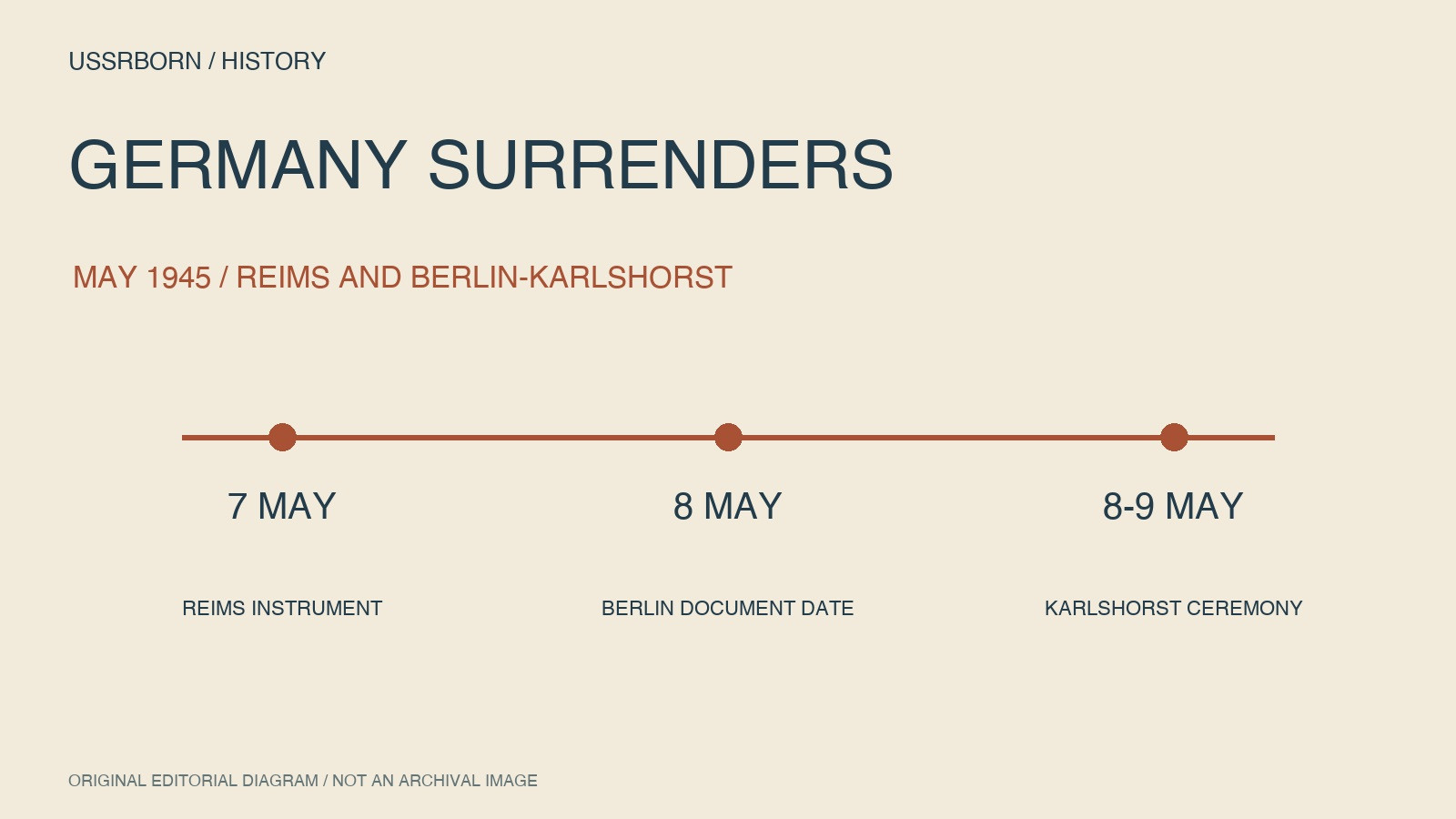
The instrument records its signing at 02:41 on 7 May 1945. Alfred Jodl, chief of the Wehrmacht Operations Staff, signed for the German command. Walter Bedell Smith represented the Allied expeditionary command, Ivan Susloparov the Soviet command, and French general Francois Sevez signed as a witness.
The text reproduced by the US National Archives ordered active operations to cease at 23:01 Central European Time on 8 May. Signing and the prescribed cessation of operations were therefore different moments. Forces were to remain in their positions at the appointed time, refrain from destroying ships or aircraft, and carry out subsequent Allied orders.
Why a second signing was required
Museum Berlin-Karlshorst explains that an additional protocol agreed at Reims already required confirmation by senior German military commanders. The second act was therefore more than a repeat performance for cameras: it placed the obligations under the signatures of the highest command.
At Karlshorst, Wilhelm Keitel, Hans-Georg von Friedeburg and Hans-Juergen Stumpff signed for Germany. Georgy Zhukov and Arthur Tedder signed for the Allies, with Carl Spaatz and Jean de Lattre de Tassigny as witnesses. The instrument bears the date 8 May, while the ceremony took place during the night of 8-9 May.
What did the Berlin instrument change?
The central obligation remained unconditional military surrender. The US National Archives identifies complete disarmament among the Berlin text's explicit requirements. It is wrong to conclude that the earlier document applied only to the Western Front: its first clause specifically included the Soviet High Command.
Nor should a military surrender be confused with a peace treaty. The Reims instrument itself distinguished military capitulation from a possible general instrument concerning Germany and its armed forces. Ending resistance, administering occupied territory and determining the postwar political settlement were connected questions, but they were not identical.
Why three dates appear
7 May is the date of the Reims signing. 8 May is the date on the Berlin instrument and the day on which active operations were ordered to end. 9 May is associated with completion of the Berlin proceedings overnight and the announcement in Moscow. The different dates reflect stages of formalisation and public announcement as well as differences in clocks; they should not be reduced to a single unexplained time conversion.
Victory over Nazi Germany ended the war in Europe. The wider Second World War continued until Japan's surrender in September 1945. Keeping those geographical scopes distinct prevents the European conclusion from being mistaken for the end of the entire global conflict.
The historic Karlshorst building is preserved as a museum. Its importance extends beyond a familiar photograph of signatures: it was the setting in which the coalition's shared victory received its final military formalisation.