The Order of Victory: Its 1943 Statute, Badge and Recipients
What the Order of Victory recognised, who authorised awards, how the badge was specified and why recipient and award totals differ.
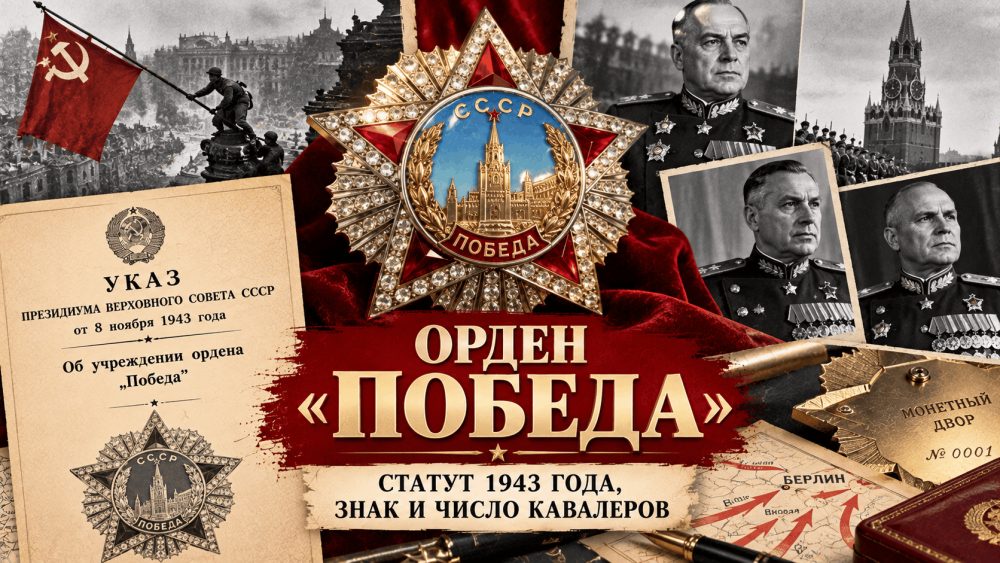
The Order of Victory was established on 8 November 1943 as the USSR's highest military order for the senior command of the Red Army. Its name does not mean that it was created after the war had ended. The founding document provided a way to recognise major achievements in command while the fighting was still continuing.
The best starting point is the statute rather than the precious stones. The statute explains the intended grounds for an award. The surviving object shows how the state represented the exceptional status of that achievement. Reading the two together gives a fuller account than a description of rarity or expense alone.
The scale of achievement required
The decree and its accompanying statute combined two requirements. The recipient belonged to the senior command, and the successful operation had to involve one or more fronts and radically alter the situation in the Red Army's favour. A high rank by itself, or participation in a successful engagement, was not what the wording identified as sufficient.
In this context, a front was a military formation, not simply the geographical line where opposing forces met. The criterion therefore concerned the scale of command and the consequences of an operation. It distinguished recognition of high-level military leadership from recognition of an individual's action in battle, without making the different forms of service interchangeable.
Three questions make the wording easier to follow: who was eligible, what scale of action was envisaged, and what result was required? These questions do not produce an automatic formula for an award. They do, however, prevent the prestige of the decoration from replacing the specific criterion written into its rules.
The decision belonged to a named state body
An award could be made only by decree of the Presidium of the Supreme Soviet of the USSR. The founding decree also provided for a memorial board bearing the recipients' names in the Grand Kremlin Palace. The decoration on a uniform was thus accompanied by a separate form of official commemoration.
Establishing an order and awarding it to an individual are different acts. The first creates the decoration, its rules and its official description. The second applies it to a particular recipient. The date 8 November 1943 belongs to the founding act; it should not automatically be copied into every recipient's biography as the date of their award.
Mikhail Kalinin, chairman of the Presidium, and Aleksandr Gorkin, its secretary, signed the founding decree. Reading the document's institutional details matters because the political prominence of a recipient does not replace the identity of the body legally issuing the decision.
What the official description specified
The design was a five-pointed ruby star bordered by diamonds, with additional diamond-set rays between its points. A central blue enamel circle contained the Kremlin wall, Lenin's Mausoleum and the Spasskaya Tower. Inscriptions identified the USSR and the name of the order. The prescribed distance between opposite tips was 72 millimetres, and platinum was specified as the principal material of the badge.
The reverse had a threaded pin and nut for attachment to clothing. It was therefore not a suspended medal hanging from a ribbon mount. The statute specified a position on the left side of the chest, 12 to 14 centimetres above the belt. Both the design and the method of wearing it help when examining a historical photograph.
A normative description is not identical to an inventory record for an individual object. The Moscow Kremlin Museums' online entry for Stalin's Order of Victory No. V describes the badge together with its case and identifies synthetic rubies among its materials. It also distinguishes the badge's dimensions from those of the case. Such a record provides verifiable physical information without requiring speculative claims about a market price.
Recipients, awards and manufactured objects
The Presidential Library lists 11 Soviet commanders and five foreign recipients, with Zhukov, Vasilevsky and Stalin each receiving the order twice. Those figures yield 16 different people and 19 awards when repeat awards are included and the later annulled case is excluded.
The library separately records Leonid Brezhnev's award on 20 February 1978 and its subsequent annulment after his death. A count of all award decisions ever made can therefore differ from a count that excludes the cancelled award. The counting rule needs to be stated rather than hidden behind an apparently definitive number.
The number of physical badges manufactured is another category. It answers a question about objects, not people. A recipient could receive the order more than once, and a particular museum object can have its own history. A roll of recipients, a series of decrees and an inventory are related records, but they are not substitutes for one another.
For example, “three recipients were awarded twice” adds three awards to a total of distinct recipients; it does not add six new people. This elementary distinction is often more useful than memorising a number without knowing what it counts.
Victory and Glory were separate orders
The Order of Glory was also established on 8 November 1943, but the two decorations served different purposes. Victory recognised senior command achievement. Glory had three classes and rewarded personal battlefield valour among soldiers and sergeants, with junior lieutenants also eligible in aviation. Sharing a founding date did not make them successive grades of a single decoration.
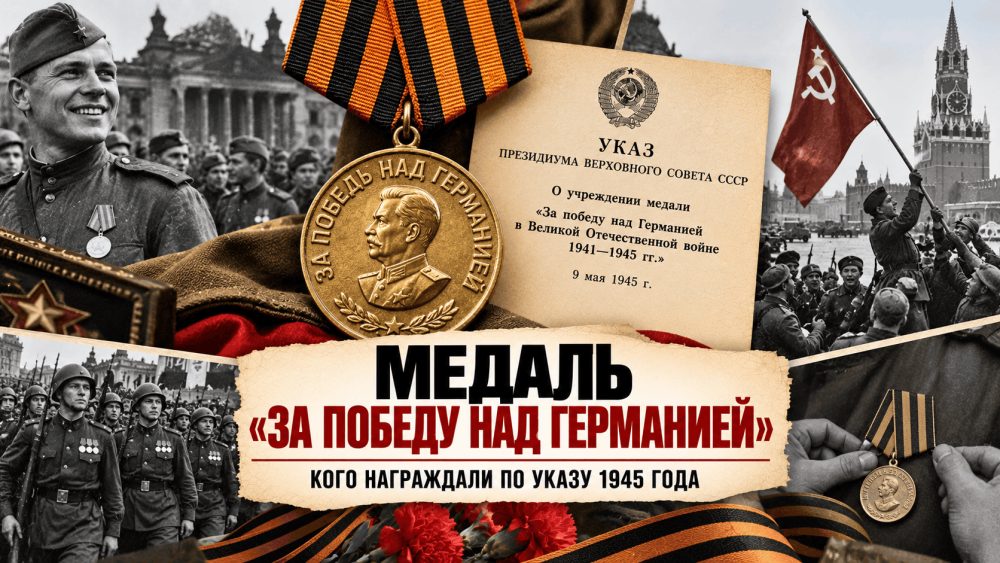
The Order of Victory should also be distinguished from the Medal for Victory over Germany. Similar words in an award's name do not identify the same object. Its complete title, founding document and design are firmer guides than a loosely remembered phrase.
A practical way to investigate the order
Three types of evidence work together. The founding decree establishes the criteria and intended form. Award records show how the decoration was applied to named individuals. Museum catalogues describe surviving objects. Each source answers a different question and places limits on the conclusions that can be drawn from it.
Viewed in this way, the Order of Victory is more than a rare piece of jewellery. It records how the Soviet state singled out achievements of its highest military leadership and expressed that recognition through a legal act, a material object and an official place in public memory.
Related articles
- The Order of Glory
- The Medal for Victory over Germany
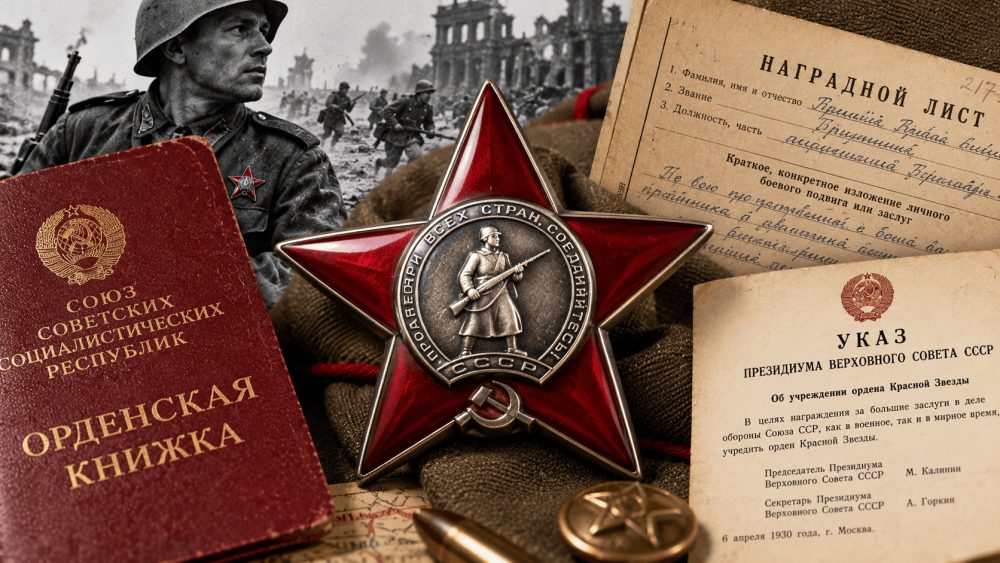
- The Order of the Red Star
- The Victory Parade of 1945