Order of the Red Star: The 1930 Statute and Award Records
When the Order of the Red Star was established, what its first statute rewarded and how a badge, museum entry and individual award record differ.
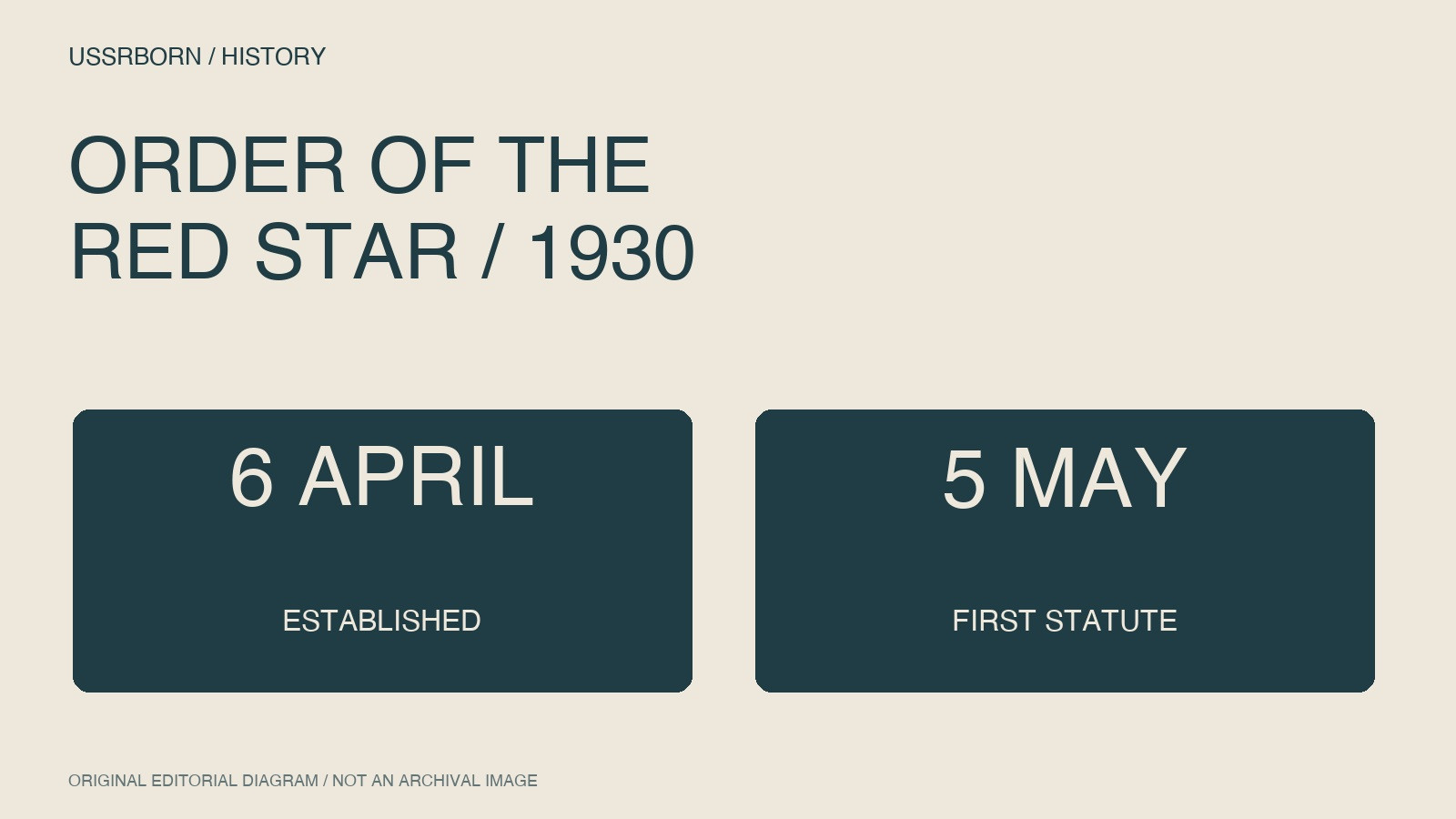
The Order of the Red Star predates the Second World War. It was established on 6 April 1930, and its first statute was approved on 5 May. From the beginning, its rules covered distinguished service in national defence during both war and peace. A red enamel star preserved in a family collection therefore cannot, by itself, explain why its owner received it. That requires the record of the particular award.
Two dates in the order’s creation
The Victory Museum distinguishes the establishment of the order from approval of its statute. These were different decisions. One introduced the decoration; the other specified eligibility and the awarding procedure. The date 5 May does not contradict 6 April. It identifies the next stage in defining the rules.
The statute of 5 May 1930 appeared in the Collection of Laws and Orders of the Workers’ and Peasants’ Government of the USSR, issue 26, article 290. Reading its text reveals the original framework without projecting later wording back onto it.
What the original statute rewarded
The rules covered rank-and-file and commanding personnel of the Red Army, as well as other Soviet citizens who had rendered outstanding services to defence. The listed grounds included:
- activity contributing to a major wartime success by the armed forces;
- individual feats performed in peacetime;
- improvements in military training;
- significant inventions and technical improvements in military affairs;
- work increasing the army’s fighting capacity and the country’s defensive capability.
This was broader than a single act of personal bravery in combat. Such an act could justify an award, but it was not the only possible basis. That matters when reading a short biography that lists decorations without explaining when or why they were received.
A statute is not a list of actual recipients. It explains the grounds on which an award could be made. Between a general rule and an individual biography stands a specific decision. That decision is the relevant evidence when the question concerns a particular person.
Who made the decision in 1930
The initial version distinguished peacetime from wartime. In peace, the Central Executive Committee of the USSR or its Presidium made awards following a submission from the Revolutionary Military Council. During war, the council was given corresponding authority, with nomination procedures differing for servicemen and other citizens.
The text also provided for an awards commission, a certificate and publication of decisions. The decoration was thus more than a metal badge: it belonged to a process for considering service and recording recognition.
The institutions described in 1930 should not, however, be mechanically applied to an award made in 1944 or 1980. The Victory Museum lists subsequent changes and identifies a new version of the statute dated 28 March 1980. Historical research requires the rules applicable to the period being investigated.
This is a useful safeguard against a common mistake. A later summary may correctly describe an order at one stage of its history while being unsuitable for explaining an earlier award. The date of the rule deserves as much attention as the name of the decoration.
Reading the object itself
The Russian Museum holds an example under inventory number Med. A-4422; its catalogue identifies silver and enamel as the materials. This describes a particular museum object. An inventory number identifies an item within the museum’s records and should not automatically be interpreted as an award number.
A separate example appears in the Museum Fund of Ukraine. The Izmail local-history museum’s entry describes order number 471611 as belonging to Vasily Andreyevich Smolyakov. It connects a badge, the number on its reverse and an owner. The description does not establish the circumstances of a particular feat, and those should not be invented from the number alone.
The insignia combines a five-pointed star with a Red Army soldier holding a rifle. Its imagery belongs to the wider history of the red star, but the order remains a distinct object with its own name and regulations. A red star appearing elsewhere on a uniform does not become the Order of the Red Star simply because the symbol is similar.
What to look for in family records
A practical starting point is the full name, date and identifying details of the award decision. These can then be compared with surviving documents and descriptions of service. If only a photograph remains, record what can actually be seen and keep unresolved questions separate.
For example, confidently identifying a decoration establishes its presence in the photograph. The picture does not automatically establish when it was presented, the recipient’s unit or the grounds for the award. Distinguishing observation from inference helps preserve an accurate family history.
Useful comparisons include the Order of Glory, the Order of the Patriotic War and the Victory over Germany Medal. Each had its own regulations. Rules cannot be transferred between them simply because the decorations appear together on one uniform.
The Order of the Red Star can be approached through three connected forms of evidence. The statute explains possible grounds, the award decision identifies an individual case, and the surviving badge supplies the object’s material history. None entirely replaces the others.