Order of the Patriotic War: Its 1942 Foundation and 1985 Awards
Distinguishing wartime and anniversary awards: the two classes, first recipients, the 1985 decree and what family documents can establish.
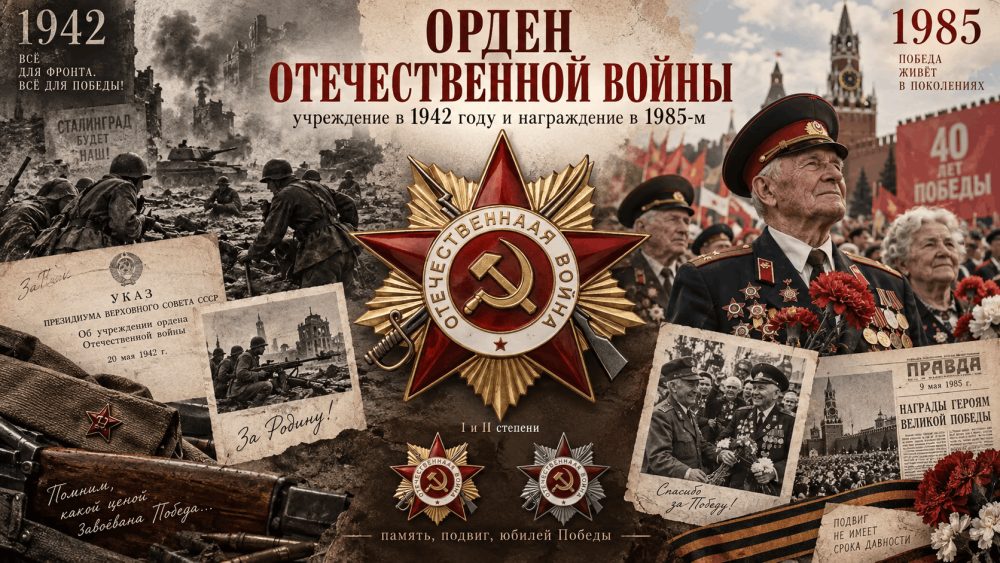
The Order of the Patriotic War was established on 20 May 1942 with two classes, the first being the higher. More than four decades later, it acquired another familiar association: the large-scale award to war participants in 1985, marking the fortieth anniversary of victory. Consequently, the same decoration's name in family papers can refer to very different circumstances.
The wartime foundation
The Presidential Library provides a digital record of the original founding decree, including its statute and description. The original document is held by the State Archive of the Russian Federation. The date of 20 May 1942 identifies the establishment of the order, not the presentation date of every surviving example.
The statute covered enlisted personnel and commanders of the Red Army, Navy, NKVD troops and partisan detachments. It recognized courage and steadfastness in battle, as well as actions contributing to successful military operations. Eligibility therefore extended across ranks and military specialties.
A notable feature was the enumeration of specific grounds for recommendation. The general language of bravery was connected to described achievements. The award concerned what someone had done in wartime service, rather than simply establishing that the person had once belonged to the armed forces.
Two classes and a distinctive design
Aleksandr Kuznetsov's project supplied the basis of the design, while the inscription naming the Patriotic War came from Sergei Dmitriyev's proposal. The composition combined a red enamel star, radiating points, a hammer and sickle, and crossed rifle and sabre. First and Second Class belonged to the same order, with the first ranked higher.
The date of manufacture matters when examining a particular object. The decoration's description changed, including in 1943, and anniversary issues belong to a much later period. A photograph of the front cannot replace the recipient's papers and the decision authorizing an award. The appearance of the rays helps distinguish classes, but does not reveal the complete circumstances of presentation.
The first recipients
Among the earliest First Class recipients were the artillerymen Ivan Krikliy, Ivan Statsenko and Aleksei Smirnov, decorated by a decree dated 2 June 1942. Their awards were associated with fighting in the Kharkiv area. The founding date, the date of an award decision and the date of the action being recognized are separate events.
This distinction becomes especially useful in family history. A decree's date should not automatically be assigned to the battle described in the citation. Administrative recognition could follow the action that prompted a recommendation. A chronological biography needs to preserve that sequence.
What the 1985 decree provided
On 11 March 1985, the Presidium of the Supreme Soviet adopted a decree awarding the order to active participants in the Great Patriotic War for the fortieth anniversary of victory. It divided recipients into categories for the two classes and extended its provisions to participants in the war against Japan.
First Class categories included Heroes of the Soviet Union who had participated in the war and holders of all three classes of the Order of Glory. The decree also named marshals, generals and admirals who had directly participated in the active army, partisan formations or underground resistance, regardless of the rank they had held during the war.
Other listed categories covered participants wounded in battle, recipients of Soviet orders or the specified wartime medals, and war-disabled persons whose injuries had been sustained in combat. These were categories established by the decree. The class was not simply selected according to a veteran's age.
Second Class was intended for those who had directly participated in the active army, partisan formations or underground resistance and did not qualify for First Class under the decree. It is therefore misleading to say that the 1985 award went to everyone in the Soviet Union who had lived through the war. Being alive during wartime was not, by itself, the stated qualification.
The defense minister, chairman of the KGB and interior minister were authorized to make awards on behalf of the Presidium. They were also responsible for determining how recommendations and applications would be considered. An administrative process therefore stood between the general decree and an individual's award.
What an anniversary award can tell a family
A wartime recommendation may describe a particular action. The 1985 award recognized membership in a specified category of war participants. Its documentary purpose was different. An entry reading “Order of the Patriotic War, First Class, 1985” does not by itself establish the place, date or circumstances of an individual battlefield exploit.
That does not make the decoration inauthentic or invalidate the recipient's military service. It means that the document answers a different question. A family biography can preserve both the wartime record and the later recognition without forcing them into a single episode.
Where several documents survive, a practical approach is to arrange them by date and record the class, awarding authority and decision number when those details are present. Separate entries should not be merged simply because they name the same order. If the supporting document is missing, it is better to leave the circumstances unresolved than to reconstruct them from the badge alone.
A useful caption for a family display might therefore identify the recipient and the documented award year, then describe the basis only as far as the papers allow. This keeps the personal meaning of the object while preserving the difference between established information and family recollection.
One decoration, different historical contexts
May 1942 explains the creation of the Order of the Patriotic War. March 1985 explains the anniversary award under defined categories. Both belong to the decoration's history, but they should not be treated as the same act of recognition. To understand a particular family heirloom, the essential combination is the recipient, class, date and documented basis of the award.
Related reading
- The Order of Glory and its three classes
- The Great Patriotic War
- Demobilization in 1945
- The Victory Parade of 24 June 1945