The Order of Glory: Its 1943 Statute and Three Classes
When the Order of Glory was created, who qualified, how its three classes differed and why the decree and Defence order have different dates.
The Order of Glory was established on 8 November 1943 to recognize personal bravery in combat. It is often called a soldier's order. Behind that convenient description stood precise rules about eligibility, three classes, the sequence of awards and the actions that could merit recognition. The original statute explains those rules without mixing them with later amendments.
Why two dates appear in the records
The founding date is 8 November 1943, when the Presidium of the Supreme Soviet of the USSR issued the decree establishing the Order of Glory, First, Second and Third Class. The Electronic Library of Historical Documents identifies the original decree in the State Archive of the Russian Federation, including its signatures by Mikhail Kalinin and Alexander Gorkin.
A collection of People's Commissariat of Defence orders reproduces the decree under Order No. 316 of 6 December 1943. That later date belongs to its announcement by Deputy People's Commissar of Defence Alexander Vasilevsky. It does not represent a second creation of the decoration.
The distinction is useful when reading family records. The date of a founding decree, the date of an individual's award order and the date of presentation can describe different events. Identifying the kind of document should come before using its date to construct a personal timeline.
Who was eligible?
The original decree specified the Red Army's enlisted and non-commissioned personnel. Aviation had an explicit exception: servicemen holding the rank of junior lieutenant were also eligible. The claim that the order could never go to an officer is therefore too broad.
The award recognized courage and fearlessness demonstrated in battle. Its purpose concerned a personal action, rather than simply time spent at the front. Possession of the order indicates an award for merit; the circumstances of a particular action must be established through the recipient's records.
The decoration originated during the Great Patriotic War, but an overview of military campaigns cannot explain an individual award. Operational history establishes the setting. A recommendation or award order identifies the person and, where recorded, the recognized action.
Three classes, awarded in sequence
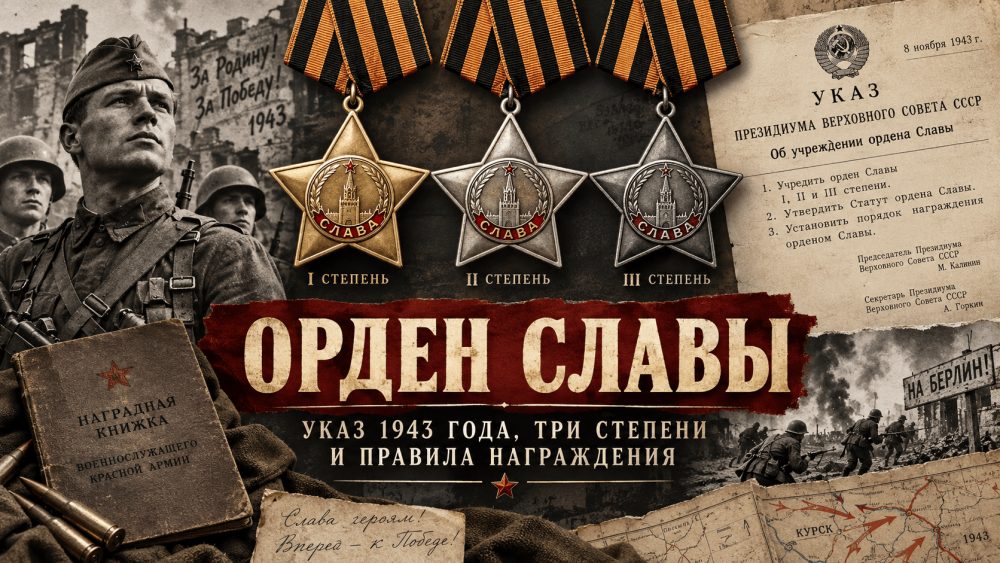
First Class was the highest. Awards nevertheless proceeded from Third Class to Second Class and finally First Class. The sequence III, II, I on the cover therefore represents progression, rather than declining importance.
A full holder, or full cavalier, of the Order of Glory possessed all three classes. That description should not automatically be replaced by awarded three times. The classes matter, not just the number of references to an award in a set of records.
Under the original statute, the Presidium of the Supreme Soviet awarded First Class. Front and army commanders could award Second and Third Class on its behalf. Commanders of the types of corps and divisions listed in the document could also award Third Class. Class therefore affected the level at which an award could be authorized, as well as the appearance of the insignia.
The actions described in the statute
The statute covered a wide range of combat situations. Examples included entering an enemy position, saving a unit's banner, obtaining reconnaissance information, continuing to fight from a disabled tank, helping wounded personnel under fire and carrying out aviation missions. Some clauses included numerical conditions; others described a dangerous situation or a contribution to a unit's success.
Crucially, the list was not confined to destroyed equipment or enemy casualties. It recognized intelligence gathering, opening a passage through obstacles, saving a commander and aiding the wounded. Reading the entire list makes the range of service behind the decoration more visible.
Its tank provisions can be considered alongside the history of the T-34, but they did not restrict eligibility to that model. Without additional records, an award does not establish that its recipient served in a T-34. A general rule about decoration and an individual's service history answer different questions.
Nor should the list be treated as an automatic mechanism in which an action immediately produced a medal. The statute described qualifying grounds. Establishing how a particular action was recognized requires the recommendation and the decision of the authorized command.
How the insignia differed
The 1943 description specified a five-pointed star measuring 46 millimetres between opposing tips. Its central image showed the Kremlin with the Spasskaya Tower, surrounded by a laurel wreath. Below it appeared the word Glory on a red enamel ribbon. The reverse carried the USSR inscription.
Materials distinguished the classes:
- First Class used gold.
- Second Class used silver, with a gilded central circle.
- Third Class used silver.
The suspension ribbon had alternating black and orange stripes. The shared composition identified the three classes as one award, while materials and gilding distinguished them. These features are useful for understanding a museum display. They do not, on their own, authenticate an object shown in a photograph; that requires examination of the object and its provenance.
From a type of award to a named person
The Taimyr Museum of Local History describes a Third Class Order of Glory belonging to Stanislav Antonovich Gumenyuk. Its account records that his daughter, Tamara Stanislavovna, donated the decoration. This connects the object to both a named veteran and its route into the collection.
The account should not be expanded into an invented description of his combat action. Where an award citation is not supplied, that action remains a separate research question. Documented provenance still contributes something important: it turns an anonymous example of a decoration into an object with a traceable personal history.
Veterans' postwar lives can be explored alongside the article on demobilization in 1945. The Victory Parade of 24 June 1945 offers another perspective on the war's conclusion. Neither wider subject replaces an individual recipient's records.
Reading the right version
The GARANT publication explicitly identifies later amendments to the statute. A consolidated account may incorporate provisions or describe privileges and wearing arrangements from a later period. It should not automatically be presented as the exact rule issued in November 1943.
A reliable investigation separates three tasks: establishing the award's creation, identifying a particular insignia, and verifying a person's decoration. The decree and statute answer the first. The object and its collection records address the second. Personal award documentation is needed for the third.
This separation prevents a familiar symbol from becoming the basis for unsupported biographical claims. It also makes clear why dates, classes, authority and provenance all matter. Together they explain how a decoration belonged to both an institutional system and a particular service history.
The cover is an original diagram of the class sequence, not a photograph of a historical decoration.
Sources
- Original decree, statute and description, announced in Defence Order No. 316 of 6 December 1943.
- Electronic Library of Historical Documents: archival record of the decree of 8 November 1943.
- GARANT: the decree with later statutory amendments.
- Taimyr Museum of Local History: a Third Class Order of Glory in its collection.