Operation Bagration, 1944: The Plan, Minsk and Army Group Centre
How four Soviet fronts carried out Operation Bagration: the plan, encirclements, Minsk’s liberation on 3 July and the consequences of the 1944 offensive.
Operation Bagration transformed the central sector of the Eastern Front in summer 1944. The Red Army defeated the main forces of Germany’s Army Group Centre and liberated Belarus. That short description, however, compresses a campaign involving several army groups, successive encirclements and advances well beyond its initial battlefields.
When did Operation Bagration take place?
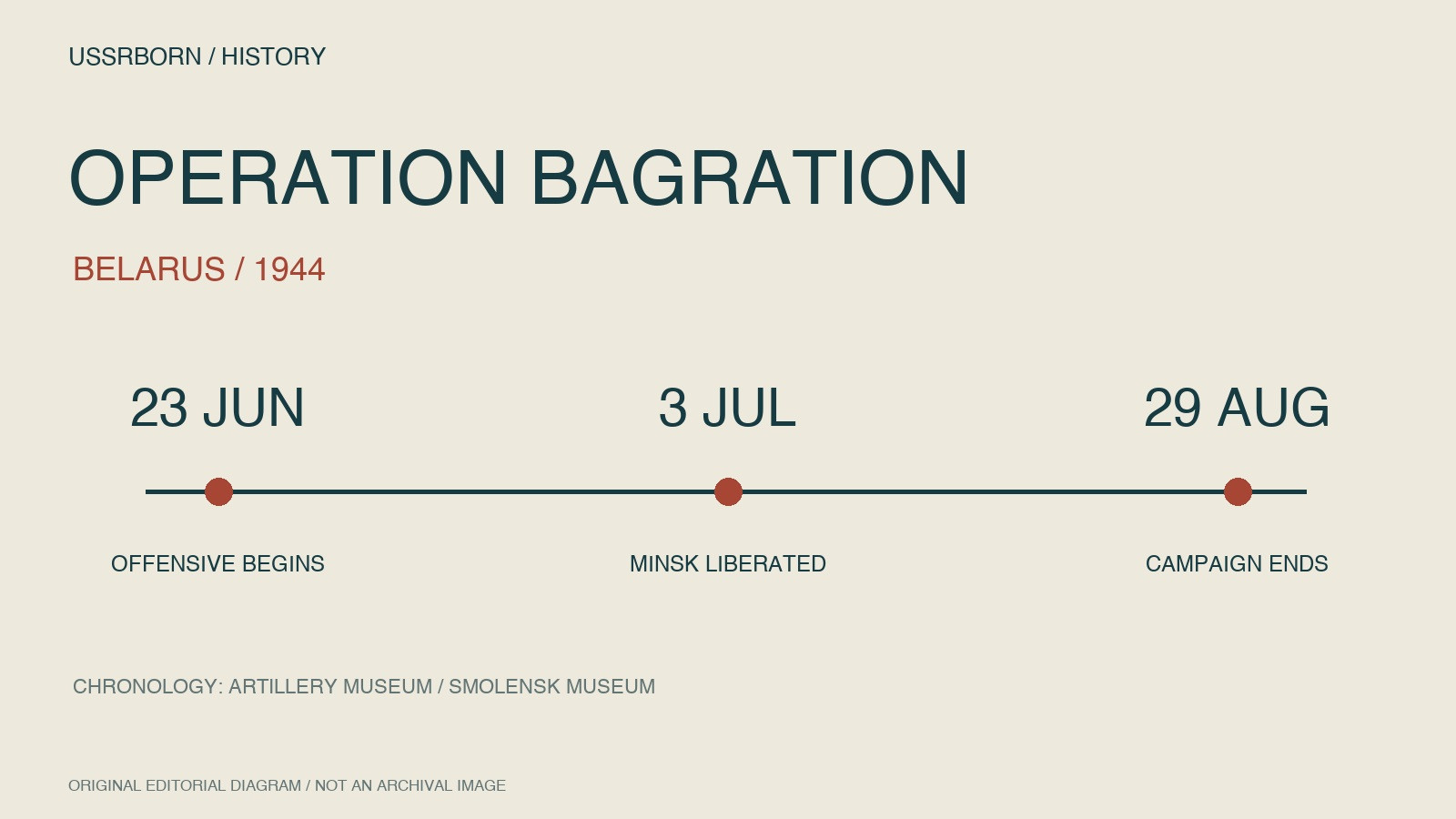
The Artillery Museum and the Smolensk Museum-Reserve date the operation to 23 June through 29 August 1944. This article follows that chronology. The United States Holocaust Memorial Museum’s timeline instead dates the opening to 22 June. Readers comparing reference works should retain that distinction rather than silently treating the dates as identical.
The name honoured Pyotr Bagration, a commander in the war of 1812. It referred to an offensive campaign, not simply the battle for Minsk. The liberation of the Belarusian capital on 3 July was a major milestone, but it did not mark the end of the operation.
Why was Belarus the target?
The Smolensk museum explains the plan through the geography of the Belarusian salient: German forces still held a large eastward projection of the front that covered approaches to Poland and East Prussia. It also threatened Soviet forces to the south. Eliminating it therefore mattered beyond the recovery of individual towns.
A useful comparison is Operation Barbarossa. In 1941, German commanders sought a rapid defeat of Soviet armies; by summer 1944, the Red Army was mounting a major offensive involving deep envelopments. Years of fighting, including the Battle of Kursk, separated those moments. Placing them in sequence makes the shift in military initiative clearer without suggesting that the outcome had always been inevitable.
Four fronts working toward one objective
The operation involved the 1st Baltic and the 3rd, 2nd and 1st Belorussian Fronts, commanded respectively by Ivan Bagramyan, Ivan Chernyakhovsky, Georgy Zakharov and Konstantin Rokossovsky. Their axes included the Vitebsk, Mogilev and Bobruisk areas and the subsequent advance toward Minsk.
In this context, a Soviet “front” was an organisation commanding several armies. Four fronts did not mean four isolated lines on a map. The important organisational problem was how their operations would reinforce one another. A breakthrough had to create opportunities beyond the immediate sector where it occurred.
The National WWII Museum’s account emphasises concealment and deception over the direction of the main attack. This draws attention to something that a table of tanks and soldiers cannot show: an opponent’s understanding of where those forces are likely to be used. Military preparation includes shaping that understanding as well as assembling the forces themselves.
Encirclements and the liberation of Minsk
The Artillery Museum places the first phase through 4 July. It describes encirclements around Vitebsk and Bobruisk and then east of Minsk. Soviet troops liberated Minsk on 3 July. The westward offensive continued from 5 July; in the museum’s chronology, the second phase ends on 29 August.
Taking a city and surrounding an army are related but different achievements. A defending force may leave a city while retaining a route of retreat; an encirclement restricts those routes. This is why campaign maps need to be read for the positions between towns, not only for dates printed beside them. The distinction helps explain why the campaign’s significance exceeded the recovery of Minsk itself.
It also explains why a single anniversary cannot summarise the whole operation. A city’s liberation provides a clear date of remembrance. A strategic campaign requires a longer frame that includes the opening attacks and the fighting that followed that milestone.
Consequences beyond the battlefield
German occupation of Belarus ended, and the advance extended into new areas of Poland and the Baltic region. Within the wider history of the Soviet-German war, Bagration was a major offensive of 1944. It was not the final campaign: further operations and months of fighting still separated it from the Allied meetings on the Elbe.
Military success did not settle political conflicts. The National WWII Museum discusses Bagration alongside the Polish Home Army’s Operation Tempest and describes Soviet disarmament and arrests of Home Army personnel. Ending Nazi occupation and determining who would hold political power were distinct questions.
Three scales therefore help make sense of Bagration: the strategic plan, the individual encirclements and the experience of people in the territories reached by the advance. Keeping them separate produces a more useful account than a single victorious arrow across a map. The offensive changed the military balance while opening a new chapter in the region’s political history.