The Battle of Kursk: the largest tank battle in history
Six thousand tanks, two million men, four thousand aircraft. Germany's last great offensive in the East — one the Red Army knew by heart before it began, and met with three hundred kilometers of defenses.
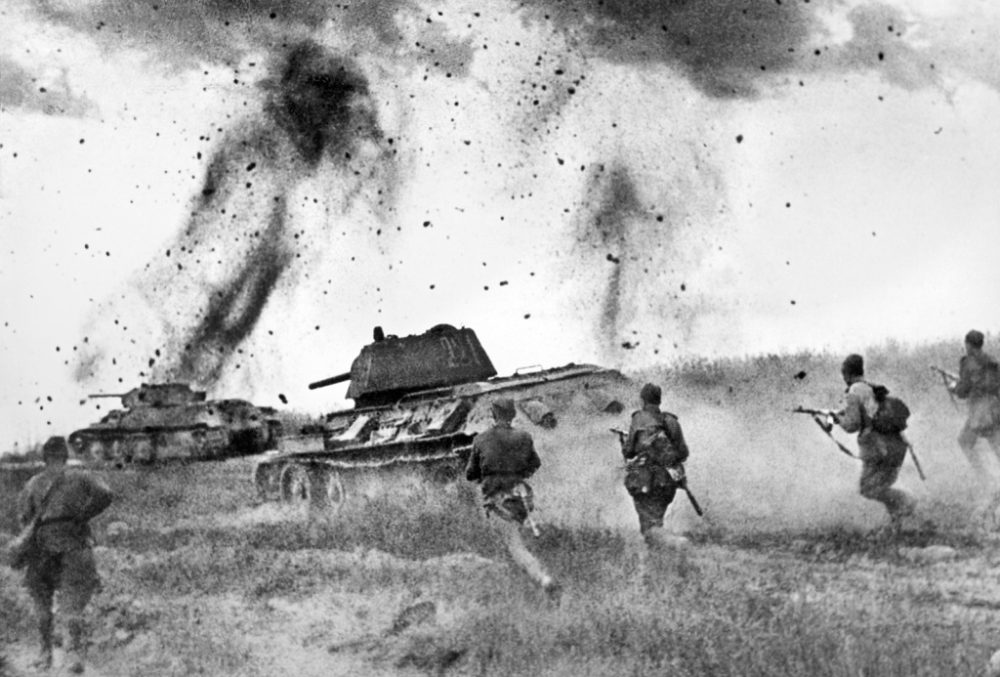
What the Battle of Kursk was
The Battle of Kursk (July 5 – August 23, 1943) was the battle of the Great Patriotic War fought on the Kursk salient — by many measures the single largest battle in the history of warfare: some six thousand tanks, two million soldiers and four thousand aircraft on both sides. It was also the largest and deadliest armored battle of all time, and its opening day, July 5, remains the costliest single day in the history of aerial warfare by aircraft shot down.
If Stalingrad took the strategic initiative away from Germany, Kursk buried the hope of winning it back: Operation Citadel was the Wehrmacht's last major offensive on the Eastern Front. After Kursk, the German army in the East did nothing but defend and retreat, all the way to Berlin.
A bulge aimed westward
By the spring of 1943, after Stalingrad and Manstein's counterstrokes at Kharkov, the front had frozen, leaving a gigantic protrusion in the line — the Kursk salient, roughly 190 by 120 kilometers, jutting into the German positions. To Hitler the bulge looked like the perfect target: slice it off with converging blows from north and south, encircle entire Soviet fronts, shorten the line, and prove to his wavering allies that Germany could still win. On April 15, 1943, he authorized Operation Citadel.
What happened next decided the battle before the first shot. The offensive was postponed again and again — Hitler was waiting for his new "wonder tanks": the Panthers, additional Tigers and Ferdinand tank destroyers. Meanwhile the Soviet command knew nearly everything about Citadel: intelligence — including material from the British and the legendary Lucy spy ring — had uncovered both the place and the design of the blow. For the first time in the war, the Soviet high command deliberately chose defense while holding superior forces: grind down the panzer spearheads on prepared lines — and only then attack.
Three hundred kilometers of defenses
What was built on the salient in three months had no precedent. Eight defensive belts with a total depth of about 300 kilometers: nearly a million mines, thousands of kilometers of trenches dug together with the inhabitants of the surrounding villages, anti-tank strongpoints, zones of pre-registered artillery fire. Behind the salient stood a strategic reserve — the entire Steppe Front. In the German rear, thousands of partisans tore up rails and communication lines.
One telling detail: an hour before the German assault, at dawn on July 5, Soviet artillery opened fire on the troops forming up to attack — the command knew even the hour of the blow.
Citadel bogs down
The German plan was the old one — blitzkrieg; but a blitzkrieg without surprise is doomed to bog down. On the northern face, Model's 9th Army gnawed through a mere 10–15 kilometers in a week and stopped. On the southern face Manstein, with his elite SS panzer divisions, drove deeper — up to 35 kilometers — but never broke the third defensive belt.
The climax came at Prokhorovka. On July 12, hundreds of armored vehicles from both sides collided near this railway station — one of the largest tank engagements in history. Soviet tradition described it for decades as a "head-on battle of 1,500 tanks" and a victory; modern research, drawing on German and Russian archives alike, paints a harsher picture: the counterattack of the 5th Guards Tank Army came at a terrible price, with Soviet tank losses that day exceeding German losses many times over. We give both frames because both matter: tactically the field arguably remained with the Germans; strategically it was at Prokhorovka that Citadel finally ran out of breath — there was no breakthrough, and the Red Army still had reserves while the Wehrmacht had none.
On July 10 the Allies landed in Sicily, and on July 13 Hitler shut Citadel down and began transferring divisions to Italy. An offensive three months in the making had lasted little more than a week.
The counterblow: Orel, Belgorod, Kharkov
Then the second half of the Soviet plan went into motion. As early as July 12, Operation Kutuzov opened against the Orel salient; on August 3 came Operation Polkovodets Rumyantsev in the south. On August 5 the Red Army liberated Orel and Belgorod — and that same evening Moscow fired its first artillery salute of the war in honor of a victory, beginning a tradition that survives to this day. On August 23, with the capture of Kharkov, the Battle of Kursk was over.
The price was enormous and unequal: Soviet losses for the whole battle are estimated at roughly 800,000 against roughly 200,000 German. The Red Army was still paying more for success than its enemy — but, unlike Germany, it could replace its losses. In that arithmetic lay the verdict: on the Kursk salient the Wehrmacht burned its last strategic reserves, including irreplaceable veteran tank crews.
What Kursk decided
After Kursk the character of the war changed for good. The strategic initiative passed to the USSR permanently: in the autumn of 1943 the Red Army reached the Dnieper; ahead lay the lifting of the siege of Leningrad, Operation Bagration and Berlin. Germany never again assembled the strength for a major offensive in the East.
The battle was also a triumph of the Soviet military school: the deliberate defense followed by a counteroffensive entered the textbooks, and the T-34, the backbone of the Soviet tank armies, cemented its reputation as the definitive tank of the war — even though its crews paid a dreadful price in duels with Tigers and Panthers. Today a memorial belfry rises over the Prokhorovka field, honored as "Russia's third field of battle" — in national memory the Kursk salient stands alongside Kulikovo and Borodino.
Frequently asked questions
When was the Battle of Kursk? From July 5 to August 23, 1943: a week of the German offensive (Operation Citadel) followed by the Soviet counteroffensives Kutuzov and Rumyantsev, which ended with the capture of Orel, Belgorod and Kharkov.
Why is Kursk called the largest tank battle in history? The battle involved some 6,000 tanks on both sides (plus 2 million men and 4,000 aircraft) — more than any other armored engagement before or since.
What happened at Prokhorovka? On July 12, 1943, one of history's largest tank clashes took place near Prokhorovka station. The Soviet counterattack stopped the German advance, but at a cost in tanks many times the German losses — modern research has revised the canonical image of a "head-on battle of 1,500 tanks."
How many people died in the Battle of Kursk? Total casualties (killed, wounded, missing) are estimated at about a million: roughly 800,000 Soviet and 200,000 German.
Why did Germany lose at Kursk? There was no surprise: Soviet intelligence had uncovered the plan, and the offensive ran into 300 kilometers of defenses. The Allied landing in Sicily, which forced Hitler to cancel the operation, and the exhaustion of German reserves also played their part.
What was the first salute of August 5, 1943? The liberation of Orel and Belgorod was marked by Moscow's first artillery salute of the war — the beginning of the tradition of victory salutes; Orel and Belgorod are known as the "cities of the first salute."
Related
- The Great Patriotic War — the full picture of the war whose initiative Kursk decided.
- The Battle of Stalingrad — the first half of the great turning point of 1942–43.
- The T-34 tank — the backbone of the Soviet tank armies on the salient.
- Joseph Stalin — the Stavka and the decision to stand on the defensive.
Sources
The facts in this article can be verified against authoritative sources:
- Encyclopaedia Britannica, "Battle of Kursk": https://www.britannica.com/event/Battle-of-Kursk
- Wikipedia, "Battle of Kursk": https://en.wikipedia.org/wiki/Battle_of_Kursk
- Wikipedia, "Operation Citadel": https://en.wikipedia.org/wiki/Operation_Citadel
- World History Encyclopedia, "Battle of Kursk: Largest Tank Battle in History": https://www.worldhistory.org/article/2704/battle-of-kursk/
- HISTORY, "Battle of Kursk: Key Tank Battle of World War II": https://www.history.com/articles/battle-of-kursk
Where figures diverge (force sizes, losses, the assessment of Prokhorovka), we give ranges and both research positions.