The Battle of Stalingrad: 200 days that turned the war
The largest and bloodiest urban battle in history: fighting for every house, the encirclement of an entire army, and nearly two million human fates. How a city on the Volga turned the tide of the Second World War.
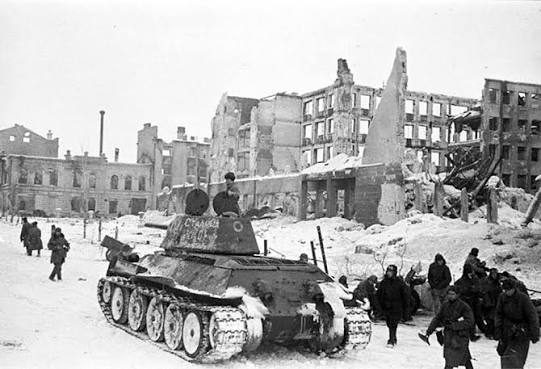
What the Battle of Stalingrad was
The Battle of Stalingrad (July 17, 1942 – February 2, 1943) was the battle of the Great Patriotic War for the city of Stalingrad (now Volgograd) on the Volga, regarded by most historians as the largest battle of the Second World War and the turning point of the entire conflict. It was the biggest and bloodiest urban battle in military history: the combined losses of both sides approach two million people.
Before Stalingrad the German army advanced; after Stalingrad — with rare exceptions — it only retreated, all the way to Berlin. Here Germany lost an entire army, and with it the strategic initiative and its belief in victory.
Why Stalingrad
In the summer of 1942 Hitler launched Operation Blue — an offensive in the south of the USSR. There were two objectives: the oil of the Caucasus, without which the German war machine was suffocating, and Stalingrad — a major industrial center and transport hub on the Volga whose capture would sever Soviet supply lines to the south. There was a third, symbolic dimension: the city bore Stalin's name, and both dictators staked personal prestige on the battle — Hitler forbade retreat from the city, Stalin forbade its surrender.
The Red Army's retreat in the summer of 1942 went so badly that on July 28 the famous Order No. 227 — "Not a step back!" — was issued: blocking detachments, penal battalions, retreat without orders treated as treason. We say it plainly: the heroism of Stalingrad's defenders was real — and behind their backs stood a system that left no choice. Both truths belong to the history of the battle.
Hell on the Volga
On August 23, 1942, German aircraft subjected Stalingrad to a massive bombardment that turned the city into burning ruins and killed thousands of civilians; the population had not been fully evacuated in time. Paradoxically, the ruins worked against the attackers: a city of stone and rebar became a fortress.
By autumn the fighting was inside the city itself — a war unlike anything before it. The front line ran through streets, factory floors and stairwells; a building's upper floor could be German while its basement was Soviet. The Germans called it Rattenkrieg — "rat war." The symbols of the defense were Pavlov's House, held by a garrison of a few dozen soldiers for 58 days; Mamayev Kurgan, which changed hands dozens of times; and the sniper duels — Vasily Zaitsev's tally ran into the hundreds. General Chuikov's 62nd Army fought with its back to the Volga: on some days the Soviet foothold on the right bank narrowed to a few hundred meters.
Everything moved across the Volga under constant fire: reinforcements to the right bank, the wounded to the left. In the hottest sectors of the city, a soldier's average life expectancy was measured in days.
Uranus: the trap snaps shut
While Paulus's 6th Army ground itself down in street fighting, the Soviet command — Zhukov and Vasilevsky — prepared what the Germans did not expect. The flanks of the German force were covered by weaker Romanian and Italian armies. On November 19, 1942, the Red Army launched Operation Uranus: two blows against the flanks, hundreds of kilometers apart, converging behind Paulus's back.
In less than a week the ring closed: the entire 6th Army and parts of the 4th Panzer Army — more than a quarter of a million men — were surrounded. Hitler forbade a breakout and promised to supply the "cauldron" by air; the Luftwaffe could not deliver even a third of what was needed. Manstein's December attempt to break through to the encircled troops failed. Inside the pocket, starvation and frostbite set in.
On January 30, 1943, Hitler promoted Paulus to field marshal — a transparent hint: no German field marshal had ever surrendered. Paulus surrendered the next day. On February 2 the last pockets of resistance capitulated. For the first time in the war, a Wehrmacht field marshal was in Soviet captivity — together with 91,000 soldiers and officers.
The price
The numbers of Stalingrad are hard to absorb, and we give them according to academic sources.
- The losses of Germany and its allies (Romania, Italy, Hungary) over the whole campaign exceeded 800,000 killed, wounded, missing and captured; in and around the city alone, Soviet teams buried 250,000 enemy bodies after the battle.
- Soviet losses were about 1.1 million killed, wounded, missing and captured; some 40,000 civilians also died.
- Of the 91,000 prisoners taken in February 1943, only 5,000–6,000 ever returned home: the emaciated men died en masse of typhus, hunger and cold in the prison camps — the last survivors returned to Germany a full decade after the war.
What Stalingrad changed
Strategically, the battle handed the initiative to the USSR: in the summer of 1943 Germany would make one last attempt to seize it back at Kursk — and fail. Psychologically the shift ran deeper still. Germany declared three days of national mourning for the first time in the war; the myth of the Wehrmacht's invincibility died on the Volga. For the Allies and for occupied Europe, Stalingrad became a name of hope: squares and metro stations in Paris and other cities bear its name to this day.
For the Soviet people Stalingrad became the supreme symbol of endurance. In 1945 the city received the title of Hero City; in 1961, during de-Stalinization under Khrushchev — who had himself served at Stalingrad as the front's political commissar — it was renamed Volgograd. Since 1967 the city has been crowned by The Motherland Calls — one of the tallest statues in the world, 85 meters with its raised sword.
Frequently asked questions
When was the Battle of Stalingrad? From July 17, 1942, to February 2, 1943 — exactly 200 days, including the defensive phase, the street fighting and Operation Uranus with the destruction of the encircled force.
Why is Stalingrad considered the turning point of the war? Germany lost an entire army and the strategic initiative: before Stalingrad the Wehrmacht was generally advancing, after it — retreating all the way to Berlin. The battle also shattered the myth of the German army's invincibility.
How many people died in the Battle of Stalingrad? The combined losses of both sides (killed, wounded, missing, captured) are on the order of two million: more than 800,000 for Germany and its allies, about 1.1 million for the USSR, plus some 40,000 civilian dead.
What happened to the German prisoners? Of the 91,000 taken prisoner in February 1943, only 5,000–6,000 survived to return home; most died of exhaustion, typhus and cold in the POW camps.
What was Order No. 227? Stalin's order of July 28, 1942 ("Not a step back!"), which banned retreat without orders and introduced blocking detachments and penal battalions. It formed the harsh backdrop of Stalingrad's defense.
What is Stalingrad called today? Volgograd — the city was renamed in 1961 during de-Stalinization. The name "Stalingrad" lives on in world memory and in the place names of other countries.
Related
- The Great Patriotic War — the full picture of the war that turned at Stalingrad.
- Joseph Stalin — whose name the city bore, and whose Order No. 227 stood behind its defense.
- The T-34 tank — the workhorse of the Soviet counterblows.
- Nikita Khrushchev — political commissar of the Stalingrad Front, who later renamed the city.
- The Siege of Leningrad — the tragedy that ran parallel to the great victory.
- The Battle of Kursk — the second half of the great turning point.
Sources
The facts in this article can be verified against authoritative sources:
- Encyclopaedia Britannica, "Battle of Stalingrad": https://www.britannica.com/event/Battle-of-Stalingrad
- Wikipedia, "Battle of Stalingrad": https://en.wikipedia.org/wiki/Battle_of_Stalingrad
- United States Holocaust Memorial Museum, "The Eastern Front: The German War against the Soviet Union": https://encyclopedia.ushmm.org/content/en/article/the-soviet-union-and-the-eastern-front
- The National WWII Museum (New Orleans), "The Eastern Front": https://www.nationalww2museum.org/war/articles/eastern-front
- World History Encyclopedia, "German-Soviet War: WWII's Bloodiest Front": https://www.worldhistory.org/German-Soviet_War/
Where casualty estimates diverge, we give ranges from academic sources rather than a single figure.