The Victory over Germany Medal: Eligibility under the 1945 Decree
Who qualified for the Victory over Germany Medal, how it was presented and why a certificate could be dated after 1945: the decree and museum records.
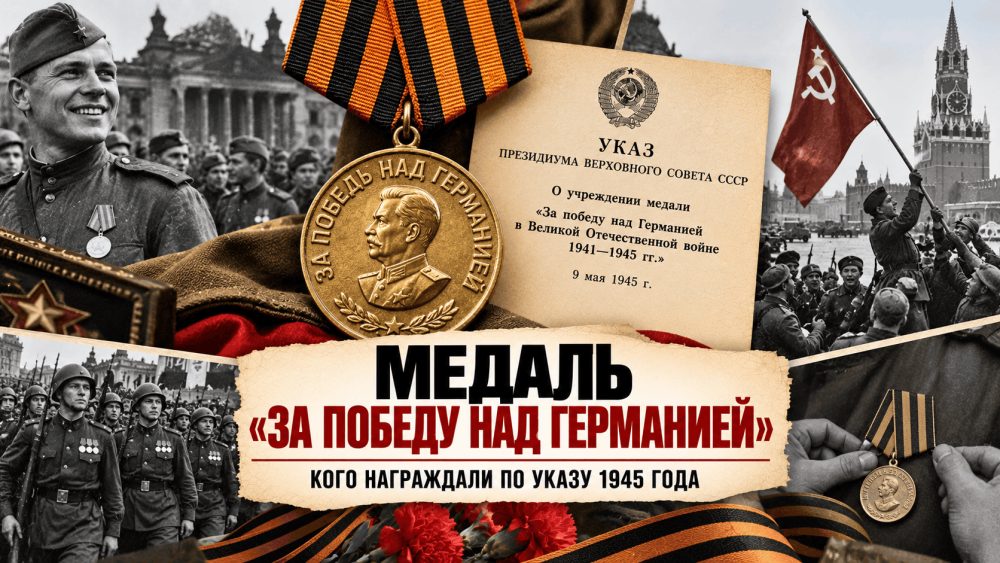
The Medal “For the Victory over Germany in the Great Patriotic War 1941-1945” was established on 9 May 1945. Familiar from veterans’ photographs and family collections, it is sometimes interpreted too narrowly. It was not reserved for participants in the capture of Berlin or only for people still serving at the front when the war ended.
Its regulations covered several categories of service. Understanding an individual award therefore requires more than identifying the object: a certificate, unit information and the recipient’s records can explain what the medal alone cannot.
What the decree established
The Presidium of the Supreme Soviet issued a decree establishing the medal and approving both its regulations and its physical description. Mikhail Kalinin and Alexander Gorkin signed it. The Presidential Library catalogues the original document with an approved design; the original is held by the State Archive of the Russian Federation.
The establishment date belongs to the award as a state distinction. It does not mean that every recipient received a medal that day. Months could separate the decree, manufacture of an example and its presentation to a particular person.
The name connects the award to victory, but not to one operation alone. The history of the Great Patriotic War includes multiple fronts, naval service, support work and wounded personnel returning home. The medal’s regulations reflected that wider picture of service.
Who qualified under the regulations?
The original text named military personnel and civilian employees on the establishment of the Red Army, Navy and NKVD troops. Its first category covered direct participation at the fronts or work supporting victory in military districts.
A second category included personnel who had served in the active forces but left because of wounds, illness or disability, as well as those transferred to work outside the military by decisions of state or party bodies. Not being in service in May 1945 did not, by itself, exclude someone from the award.
A note accompanying the published legal text records an addition dated 5 July 1945, extending eligibility to personnel of NKVD and NKGB organs. That addition should be distinguished from the wording adopted in May.
The reference to work in military districts did not automatically cover every civilian worker on the home front. The text specified categories of personnel. Equally, the broad title of the medal cannot establish which particular provision applied to an individual recipient.
This makes the regulations useful for family history without turning them into a substitute for personal records. They identify possible grounds for an award; a service file or supporting document is needed to connect those grounds to a person.
Evidence and presentation
The regulations required documents confirming participation in the war. These could be issued by unit commanders, heads of military medical establishments and the relevant local executive committees of Soviets.
Commanders presented medals to personnel still in their units. For those who had left the army, navy or NKVD troops, presentation fell to military commissars at the recipient’s place of residence. These two routes explain why a family certificate may bear a local commissar’s signature even when the recipient served far from home.
The process is easier to understand alongside the history of demobilisation in 1945. Returning home and receiving an award were separate events. Their dates should not be inferred from one another without supporting evidence.
Kharkiv Historical Museum researcher Alla Leheida described 40 medals accompanied by certificates in the collection: 19 were presented in 1945, another 19 in 1946 and two in 1947. These figures concern one museum sample, not all awards. They nevertheless demonstrate why a later presentation date is consistent with establishment of the medal in May 1945.
A certificate also preserves an administrative event that the medal’s face does not record. The years in the award’s title identify the war being commemorated, not the date on which a particular example changed hands.
The medal and its ribbon
The official description specified a circular brass medal, 32 millimetres in diameter. Its obverse carried a profile of Stalin in a marshal’s uniform, with inscriptions expressing the righteousness of the cause and victory. The reverse bore the award’s title, the war years and a five-pointed star.
A ring and suspension loop connected it to a pentagonal mounting. The 24-millimetre silk moiré ribbon had five equal longitudinal stripes, three black and two orange, with narrow orange edging. The regulations placed the medal on the left side of the chest, after the Medal for the Defence of the Soviet Transarctic when other decorations were worn.
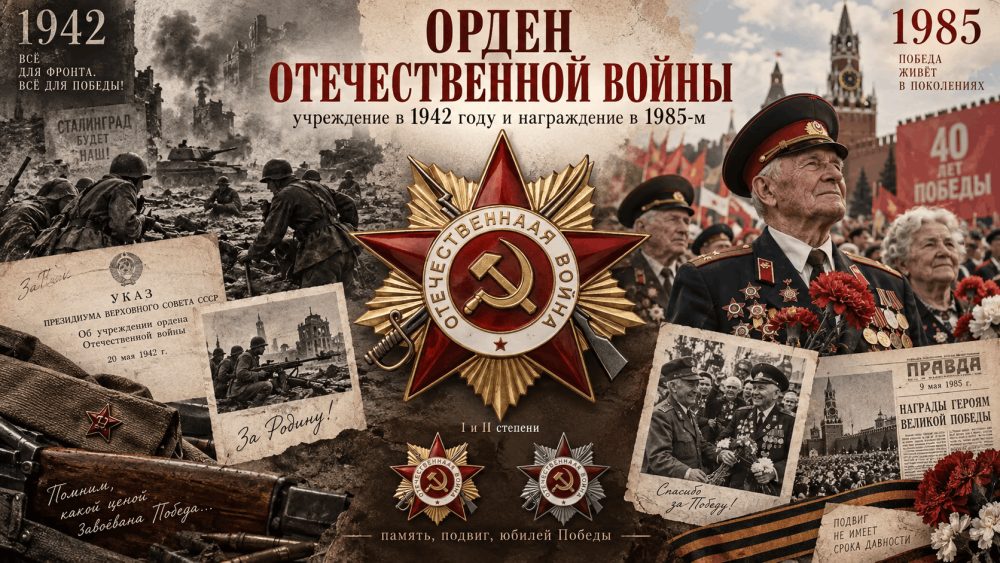
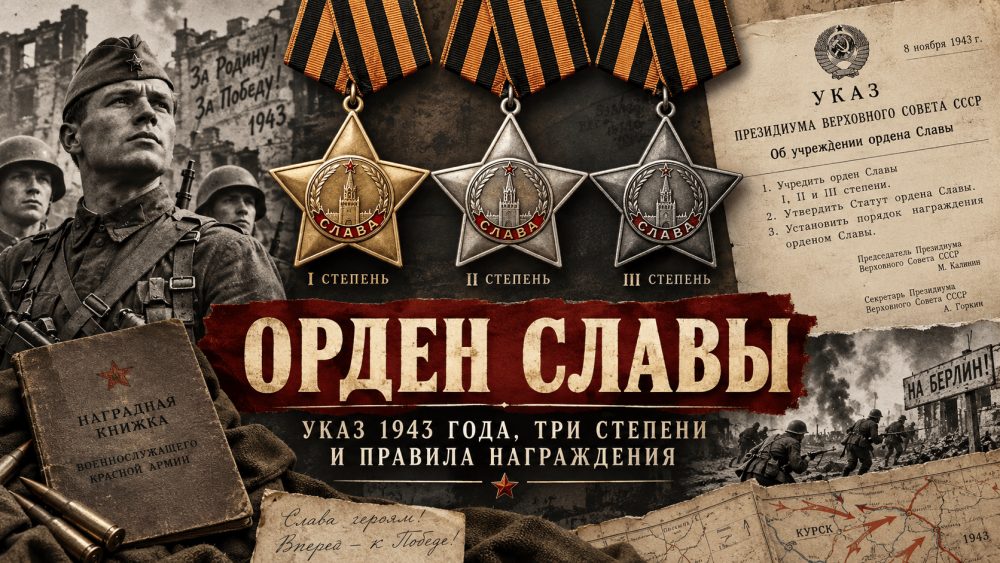
Similar ribbon colours do not make different awards interchangeable. The Order of Glory, for example, has its own statute and classes. The 1945 victory medal must likewise be distinguished from the Order of the Patriotic War and its 1985 anniversary awards.
Identifying a decoration accurately means reading its full name and examining both sides, rather than relying on the colour of the ribbon alone.
Reading a family collection
A useful starting point is to examine the object and its paperwork together: the full award title, recipient’s name, presentation date, signature and stamp. These details can then be compared with service records. This is a research method, not a promise to reconstruct an entire wartime career from one medal.
The Tatsinsky local history museum’s catalogue, for instance, identifies an example as belonging to wartime participant Maria Danilovna Goloborshcheva, née Lysenko. Such a named museum record supplies something the appearance of a standard award cannot: a connection to its owner.
Does the medal prove service in the battle for Berlin? No. Eligibility was considerably broader.
Could someone discharged after being wounded receive it? Yes. The regulations expressly included that category.
Did presentation necessarily happen in 1945? No. Surviving museum certificates document later presentations as well.